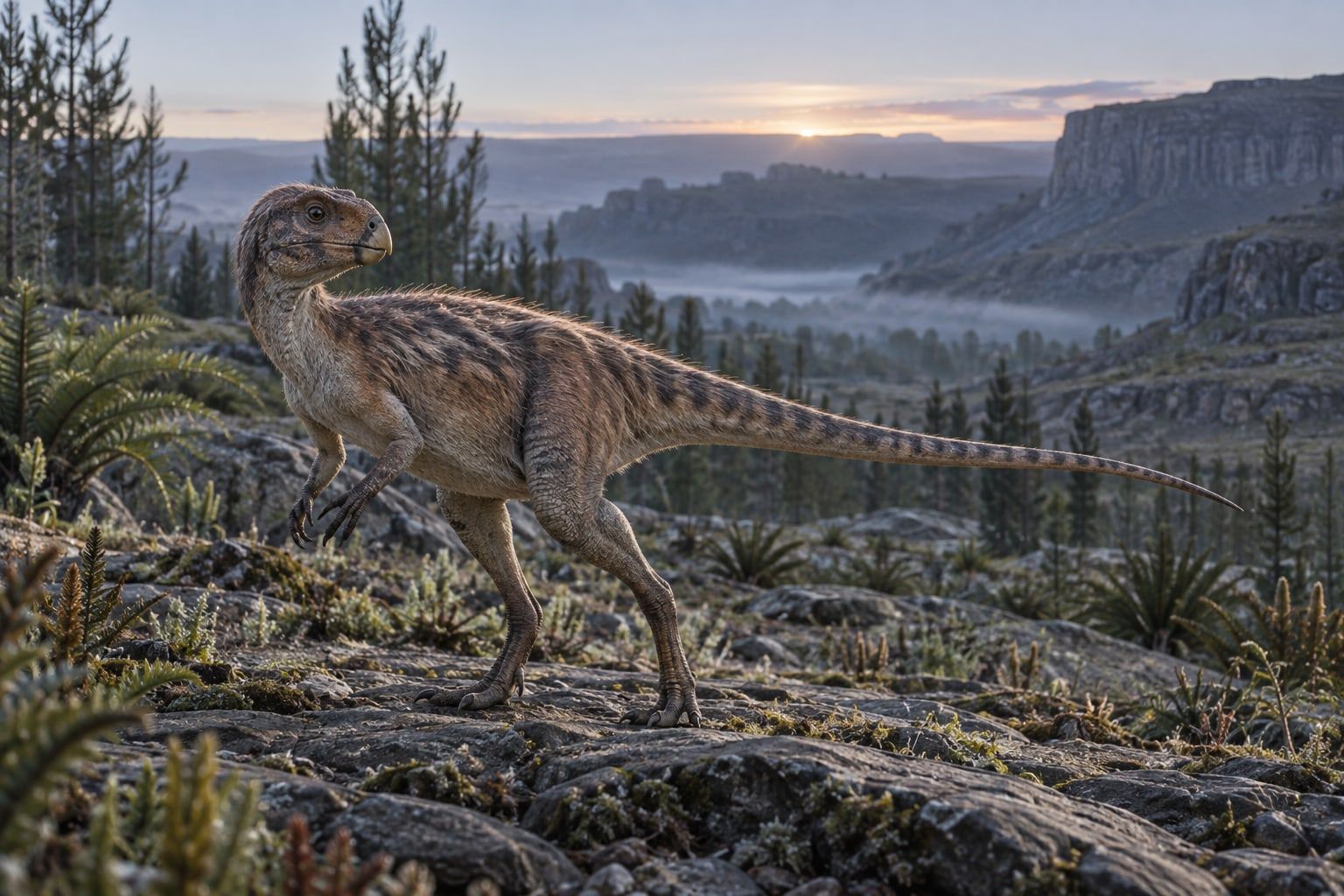
Heterodontosaurus
het-er-oh-DON-toh-SORE-us
"different-toothed lizard"
DV-0188
- Lived
- 201 to 193 million years ago, Early Jurassic
- Diet
- Herbivore
- Length
- about 1.2 m (4 ft)
- Group
- Early ornithischians, Heterodontosauridae
- Found in
- South Africa
- Named by
- Crompton and Charig 1962
Field notes
About Heterodontosaurus
What it was like
Heterodontosaurus was a small plant eater with an unusual set of teeth, giving the whole family its name. At the front of its upper jaw sat small, incisor-like teeth, followed by a pair of long, canine-like tusks, then a gap before rows of chisel-shaped cheek teeth farther back. It grew to about 1.2 meters (4 feet) long, walked on two legs, and had slender hands with five fingers each. Despite the tusks, it was most likely a plant eater, or perhaps an occasional omnivore.
Its world
Heterodontosaurus lived in what is now South Africa during the Early Jurassic, about 193 million years ago. Its bones, five finds in all, come from the Elliot and Clarens formations. It shared its world with the long-necked Massospondylus, the early theropod Dracovenator, and its own smaller relative Lesothosaurus.
How it was found
Crompton and Charig named Heterodontosaurus in 1962. It is the namesake of Heterodontosauridae, a family of early ornithischians that also includes Pegomastax, Abrictosaurus, and Fruitadens. Several other heterodontosaurids are known from the same rock layers as Heterodontosaurus, making the group unusually well documented for such early dinosaurs.
The evidence
Where its fossils were found
Today
195 million years ago
To scale
How big was Heterodontosaurus?
Lived alongside
Found in the same rock formations.
Close relatives
Other members of Heterodontosauridae.
Sources: Paleobiology Database, WikidataNamed in: A. W. Crompton and A. J. Charig. 1962. A new ornithischian from the Upper Triassic of South Africa. Nature 196:1074-1077