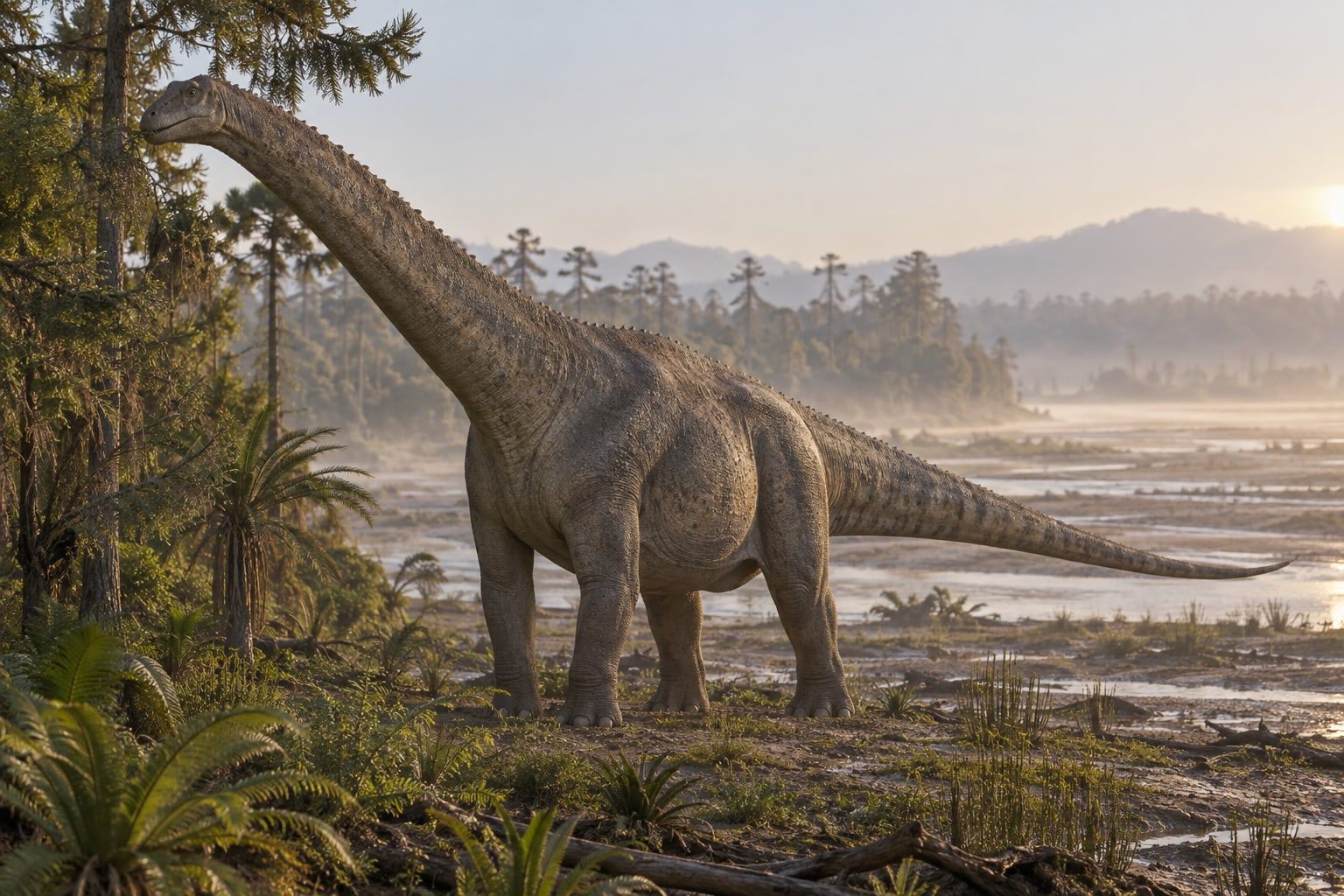
Nagatitan
"naga giant"
DV-1311 · type species Nagatitan chaiyaphumensis
- Lived
- 121 to 101 million years ago, Early Cretaceous
- Diet
- Herbivore
- Group
- Sauropods, Euhelopodidae
- Found in
- Thailand
- Named by
- Sethapanichsakul et al. 2026
Field notes
About Nagatitan
What it was like
Nagatitan is known from a partial skeleton, not enough to give a precise size, but its bones point to a very large, long-necked plant eater, among the biggest sauropods so far found in this part of Asia. Like other titanosauriforms, it probably moved on four sturdy, column-like legs and browsed on plants well above the ground.
Its world
Nagatitan lived in what is now Thailand during the Early Cretaceous, between about 121 and 101 million years ago. Its remains, from a single find, come from the Khok Kruat Formation, where it shared its world with the small horned Psittacosaurus and the predator Siamraptor.
How it was found
Sethapanichsakul and colleagues named Nagatitan in 2026, giving it the type species Nagatitan chaiyaphumensis. It is related to other titanosauriforms from Asia such as Euhelopus and Phuwiangosaurus. As a newly named genus, much about Nagatitan is still being studied.
The evidence
Where its fossils were found
Today
110 million years ago
Lived alongside
Found in the same rock formations.
Close relatives
Other members of Euhelopodidae.
Sources: Paleobiology Database, WikidataNamed in: T. Sethapanichsakul, S. Khansubha, and S. Manitkoon, R. Hanta, P. D. Mannion, P. Upchurch. 2026. The first sauropod dinosaur from the Lower Cretaceous Khok Kruat Formation of Thailand enriches the diversity of somphospondylan titanosauriforms in southeast Asia. Scientific Reports 16(1):12467:1-27