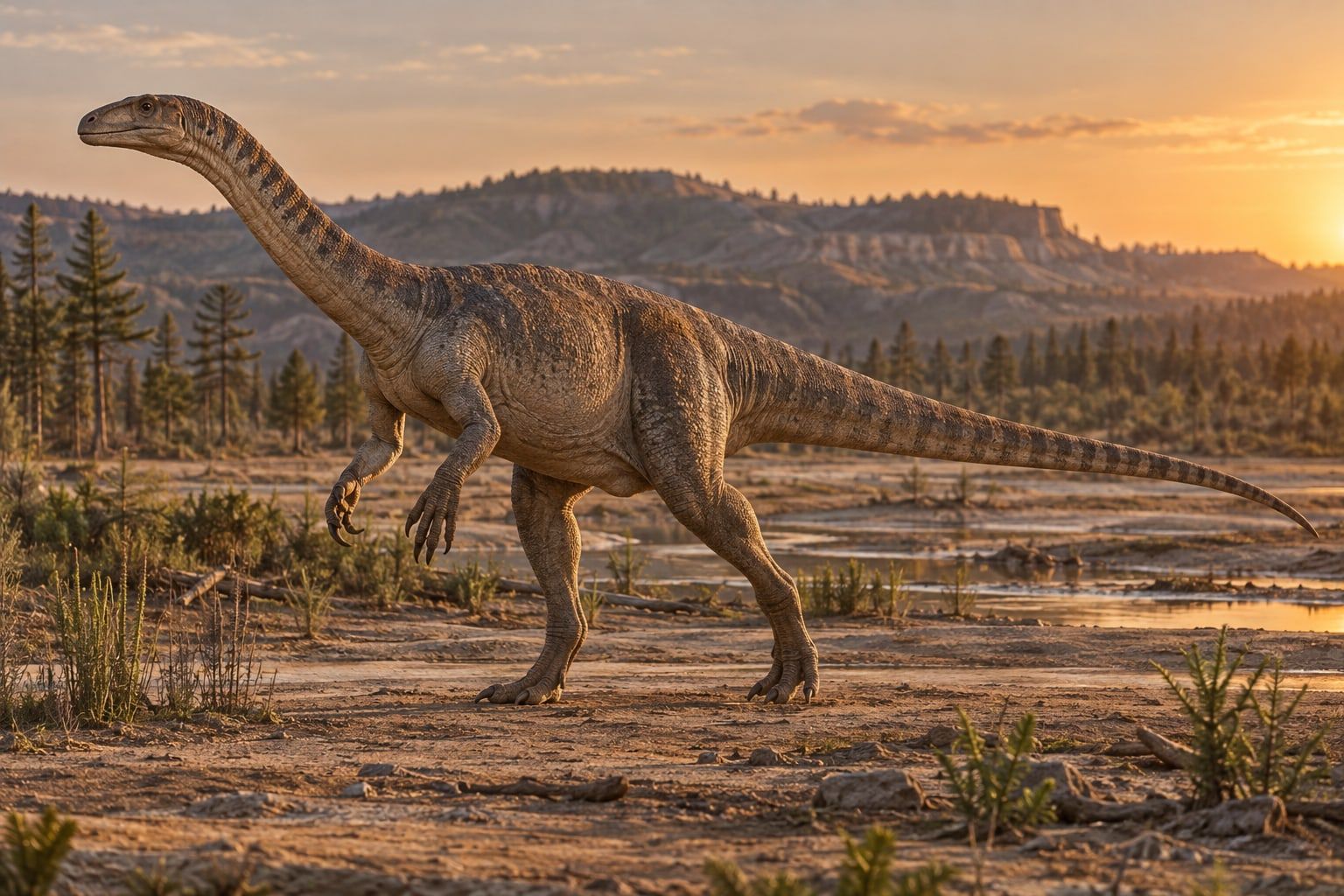
Plateosaurus
PLAT-ee-oh-SORE-us
"broad lizard"
DV-0007
- Lived
- 227 to 201 million years ago, Late Triassic
- Diet
- Herbivore
- Length
- about 8 m (26 ft)
- Group
- Early sauropodomorphs, Plateosauridae
- Found in
- Germany, France and Switzerland
- Named by
- Meyer 1837
Field notes
About Plateosaurus
What it was like
Plateosaurus was a bipedal plant eater with a small head on a long, flexible neck, plump but sharp teeth for cropping plants, and powerful hind legs. It grew to about 8 meters (26 feet) long. Its short but muscular arms ended in grasping hands with large claws on three fingers.
Individual Plateosaurus varied a great deal in adult size, more than is typical for a dinosaur, and scientists are still studying what drove this variation. Its claws may have been used for defense or for pulling down branches while feeding.
Its world
Plateosaurus lived across what is now Germany, France, and Switzerland, from about 227 to 201 million years ago, during the Late Triassic, with possible finds also reported from Greenland and the United Kingdom. Its fossils come from formations including Trossingen, Löwenstein, Klettgau, and Feuerletten.
It shared its world with the predator Liliensternus, the small Procompsognathus, and other early relatives of the sauropods such as Ruehleia and Efraasia.
How it was found
Meyer named Plateosaurus in 1837, making it one of the earliest named dinosaurs still considered valid today. About 33 finds of the genus are known, some of them nearly complete skeletons, making it one of the best-known dinosaurs from its time.
The evidence
Where its fossils were found
Today
210 million years ago
To scale
How big was Plateosaurus?
Lived alongside
Found in the same rock formations.
Close relatives
Other members of Plateosauridae.
Sources: Paleobiology Database, WikidataNamed in: H. v. Meyer. 1837. Mittheilungen, an Professor Bronn gerichtet [Communications, sent to Professor Bronn]. Neues Jahrbuch für Mineralogie, Geognosie, Geologie und Petrefaktenkunde 1837:314-317