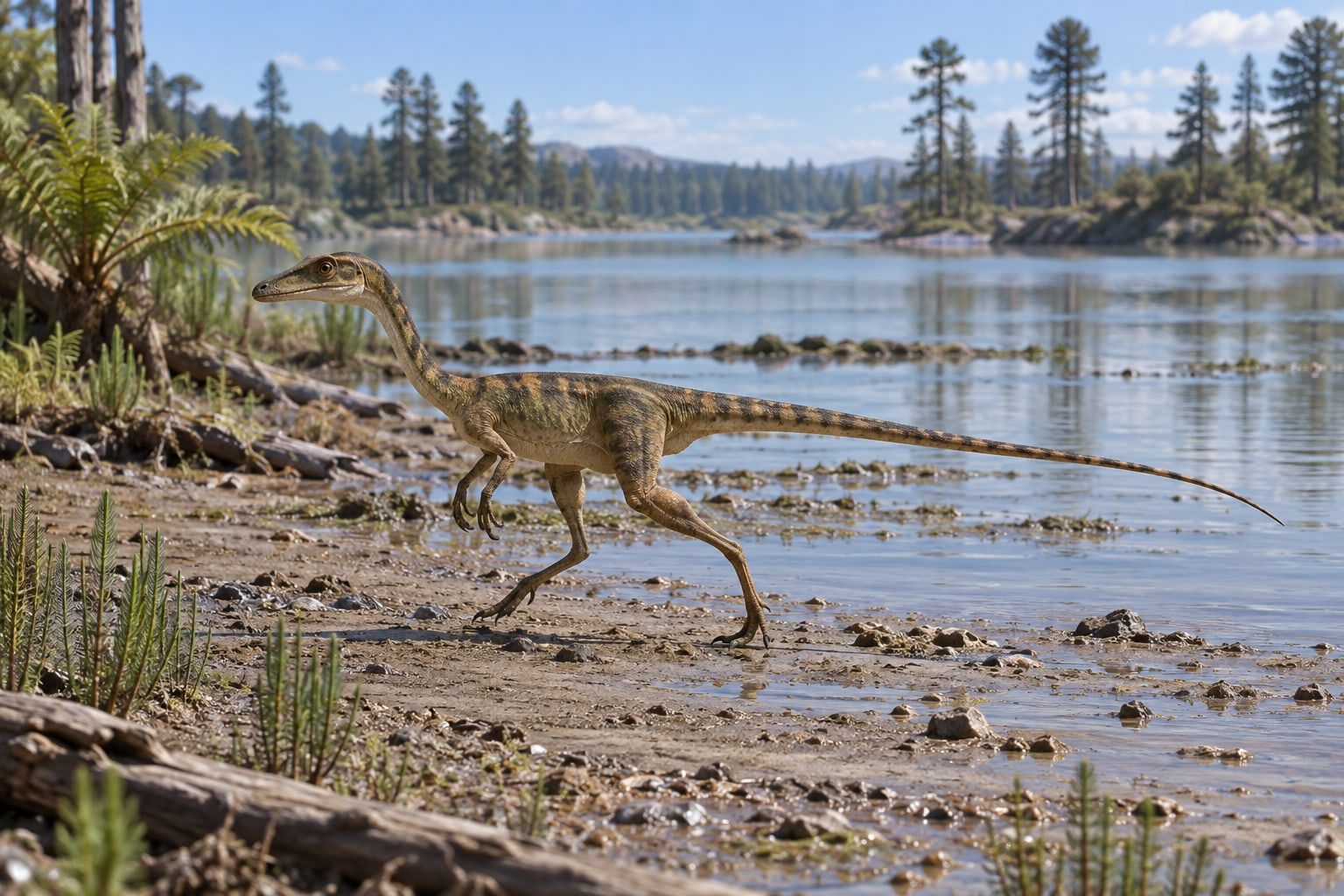
Procompsognathus
pro-komp-SOG-nuh-thus
"before Compsognathus"
DV-0087 · type species Procompsognathus triassicus
- Lived
- 215 to 211 million years ago, Late Triassic
- Diet
- Carnivore
- Length
- about 1 m (3 ft)
- Group
- Theropods, Coelophysidae
- Found in
- Germany
- Named by
- Fraas 1913
Field notes
About Procompsognathus
What it was like
Procompsognathus was a small, lightly built theropod that ran on two legs. It grew to about 1 meter (3.3 feet) long, with a long tail that balanced a slender body built for speed. As a member of Coelophysidae, it was probably a swift hunter of small prey such as insects and other small animals, gripping its catch with narrow, pointed teeth.
Its fossil remains are incomplete, so many details of its skull and limbs are still uncertain.
Its world
Procompsognathus lived in what is now Germany during the Late Triassic, between about 215 and 211 million years ago. Its bones come from the Löwenstein Formation, a single find that gives paleontologists their only look at the animal.
It shared its habitat with the plant-eating Plateosaurus and Efraasia, the predator Liliensternus, and the little-known Tuebingosaurus.
How it was found
Fraas named Procompsognathus in 1913, giving it the type species Procompsognathus triassicus. It belongs to Coelophysidae, a family of early theropods that also includes Coelophysis and Megapnosaurus. With only a single find known, much about Procompsognathus remains uncertain, including exactly how it relates to its close relatives.
The evidence
Where its fossils were found
Today
210 million years ago
To scale
How big was Procompsognathus?
Lived alongside
Found in the same rock formations.
Close relatives
Other members of Coelophysidae.
Sources: Paleobiology Database, WikidataNamed in: E. Fraas. 1913. Die neuesten Dinosaurierfunde in der schwäbischen Trias [The newest dinosaur finds in the Swabian Trias]. Naturwissenschaften 1(45):1097-1100