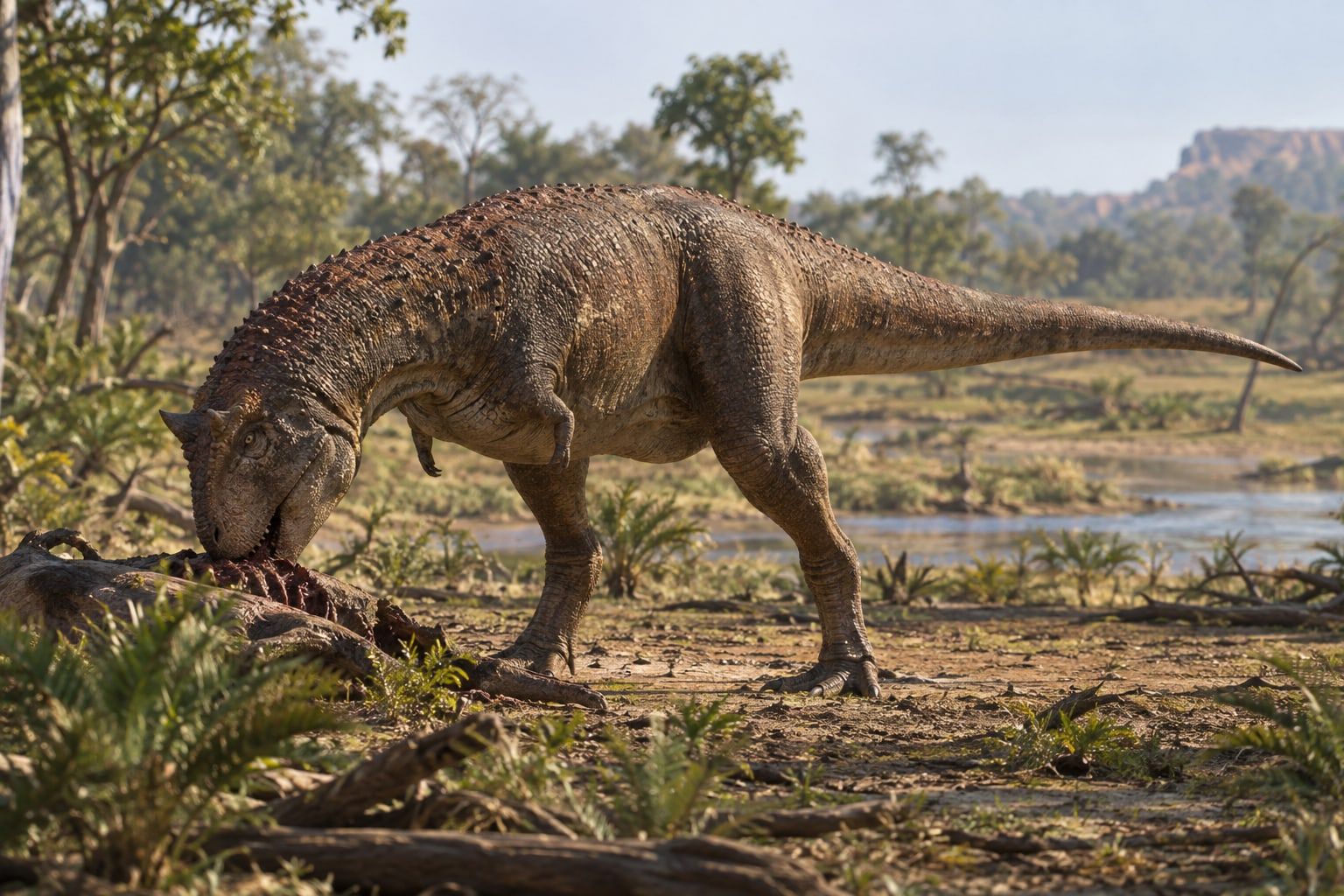
Rajasaurus
RAH-jah-SORE-us
"king lizard"
DV-0522
- Lived
- 72 to 66 million years ago, Late Cretaceous
- Diet
- Carnivore
- Length
- estimates range from 6.6 to 11 m (22 to 34 ft)
- Group
- Theropods, Abelisauridae
- Found in
- India
- Named by
- Wilson et al. 2003
Field notes
About Rajasaurus
What it was like
Rajasaurus was a carnivorous abelisaurid with a single short horn on its forehead, likely used for display and for head-butting rivals rather than for hunting. Like other abelisaurids, it had a short, deep skull and probably relied on ambush rather than a long chase to catch prey.
Its exact size is hard to pin down because the skeleton found so far is incomplete, so estimates of its length still vary between researchers.
Its world
Rajasaurus lived from about 72 to 66 million years ago, in the Late Cretaceous, in what is now India. Its fossils come from the Lameta Formation. At the time, India had broken away from the rest of Gondwana and was drifting as its own landmass, though some animals may still have been able to reach it from nearby regions.
It shared its world with the long-necked sauropods Isisaurus, Antarctosaurus, and Jainosaurus, the theropods Indosaurus and Indosuchus, and the smaller predators Rahiolisaurus and Laevisuchus.
How it was found
Wilson and colleagues named Rajasaurus in 2003, from a partial skeleton that included the braincase, spine, hip, legs, and tail, a first for a theropod found in India. It remains known from that single find, making it one of the more important recent dinosaur discoveries from India.
The evidence
Where its fossils were found
Today
70 million years ago
Lived alongside
Found in the same rock formations.
Close relatives
Other members of Abelisauridae.
Sources: Paleobiology Database, WikidataNamed in: J. A. Wilson, P. C. Sereno, and S. Srivastava, D. K. Bhatt, A. Khosla, A. Sahni. 2003. A new abelisaurid (Dinosauria, Theropoda) from the Lameta Formation (Cretaceous, Maastrichtian) of India. Contributions from the Museum of Paleontology, University of Michigan 31(1):1-42