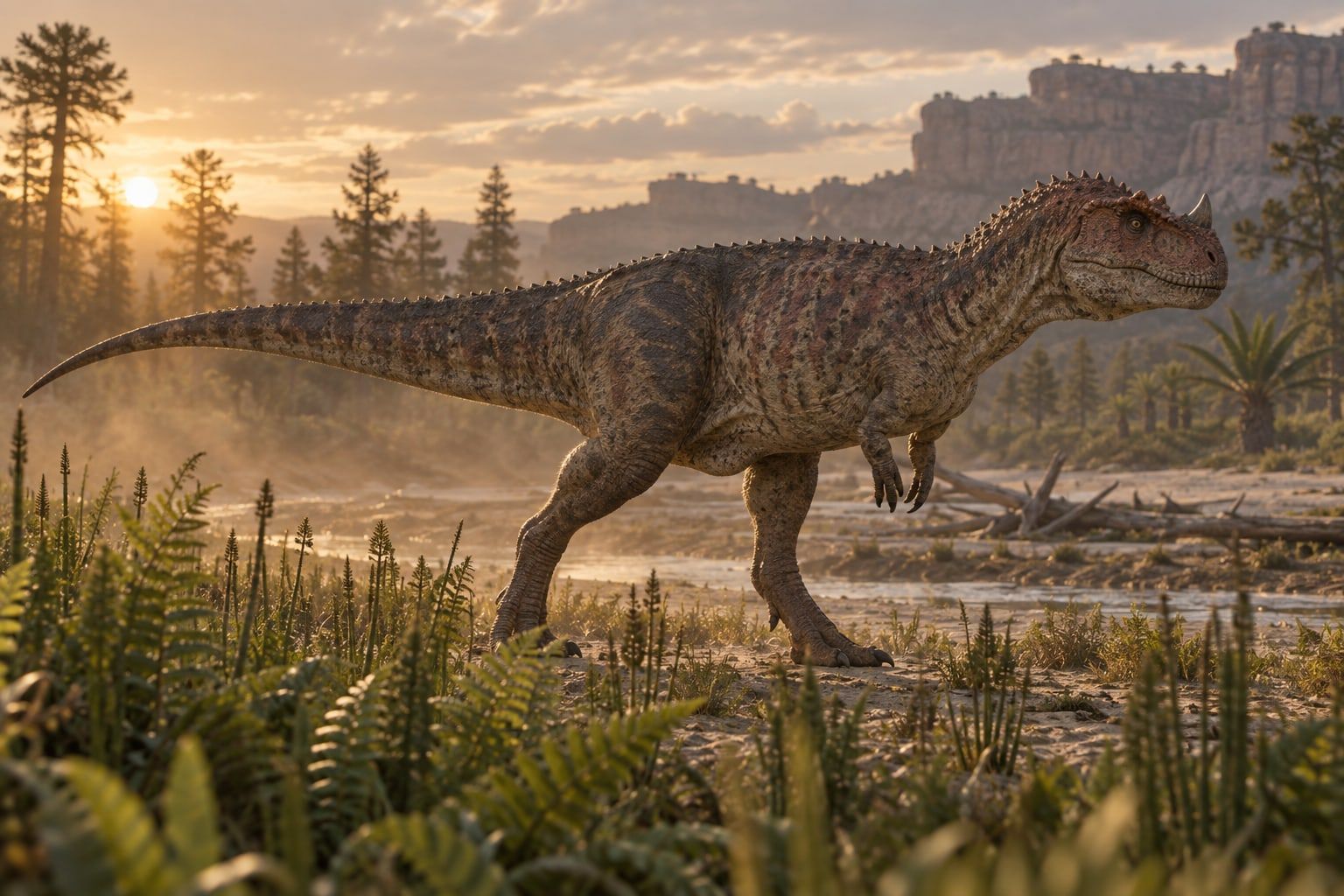
Ceratosaurus
seh-RAT-oh-SORE-us
"horned lizard"
DV-0047
- Lived
- 155 to 143 million years ago, Late Jurassic to Early Cretaceous
- Diet
- Carnivore
- Length
- about 6 m (20 ft)
- Group
- Theropods
- Found in
- United States, Portugal and Tanzania
- Named by
- Marsh 1884
Field notes
About Ceratosaurus
What it was like
Ceratosaurus was a mid-sized meat-eating dinosaur that grew to about 6 meters (20 feet) long. It is best known for a tall, blade-like horn on its snout and a smaller horn above each eye, along with deep, powerful jaws lined with long, blade-shaped teeth.
A row of small bony plates ran down the middle of its neck, back, and tail. Its arms were short but still had four clawed fingers. The snout horn was probably too fragile for fighting and more likely served as a display feature to attract mates or signal to rivals.
Its world
Ceratosaurus lived from about 155 to 143 million years ago, spanning the Late Jurassic and Early Cretaceous, in what is now the United States, Portugal, and Tanzania, with possible remains also reported from Uruguay. In the United States, fossils have been found in Colorado, Wyoming, Utah, and Oklahoma.
It shared its world with other large predators, including Torvosaurus and Allosaurus, and with plant eaters such as Stegosaurus, Brachiosaurus, and Diplodocus.
How it was found
Marsh named Ceratosaurus in 1884, based on a nearly complete skeleton. Around 26 finds are now known, though only a handful are as complete as the first. Ceratosaurus gives its name to Ceratosauria, a wider group of theropods, and its closer relatives include Genyodectes and Saltriovenator.
The evidence
Where its fossils were found
Today
150 million years ago
To scale
How big was Ceratosaurus?
Lived alongside
Found in the same rock formations.
Close relatives
Other members of Ceratosauria.
Sources: Paleobiology Database, WikidataNamed in: O. C. Marsh. 1884. Principal characters of American Jurassic dinosaurs. Part VIII. The order Theropoda. The American Journal of Science, series 3 27:329-340