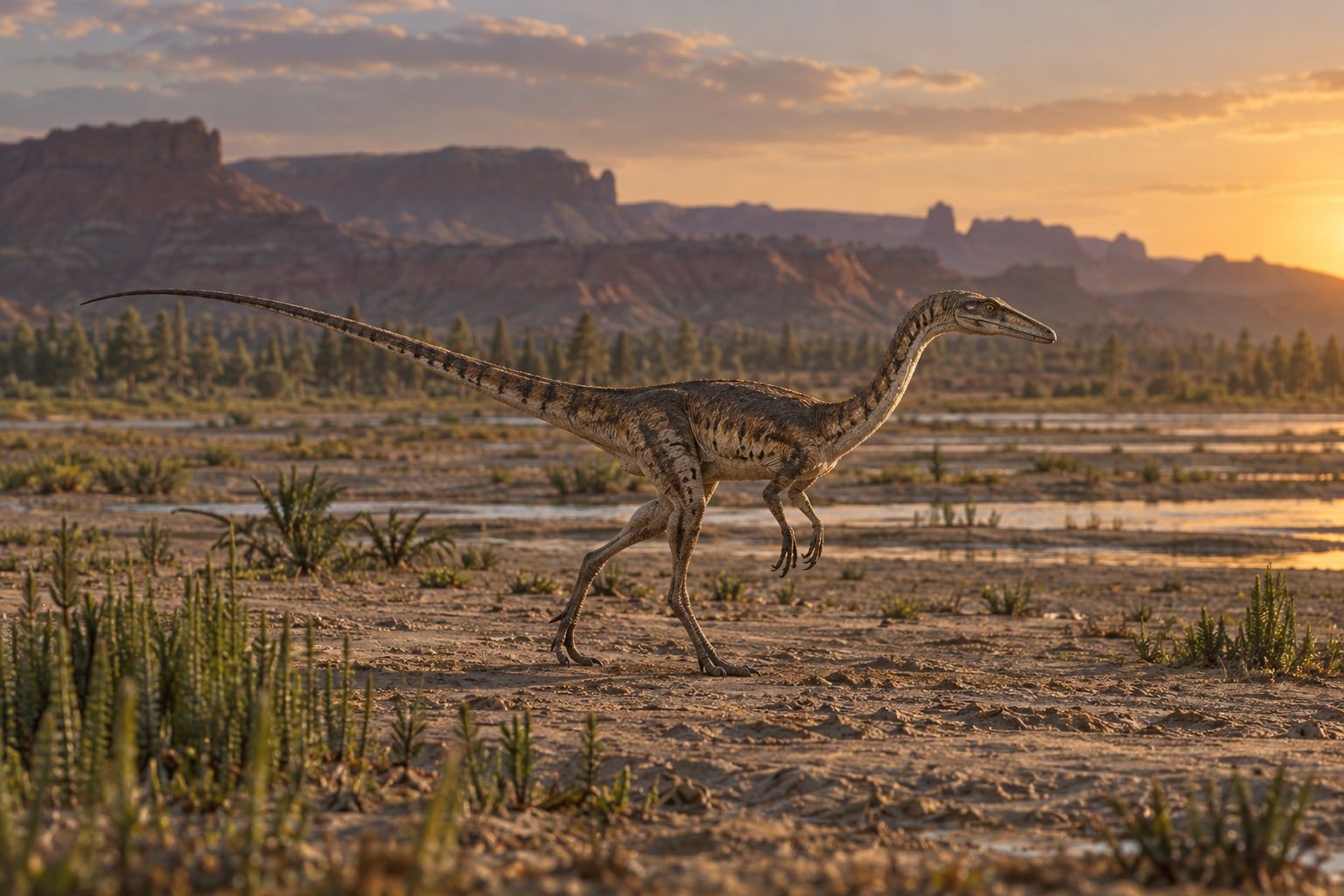
Coelophysis
SEE-loh-FY-sis
"hollow form"
DV-0052
- Lived
- 227 to 201 million years ago, Late Triassic
- Diet
- Carnivore
- Length
- about 3 m (10 ft)
- Group
- Theropods, Coelophysidae
- Found in
- United States
- Named by
- Cope 1889
Field notes
About Coelophysis
What it was like
Coelophysis was a small, slender, bipedal predator built for speed, with a long neck, a narrow skull, and rows of sharp, curved teeth. It grew to about 3 meters (10 feet) long, though much of that length was a thin, whip-like tail.
Its bones were thin-walled and lightly built, keeping the animal quick on its feet. Coelophysis probably hunted small animals, and one fossil even preserves bones inside its body cavity that some researchers think are the remains of a meal.
Its world
Coelophysis lived from about 227 to 201 million years ago, in the Late Triassic, in what is now the southwestern United States, with fossils found in New Mexico, Texas, Arizona, and as far away as Connecticut and Massachusetts. Its bones come from formations including Chinle, Petrified Forest, Cooper Canyon, and Dockum.
It lived alongside early dinosaur relatives such as Chindesaurus, Daemonosaurus, and Camposaurus, in a world where dinosaurs were still a small part of the animal community.
How it was found
Cope named Coelophysis in 1889. About 22 fossil finds are known, including one exceptional site where the skeletons of many individuals were found together, among the largest gatherings of a single dinosaur species ever found. Coelophysis is considered one of the earliest known dinosaur genera. The related genus Megapnosaurus was once classified as a species of Coelophysis, though most paleontologists now treat it as separate.
The evidence
Where its fossils were found
Today
210 million years ago
To scale
How big was Coelophysis?
Lived alongside
Found in the same rock formations.
Close relatives
Other members of Coelophysidae.
Sources: Paleobiology Database, WikidataNamed in: E. D. Cope. 1889. On a new genus of Triassic Dinosauria. The American Naturalist 23:626