Iguanodon
ig-WAH-nuh-don
"iguana tooth"
DV-0002
- Lived
- 143 to 120 million years ago, Early Cretaceous
- Diet
- Herbivore
- Length
- about 10 m (33 ft)
- Group
- Ornithopods
- Found in
- United Kingdom, Spain, Germany, France and Portugal
- Named by
- Mantell 1825
Field notes
About Iguanodon
A bulky, adaptable plant-eater
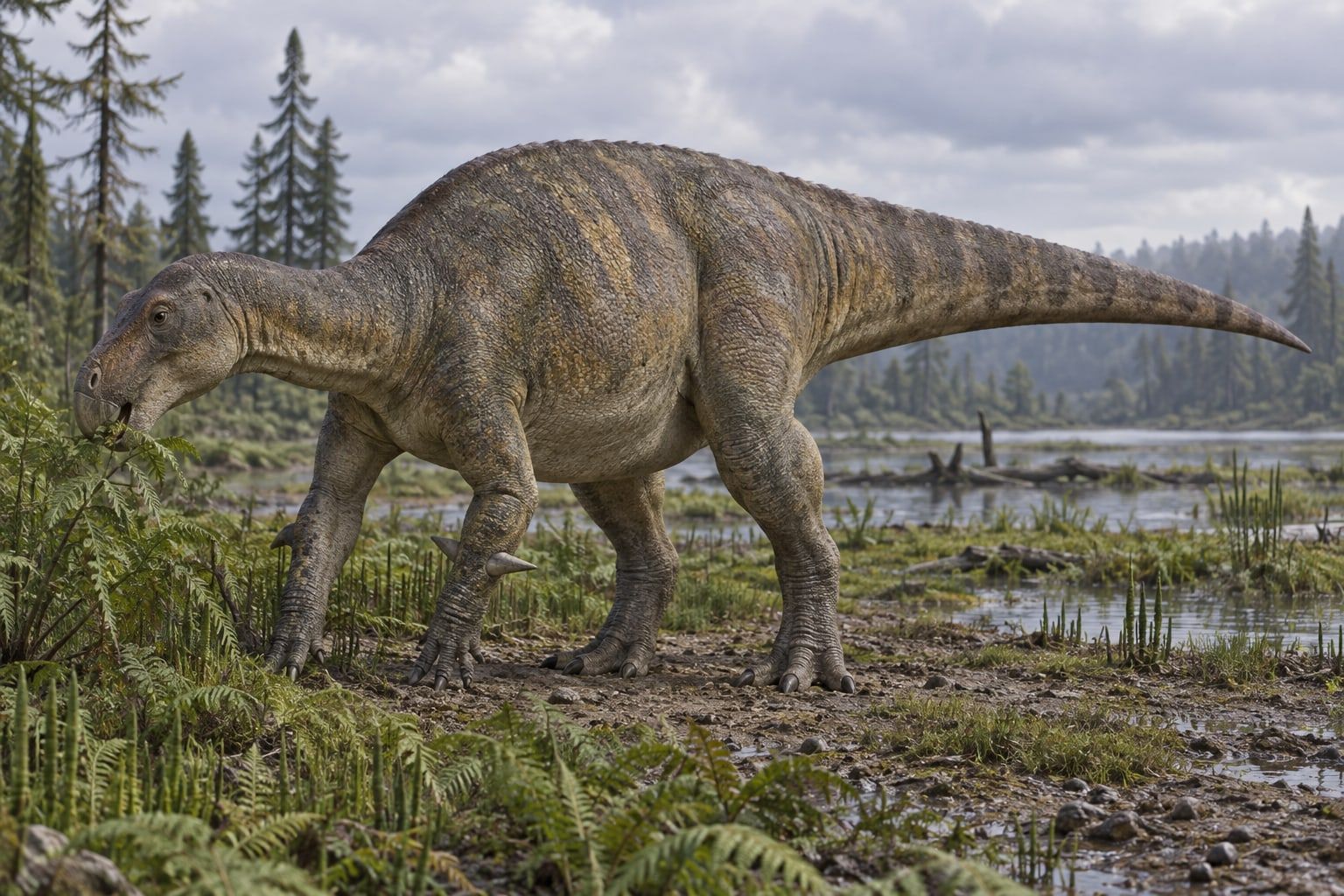
Iguanodon was a bulky plant-eater that could walk on two legs or drop onto all four, growing to roughly 10 meters, or about 33 feet, in length. It had a long, prehensile fifth finger for gathering food and a large, sharp thumb spike on each hand, likely used for defense. Its jaws held rows of ridged teeth for grinding tough plants, teeth that reminded early scientists of an iguana's, which is how the animal got its name.
Its world
Iguanodon lived during the Early Cretaceous, between about 143 and 120 million years ago, across what is now the United Kingdom, Spain, Germany, France, and Portugal, with additional finds reported from Belgium and China. Its remains have turned up in 107 separate finds, preserved in rock beds such as the Weald Clay and Wessex formations, making it one of the better-known dinosaurs of its time. It shared its world with the armored Polacanthus and Hylaeosaurus, the small Hypsilophodon, the sauropod Cetiosaurus, the clawed hunter Baryonyx, and its close relative Mantellisaurus.
How it was found
Mantell named Iguanodon in 1825, working from teeth and bone fragments found in the United Kingdom. It was only the second dinosaur genus ever formally named. Because later Iguanodon skeletons turned up more complete, scientists revised their picture of the animal more than once, moving it from an early reconstruction as a heavy, four-legged creature to the two-legged animal recognized today. Its relatives include Camptosaurus and the more recently named Bayannurosaurus, part of the wider group of plant-eaters called Iguanodontia.
The evidence
Where its fossils were found
Today
130 million years ago
To scale
How big was Iguanodon?
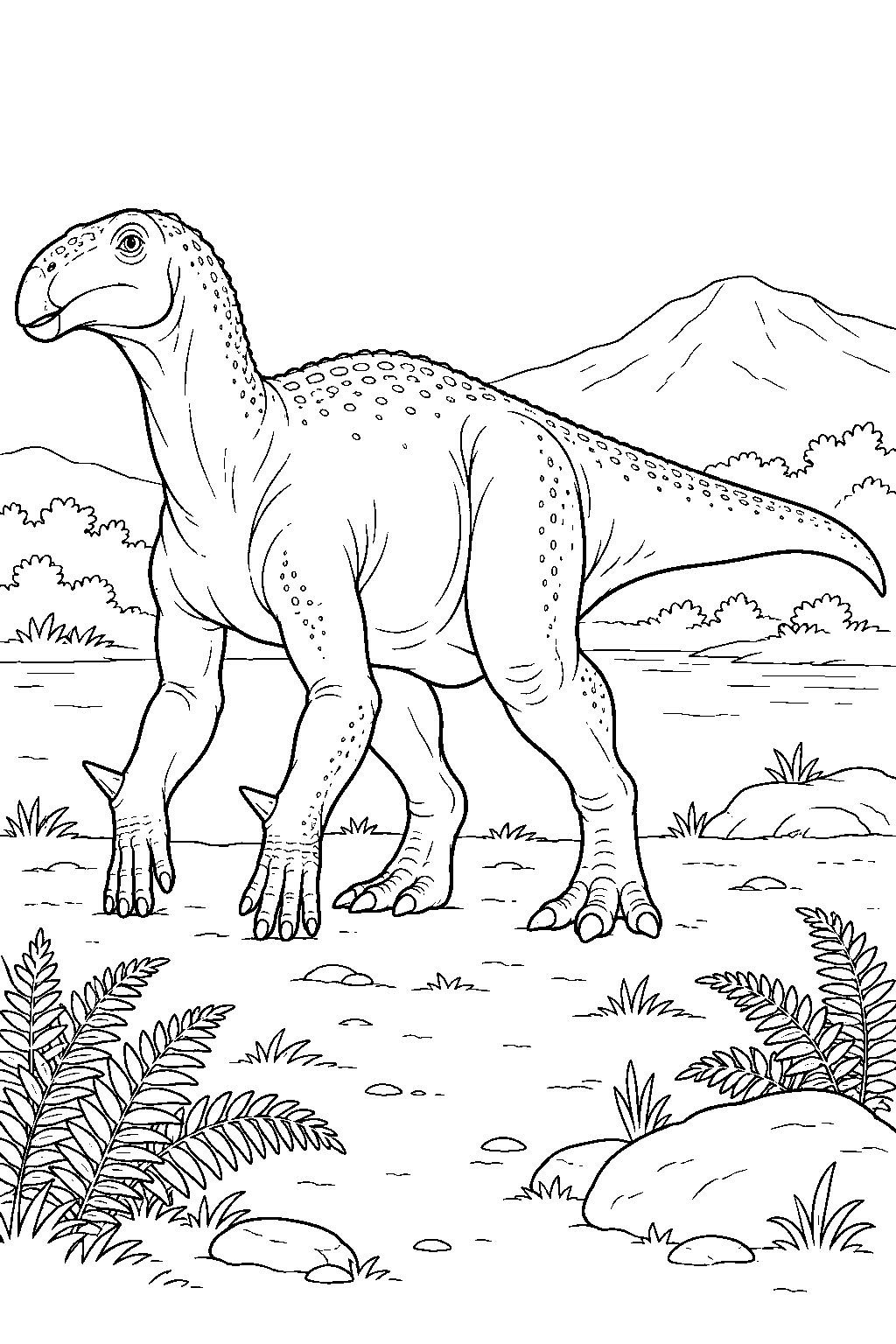 Play and learnColor it in: a printable Iguanodon coloring pageFree to print or download.
Lived alongside
Found in the same rock formations.
Close relatives
Other members of Ankylopollexia.
Sources: Paleobiology Database, WikidataNamed in: G. A. Mantell. 1825. Notice on the Iguanodon, a newly discovered fossil reptile, from the sandstone of Tilgate Forest, in Sussex. Philosophical Transactions of the Royal Society of London 115:179-186