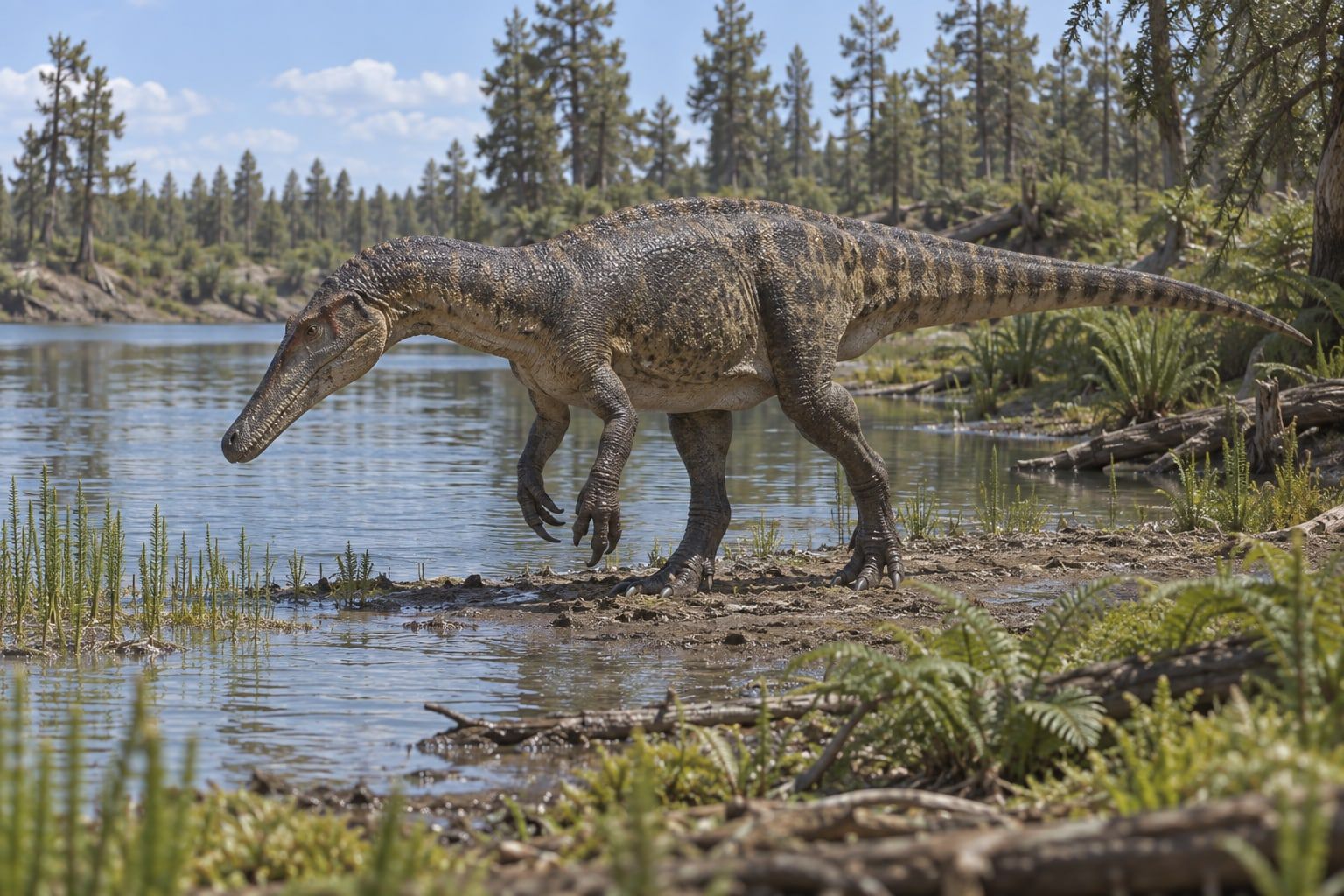
Baryonyx
BARE-ee-ON-iks
"heavy claw"
DV-0311 · type species Baryonyx walkeri
- Lived
- 137 to 121 million years ago, Early Cretaceous
- Diet
- Carnivore
- Length
- about 9 m (30 ft)
- Group
- Theropods, Spinosauridae
- Found in
- United Kingdom, Spain and Portugal
- Named by
- Charig and Milner 1986
Field notes
About Baryonyx
What it was like
Baryonyx had a long, narrow snout that looked much like a crocodile's, lined with many cone-shaped teeth. It grew to roughly 9 meters (30 feet) long. Its most striking feature was a huge curved claw on each hand, which gives the genus its name.
Baryonyx probably waded in rivers and used its claws and jaws to catch fish, though it may also have fed on other prey or scavenged when the chance arose. Its neck curved into an S shape, and a low ridge likely ran along part of its back.
Its world
Baryonyx lived from about 137 to 121 million years ago, during the Early Cretaceous. Its fossils come from formations such as Weald Clay and Wessex in the United Kingdom, as well as Papo Seco in Portugal and Pinilla de los Moros in Spain.
It shared its habitat with plant eaters such as Iguanodon and Polacanthus, and with other predators including Megalosaurus and Neovenator. Rivers, lagoons, and coastal plains across the region supported a wide range of fish and other animals.
How it was found
Charig and Milner named Baryonyx in 1986, based on a skeleton found in the United Kingdom. Around 6 finds are now known across three countries, making Baryonyx one of the better known spinosaurids. Its closest relatives include Spinosaurus, Suchomimus, and Irritator, all sharing the same crocodile-like skull shape.
The evidence
Where its fossils were found
Today
130 million years ago
To scale
How big was Baryonyx?
Lived alongside
Found in the same rock formations.
Close relatives
Other members of Spinosauridae.
Sources: Paleobiology Database, WikidataNamed in: A. J. Charig and A. C. Milner. 1986. Baryonyx, a remarkable new theropod dinosaur. Nature 324(6095):359-361