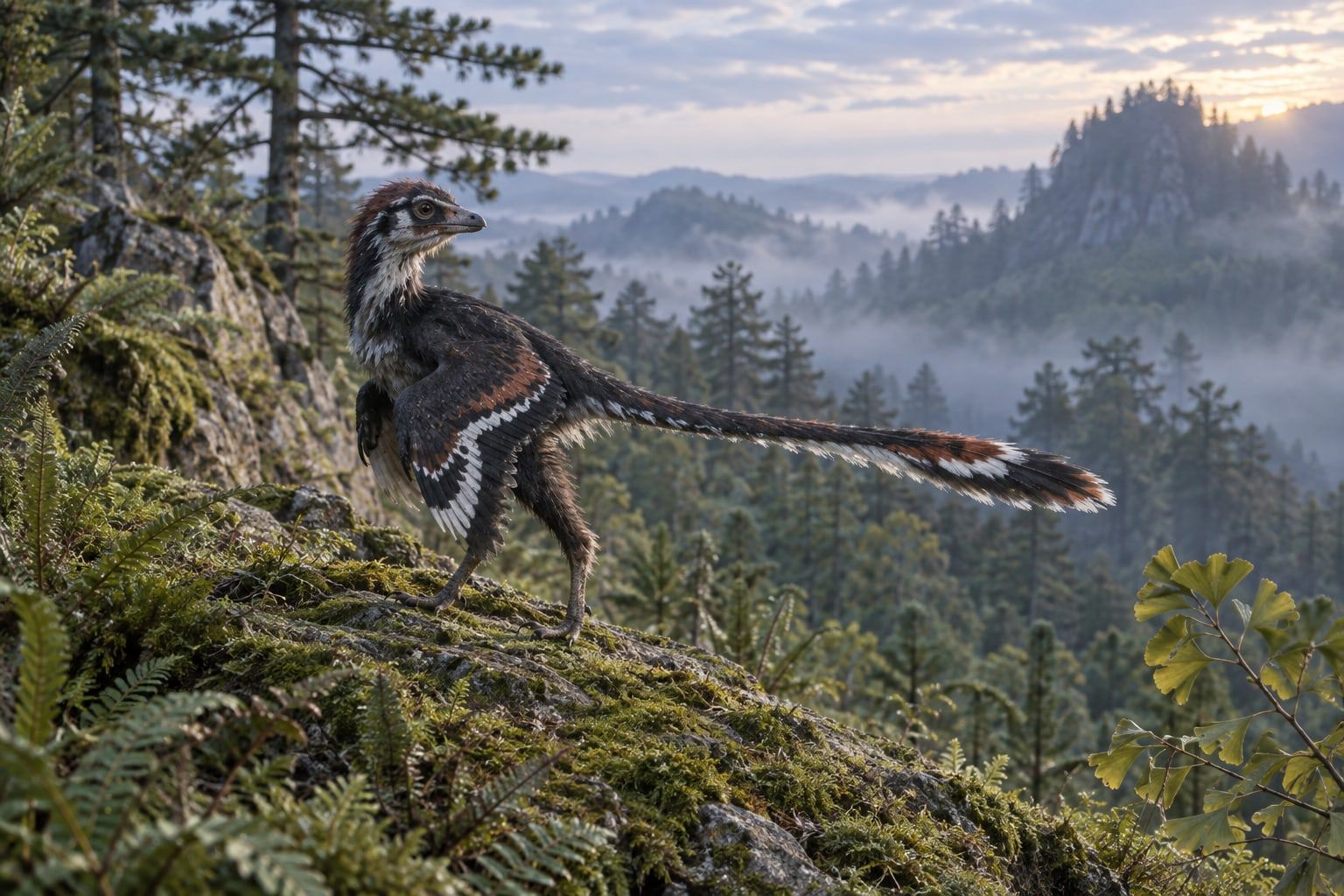
Anchiornis
AN-kee-OR-nis
"near bird"
DV-0676
- Lived
- 168 to 152 million years ago, Middle Jurassic to Late Jurassic
- Diet
- Omnivore
- Group
- Theropods, Troodontidae
- Found in
- China
- Named by
- Xu et al. 2009
Field notes
About Anchiornis
What it was like
Anchiornis was a small, feathered dinosaur with long feathers on both its arms and its legs, giving it four wing-like limbs rather than two. It probably could not fly well, if at all, but may have used its feathered limbs to glide or to help control its landings.
Its fossils are so well preserved that scientists have been able to work out its actual color pattern: gray body feathers, a reddish crest on the head, and black and white banding on the wings, one of the first times this has been done for any dinosaur.
It ate a mix of foods, making it an omnivore rather than a strict meat eater or plant eater.
Its world
Anchiornis lived from about 168 to 152 million years ago, spanning the Middle and Late Jurassic, in what is now China. Its fossils come from the Tiaojishan Formation.
It shared this forested world with other small feathered dinosaurs, including Yi, Epidexipteryx, Caihong, Pedopenna, Eosinopteryx, and Serikornis, as well as the armored plant eater Tianyulong.
How it was found
Xu and colleagues named Anchiornis in 2009. Only about three fossil finds of the genus are formally documented, but hundreds of individual specimens have since come from the same rocks, making it one of the best-known feathered dinosaurs and an important source of information on how birds evolved.
The evidence
Where its fossils were found
Today
160 million years ago
Lived alongside
Found in the same rock formations.
Close relatives
Other members of Troodontidae.
Sources: Paleobiology Database, WikidataNamed in: X. Xu, Q. Zhao, and M. Norell, C. Sullivan, D. Hone, G. Erickson, X. Wang, F. Han, Y. Guo. 2009. A new feathered maniraptoran dinosaur fossil that fills a morphological gap in avian origin. Chinese Science Bulletin 54(3):430-435