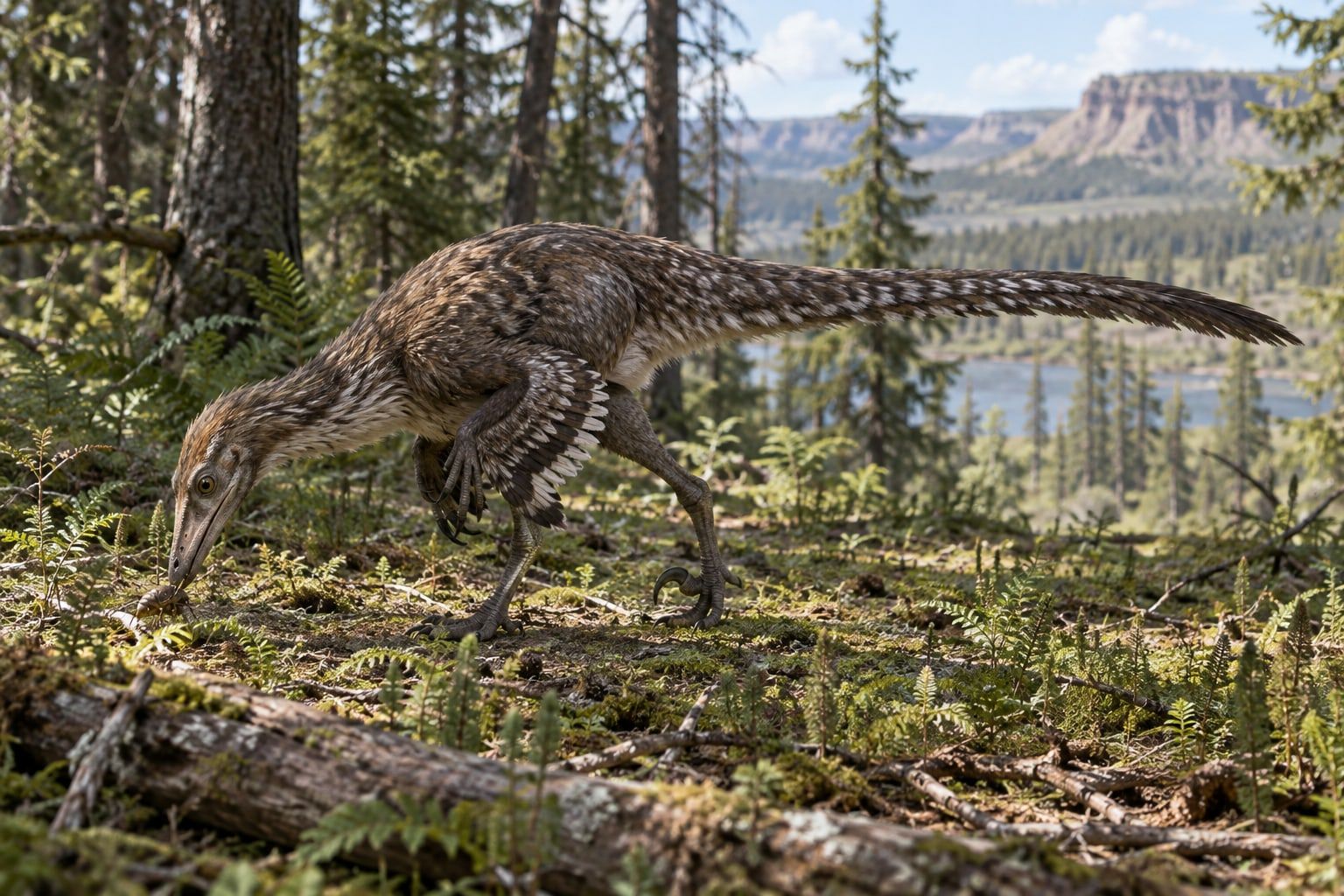
Troodon
TRO-oh-don
"wounding tooth"
DV-0015
- Lived
- 84 to 66 million years ago, Late Cretaceous
- Diet
- Omnivore
- Length
- about 2.4 m (8 ft)
- Group
- Theropods, Troodontidae
- Found in
- Canada and United States
- Named by
- Leidy 1856
Field notes
About Troodon
What it was like
Troodon was a small, bird-like theropod with large eyes, long legs, and a slender build suited for speed. It grew to about 2.4 meters (8 feet) long, including a long tail, and had teeth with fine serrations more like those of plant eaters than most meat-eating dinosaurs.
This unusual tooth shape suggests Troodon was probably an omnivore, eating both plants and small animals rather than hunting large prey. Its large eyes and relatively big brain for its size suggest it had sharp senses.
Its world
Troodon lived from about 84 to 66 million years ago, during the Late Cretaceous, mainly in what is now Alberta and Montana, with fossils also reported from Wyoming, Alaska, North Dakota, and Saskatchewan, and possible finds from Russia and China.
It shared its world with other small predators, including Saurornitholestes and Dromaeosaurus, as well as plant eaters such as Edmontosaurus and the armored Euoplocephalus and Edmontonia.
How it was found
Leidy named Troodon in 1856, making it one of the first dinosaurs described from North America, though it was originally mistaken for a lizard. Around 85 finds have since been linked to the genus, but scientists disagree about whether many of these fossils truly belong to Troodon or to closely related genera such as Stenonychosaurus and Latenivenatrix. Because the original fossils are so incomplete, the genus's validity is still actively debated among paleontologists.
The evidence
Where its fossils were found
Today
75 million years ago
To scale
How big was Troodon?
Lived alongside
Found in the same rock formations.
Close relatives
Other members of Troodontidae.
Sources: Paleobiology Database, WikidataNamed in: J. Leidy. 1856. Notices of remains of extinct reptiles and fishes, discovered by Dr. F. V. Hayden in the bad lands of the Judith River, Nebraska Territory. Proceedings of the Academy of Natural Sciences of Philadelphia 8:72-73