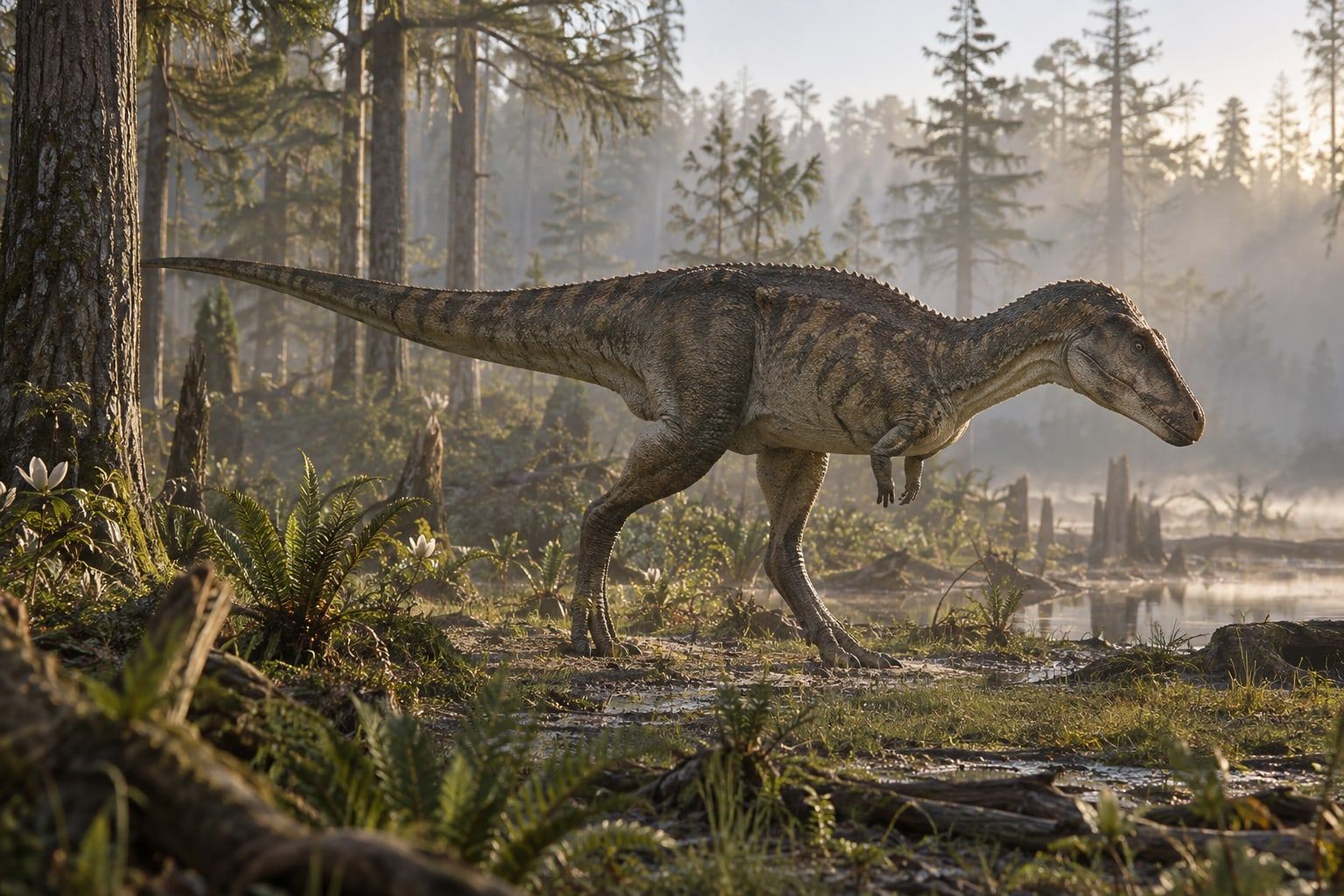
Appalachiosaurus
AP-uh-LAY-chee-oh-SORE-us
"Appalachian lizard"
DV-0560
- Lived
- 86 to 66 million years ago, Late Cretaceous
- Diet
- Carnivore
- Group
- Theropods
- Found in
- United States
- Named by
- Carr et al. 2005
Field notes
About Appalachiosaurus
What it was like
Appalachiosaurus was a bipedal, carnivorous tyrannosauroid, an early cousin of Tyrannosaurus, though far smaller and more lightly built. Only a juvenile skeleton has been found, so its adult size is uncertain, though it was likely bigger than the young individual known so far.
Like other early tyrannosauroids, it probably had a narrower skull and longer arms than later giants such as Tyrannosaurus, features that became reduced as the tyrannosaur lineage grew larger over the Late Cretaceous.
Its world
Appalachiosaurus lived from about 86 to 66 million years ago, in the Late Cretaceous, in what is now the southeastern United States. Its bones come from Alabama, Georgia, and South Carolina, including the Demopolis Chalk and Blufftown formations.
This region was once part of Appalachia, an island landmass separated from the rest of North America by a shallow sea. Fewer dinosaur fossils have been found here than farther west on the continent, but about six finds of Appalachiosaurus are known, along with fossils of the small predator Saurornitholestes.
How it was found
Carr and colleagues named Appalachiosaurus in 2005. Its relatives include Dryptosaurus, Dilong, and Raptorex, along with other early tyrannosauroids such as Eotyrannus and Xiongguanlong, showing that the group had already spread widely before Tyrannosaurus and its close relatives grew to their enormous later sizes.
The evidence
Where its fossils were found
Today
75 million years ago
Lived alongside
Found in the same rock formations.
Close relatives
Other members of Tyrannosauroidea.
Sources: Paleobiology Database, WikidataNamed in: T. D. Carr, T. E. Williamson, and D. R. Schwimmer. 2005. A new genus and species of tyrannosauroid from the Late Cretaceous (Middle Campanian) Demopolis formation of Alabama. Journal of Vertebrate Paleontology 25(1):119-143