Asiatyrannus
"Asian tyrant"
Type species Asiatyrannus xui
- Lived
- 72 to 66 million years ago, Late Cretaceous
- Diet
- Carnivore
- Group
- Theropods, Tyrannosauridae
- Found in
- China
- Named by
- Zheng et al. 2024
Where its fossils were found
The evidence
Today

70 million years ago
Habitat
Its bones come from red mudstone in the Nanxiong Formation of southern China. Other dinosaurs from these rocks include Qianzhousaurus, Corythoraptor and Tongtianlong.
Field notes
About Asiatyrannus
What it was like
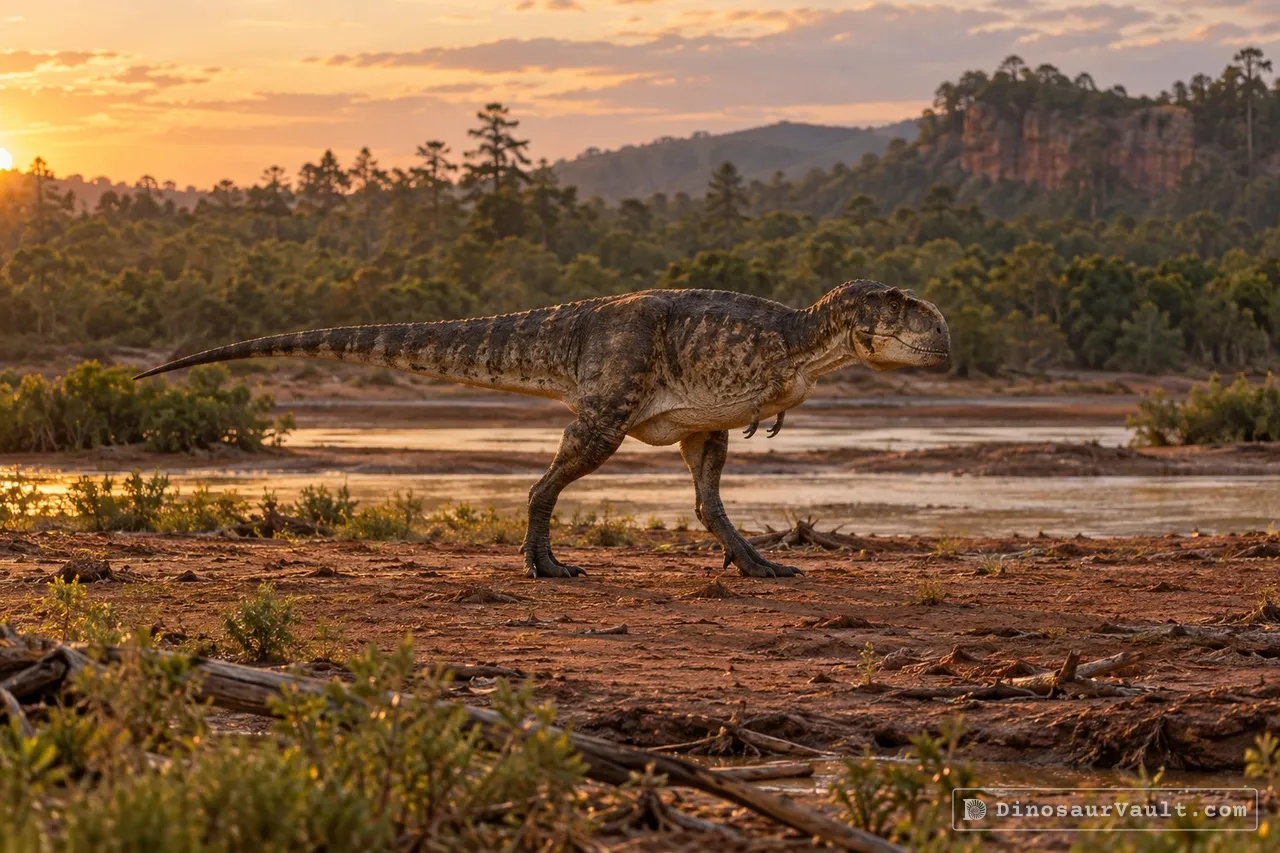
Asiatyrannus was a small tyrannosaur with a short, deep snout. It was built like its giant relatives, with a big head, strong teeth and tiny arms, but it was much smaller.
Some scientists think the skeleton comes from a young animal, perhaps a young Tarbosaurus, rather than a separate genus, so its status is debated.
Its world
It lived about 72 to 66 million years ago, near the end of the Late Cretaceous, in what is now southern China. Its fossil comes from the Nanxiong Formation, which also produced the long-snouted tyrannosaur Qianzhousaurus.
How it was found
Zheng and colleagues named Asiatyrannus in 2024, from a single skull and partial skeleton.
Field gallery
More views of Asiatyrannus
Scenes reconstructed from the available fossil evidence.
Lived alongside
Found in the same rock formations


A rock formation can hold fossils laid down millions of years apart, so not every animal here met Asiatyrannus.
The evidence
The science behind Asiatyrannus
Which parts of the picture come from its own bones, and which come from its relatives.
From its own fossils
- A single specimen preserves a nearly complete skull, much of the hind legs and some tail vertebrae.
- Its snout is proportionally deeper than that of Qianzhousaurus, another tyrannosaur from the same formation.
- A thin slice of its lower leg bone shows that the animal was still growing when it died.
Borrowed from relatives
- The missing arms and trunk are restored from better-known tyrannosaurids such as Tarbosaurus and Tyrannosaurus.
Still unknown
- Whether Asiatyrannus is a separate genus or a young Tarbosaurus.
- Its full adult size.
- Its skin covering and color.
Discovery timeline
- 2014Same rocksLü et al.
- 2024Named itZheng et al.
- 2026RedescriptionRaun et al.
Key papers
The research behind what we know of Asiatyrannus
Same rocks
Described Qianzhousaurus from the same formation and showed that its long snout was a lasting body plan rather than just a juvenile feature.
A new clade of Asian Late Cretaceous long-snouted tyrannosaurids. Nature Communications 5
Read the paper : A new clade of Asian Late Cretaceous long-snouted tyrannosaurids (opens in a new tab)Named it
Named a deep-snouted tyrannosaur from a skull and partial skeleton, interpreting it as a small-bodied species that had not finished growing.
The first deep-snouted tyrannosaur from Upper Cretaceous Ganzhou City of southeastern China. Scientific Reports 14
Read the paper : The first deep-snouted tyrannosaur from Upper Cretaceous Ganzhou City of southeastern China (opens in a new tab)Redescription
Compared the proposed distinguishing traits with young Tarbosaurus and argued that Asiatyrannus probably belongs to that genus.
Taxonomic reassessment of juvenile tyrannosaurine specimens from Asia reveal large biogeographic ranges in tyrannosaurids. Cretaceous Research 186: 106412
Read the paper : Taxonomic reassessment of juvenile tyrannosaurine specimens from Asia reveal large biogeographic ranges in tyrannosaurids (opens in a new tab)
Close relatives
Other members of Tyrannosauridae


Sources: Wikidata