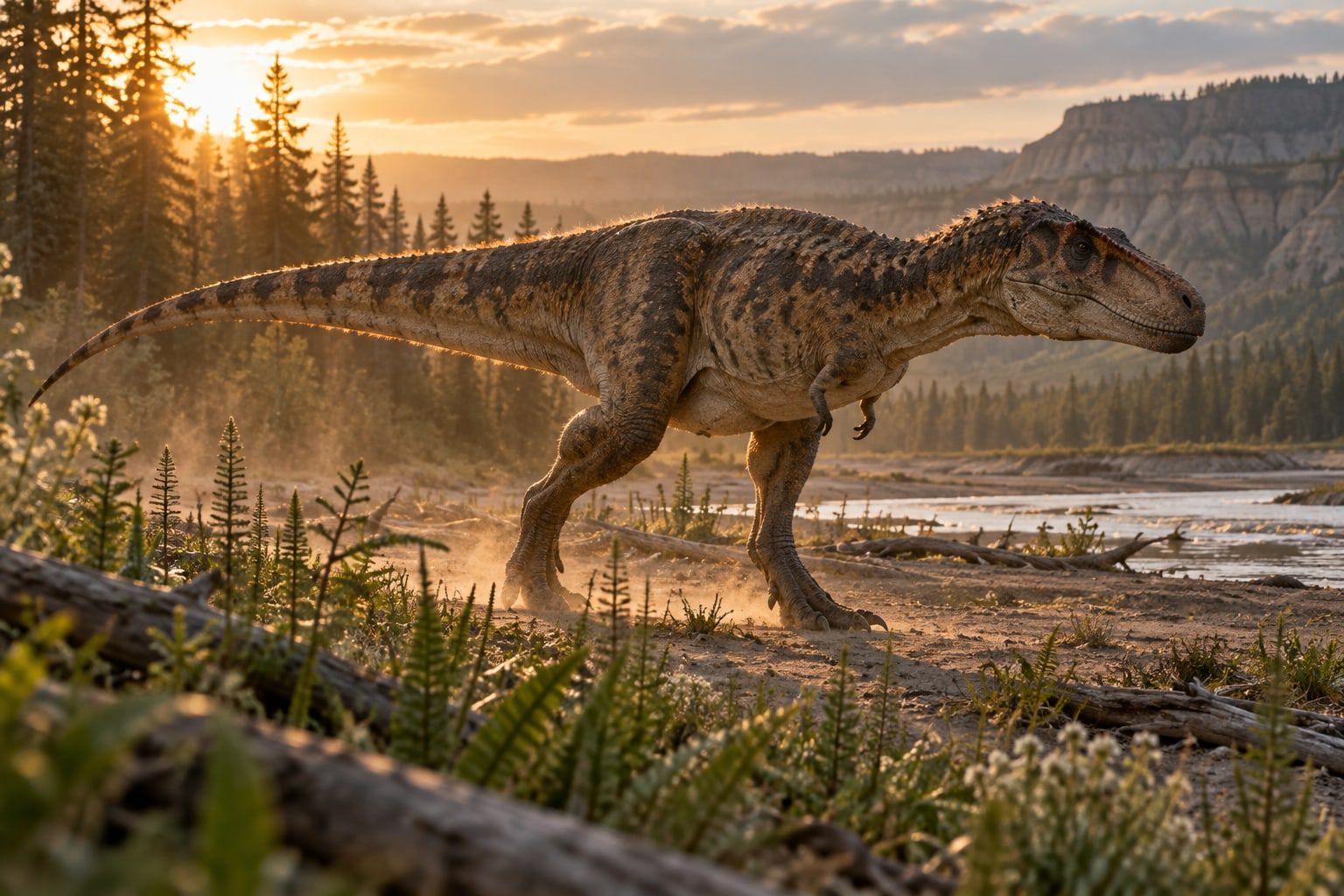
Gorgosaurus
GOR-go-SORE-us
"dreadful lizard"
DV-0094 · type species Gorgosaurus libratus
- Lived
- 84 to 72 million years ago, Late Cretaceous
- Diet
- Carnivore
- Length
- about 9 m (30 ft)
- Group
- Theropods, Tyrannosauridae
- Found in
- Canada and United States
- Named by
- Lambe 1914
Field notes
About Gorgosaurus
What it was like
Gorgosaurus was a large, two-legged hunter with a deep skull, banana-shaped teeth, and powerful jaws. It grew to about 9 meters (30 feet) long, walking on strong hind legs while its arms stayed small, each ending in two clawed fingers. Its eyes faced partly forward, giving it good depth perception for tracking prey.
It was closely related to Albertosaurus, and more distant kin to Tyrannosaurus, Tarbosaurus, and Daspletosaurus. Gorgosaurus was likely a fast, agile hunter compared to its bulkier relatives, built more for speed than raw power.
Its world
Gorgosaurus lived from about 84 to 72 million years ago, during the Late Cretaceous, across what is now Alberta and Montana, with finds also reported in North Carolina and South Dakota. Its bones come from rock layers such as Dinosaur Park, Judith River, Hell Creek, and Oldman.
It shared its floodplain habitat with plant eaters like Stegoceras and small hunters such as Troodon, Dromaeosaurus, and Saurornitholestes. In some areas it lived alongside Daspletosaurus, another large tyrannosaurid, and the two may have hunted different prey to avoid competing directly.
How it was found
Lambe named Gorgosaurus in 1914 from fossils found in Alberta. About 17 finds of the genus are known today, making it one of the better-represented tyrannosaurids in the fossil record. The type species is Gorgosaurus libratus.
The evidence
Where its fossils were found
Today
80 million years ago
To scale
How big was Gorgosaurus?
Lived alongside
Found in the same rock formations.
Close relatives
Other members of Tyrannosauridae.
Sources: Paleobiology Database, WikidataNamed in: L. M. Lambe. 1914. On a new genus and species of carnivorous dinosaur from the Belly River Formation of Alberta, with a description of the skull of Stephanosaurus marginatus from the same horizon. The Ottawa Naturalist 28:13-20