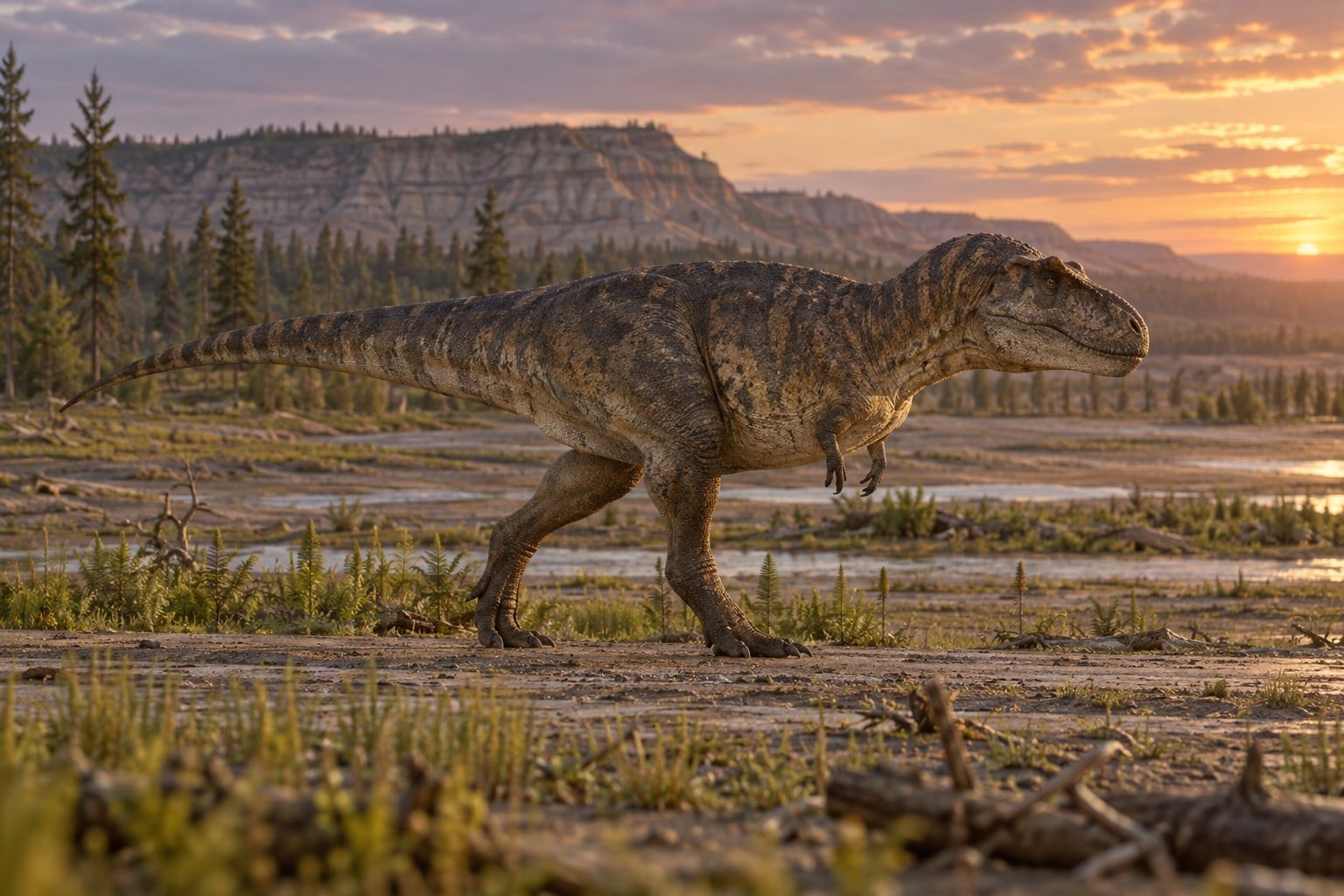
Albertosaurus
al-BER-tuh-SORE-us
"Alberta lizard"
DV-0073
- Lived
- 84 to 66 million years ago, Late Cretaceous
- Diet
- Carnivore
- Length
- about 9 m (30 ft)
- Group
- Theropods, Tyrannosauridae
- Found in
- Canada
- Named by
- Osborn 1905
Field notes
About Albertosaurus
What it was like
Albertosaurus was a bipedal predator with a massive head, rows of sharp teeth, and small, two-fingered arms. It grew to about 9 meters (30 feet) long, smaller than its famous relative Tyrannosaurus but still a formidable hunter.
It probably had a strong sense of smell and good eyesight, useful for finding prey across open floodplains. Some paleontologists think Albertosaurus may have hunted or scavenged in groups, based on a bonebed where the remains of several individuals were found together.
Its world
Albertosaurus lived from about 84 to 66 million years ago, in the Late Cretaceous, mostly in what is now Alberta, Canada, with possible remains also reported from Saskatchewan and the states of Montana and Missouri in the United States. Its fossils come from formations including Horseshoe Canyon, Judith River, Oldman, and Scollard.
It shared its world with the armored Euoplocephalus, the ostrich-like Ornithomimus and Struthiomimus, the small hunter Troodon, and close relatives such as Gorgosaurus and Daspletosaurus.
How it was found
Osborn named Albertosaurus in 1905. Since then, paleontologists have recovered about 21 fossil finds, giving Albertosaurus one of the more complete fossil records among tyrannosaurids. Some scientists count the closely related Gorgosaurus as a second species of Albertosaurus, while others treat it as a separate genus; the question is still debated.
The evidence
Where its fossils were found
Today
75 million years ago
To scale
How big was Albertosaurus?
Lived alongside
Found in the same rock formations.
Close relatives
Other members of Tyrannosauridae.
Sources: Paleobiology Database, WikidataNamed in: H. F. Osborn. 1905. Tyrannosaurus and other Cretaceous carnivorous dinosaurs. Bulletin of the American Museum of Natural History 21(14):259-265