Beipiaosaurus
DV-0434 · type species Beipiaosaurus inexpectus
- Lived
- 126 to 120 million years ago, Early Cretaceous
- Diet
- Herbivore
- Length
- about 2 m (7 ft)
- Group
- Theropods
- Found in
- China
- Named by
- Xu et al. 1999
Field notes
About Beipiaosaurus
What it was like
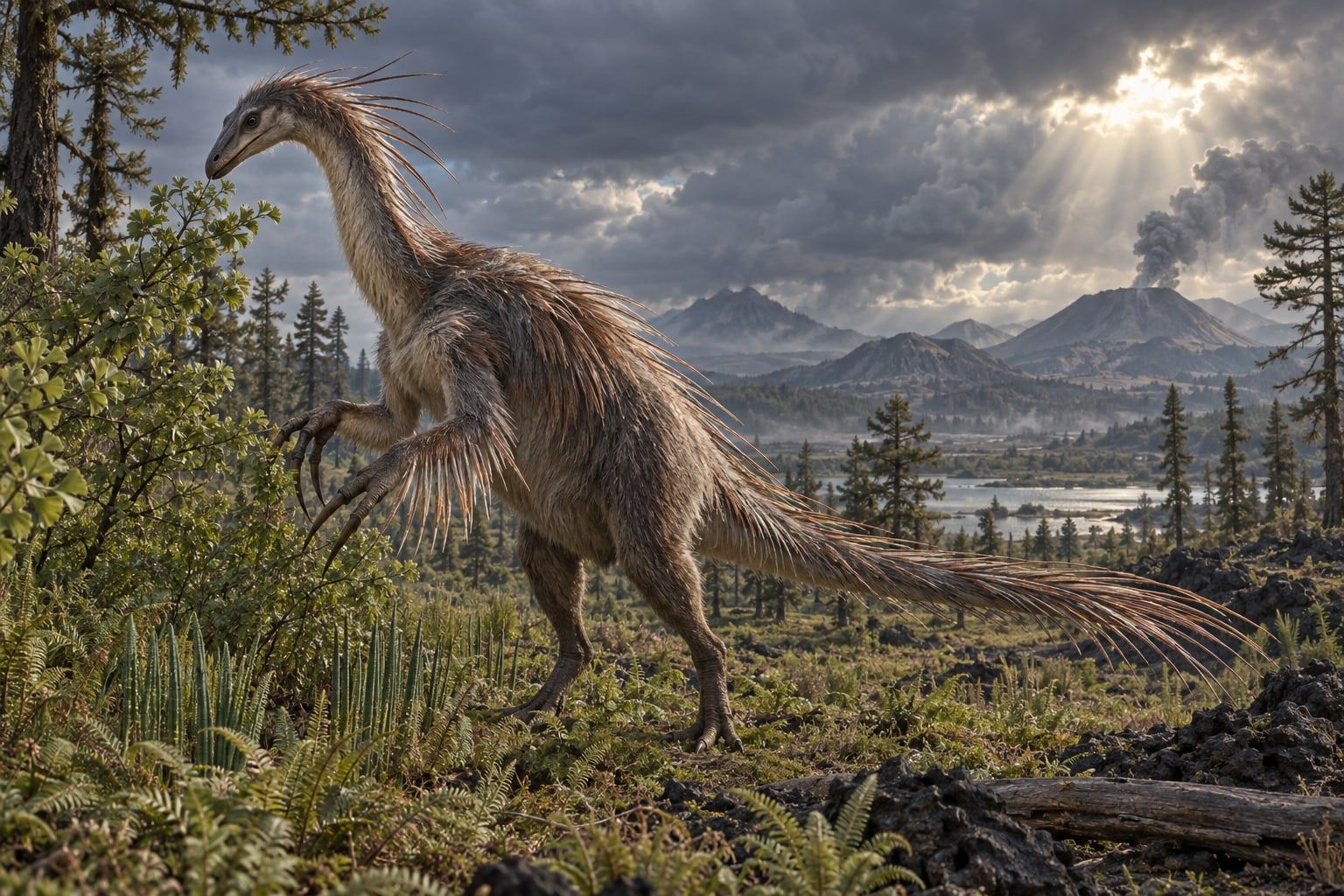
Beipiaosaurus was an unusual theropod: a member of the therizinosaurs, a group of plant-eating dinosaurs that evolved from meat-eating ancestors and ended up with long claws, small heads, and rounded bodies built for digesting plants. Its body was covered in long, simple, filament-like feathers, among the clearest early evidence that feathers were not limited to the close relatives of birds. Beipiaosaurus grew to about 2 meters (6.6 feet) long. The type species is Beipiaosaurus inexpectus.
Its world
Beipiaosaurus lived from about 126 to 120 million years ago, during the Early Cretaceous, in what is now China. Its fossils come from the Yixian Formation, alongside other feathered dinosaurs such as Sinornithosaurus, Sinosauropteryx, and Caudipteryx, the plant eater Psittacosaurus, and the much larger, feathered predator Yutyrannus. Together, these finds make the Yixian Formation one of the richest sources of feathered dinosaur fossils anywhere in the world.
How it was found
Xu and colleagues named Beipiaosaurus in 1999. Two fossil finds are known today. Its discovery helped show that feathers were spread widely across the theropod family tree, not confined to the small group of dinosaurs most closely related to birds.
The evidence
Where its fossils were found
Today
125 million years ago
To scale
How big was Beipiaosaurus?
Lived alongside
Found in the same rock formations.
Close relatives
Other members of Therizinosauroidea.
Sources: Paleobiology Database, WikidataNamed in: X. Xu, Z.-L. Tang, and X.-L. Wang. 1999. A therizinosauroid dinosaur with integumentary structures from China. Nature 399:350-354