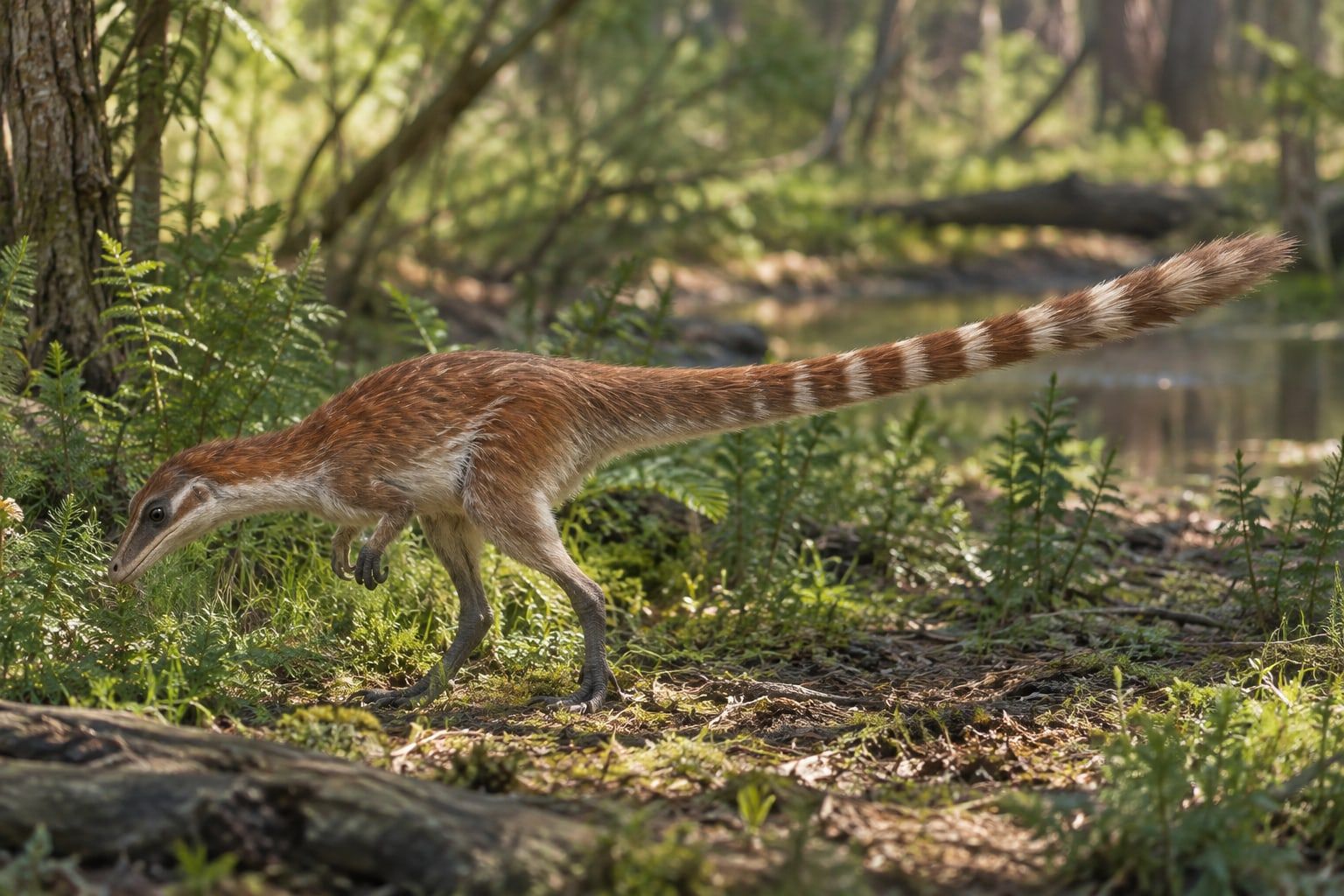
Sinosauropteryx
SY-no-sore-OP-ter-ix
"Chinese reptile wing"
DV-0402
- Lived
- 126 to 120 million years ago, Early Cretaceous
- Diet
- Carnivore
- Length
- about 1.1 m (4 ft)
- Group
- Theropods, Sinosauropterygidae
- Found in
- China
- Named by
- Ji and Ji 1996
Field notes
About Sinosauropteryx
What it was like
Sinosauropteryx was a small, fast-moving hunter with an unusually long tail and short arms. It grew to only about 1.1 meters (3.6 feet) long, small enough to have hunted lizards and other tiny animals rather than anything large.
It is best known for being the first non-bird dinosaur ever found with clear evidence of feathers, a short, simple, hair-like coat rather than the flight feathers seen in birds. Some fossils preserve dark banding along the tail, evidence of a color pattern, though the exact colors are still debated.
Its world
Sinosauropteryx lived from about 126 to 120 million years ago, in the Early Cretaceous, in what is now China. Its fossils come from the Yixian Formation.
It shared this world with other feathered dinosaurs such as Beipiaosaurus, Dilong, Caudipteryx, Sinornithosaurus, and Liaoningosaurus, the larger predator Yutyrannus, and the plant eater Psittacosaurus.
How it was found
Sinosauropteryx was named in 1996 by two paleontologists who both happened to be named Ji. Only about four fossil finds of the genus are known, but because the earliest ones were so well preserved, they helped convince scientists that many dinosaurs, not just birds, carried feathers.
The evidence
Where its fossils were found
Today
125 million years ago
To scale
How big was Sinosauropteryx?
Lived alongside
Found in the same rock formations.
Close relatives
Other members of Sinosauropterygidae.
Sources: Paleobiology Database, WikidataNamed in: Q. Ji and S. Ji. 1996. [On discovery of the earliest bird fossil in China and the origin of birds]. Chinese Geology 10(233):30-33