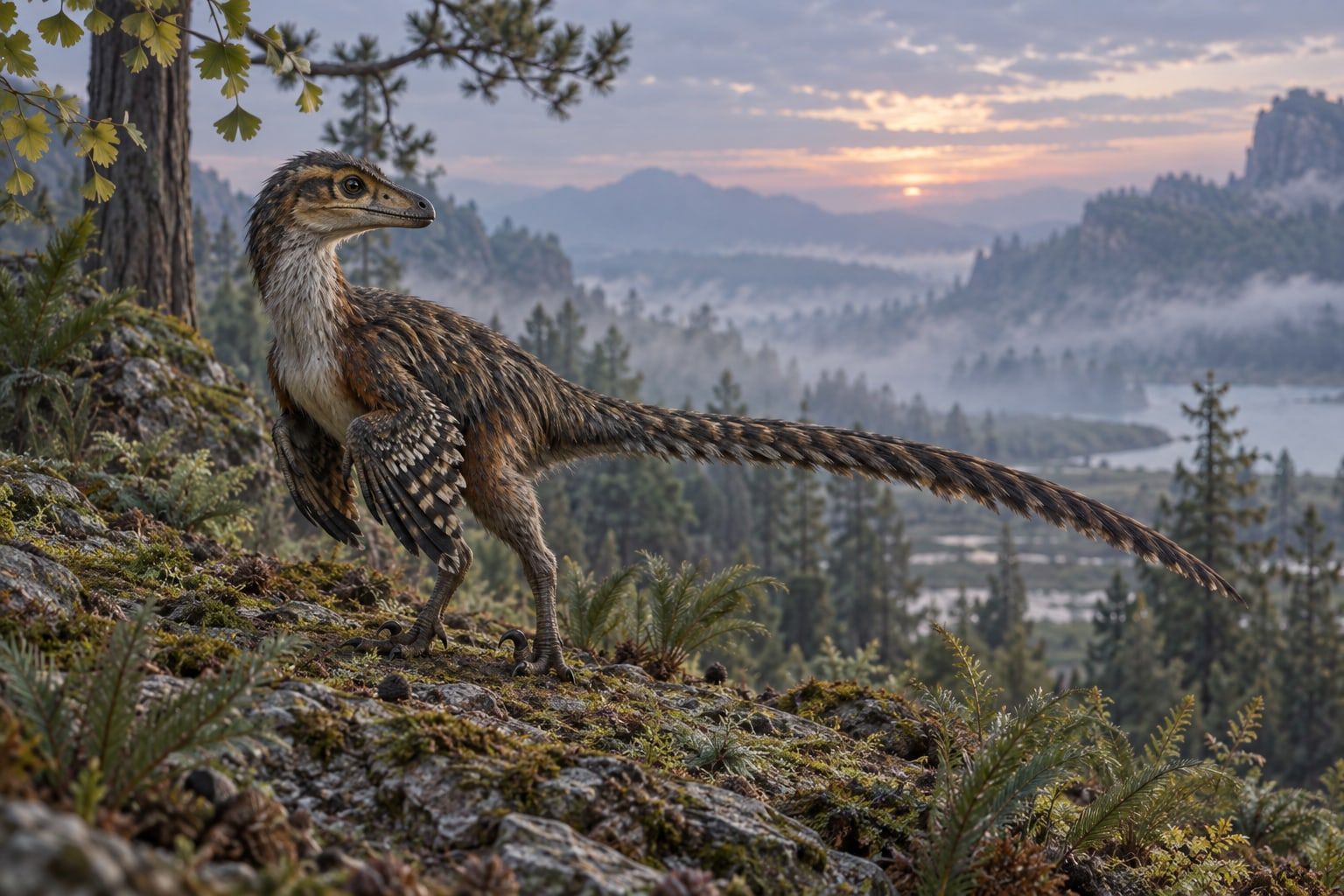
Sinornithosaurus
"Chinese bird lizard"
DV-0452
- Lived
- 126 to 120 million years ago, Early Cretaceous
- Diet
- Carnivore
- Length
- about 2 m (7 ft)
- Group
- Theropods, Dromaeosauridae
- Found in
- China
- Named by
- Xu et al. 1999
Field notes
About Sinornithosaurus
What it was like
Sinornithosaurus was a small, feathered dromaeosaur, part of the same raptor-like family as Velociraptor and Microraptor. Like its relatives, it likely had long, grasping hands and a sickle-shaped claw on the second toe of each foot, tools probably used for gripping prey. Its body was covered in filament-like feathers, among the clearest early evidence that many small theropods were feathered, not scaly, animals. Sinornithosaurus grew to about 2 meters (6.6 feet) long.
Some researchers have argued that grooves on its teeth suggest it delivered venom into prey, though other scientists dispute this idea, and no agreement has been reached.
Its world
Sinornithosaurus lived from about 126 to 120 million years ago, during the Early Cretaceous, in what is now China. Its fossils come from the Yixian Formation, a site famous for extraordinary feathered dinosaur finds. It shared this world with other feathered dinosaurs such as Beipiaosaurus, Caudipteryx, and Sinosauropteryx, the plant eater Psittacosaurus, and the much larger, feathered predator Yutyrannus.
How it was found
Xu and colleagues named Sinornithosaurus in 1999, from fossils found in the Yixian Formation. Three fossil finds are known today. Its excellent preservation helped paleontologists study feather structure in a small, bird-like theropod, adding to the evidence that birds evolved from within this group of dinosaurs.
The evidence
Where its fossils were found
Today
125 million years ago
To scale
How big was Sinornithosaurus?
Lived alongside
Found in the same rock formations.
Close relatives
Other members of Dromaeosauridae.
Sources: Paleobiology Database, WikidataNamed in: X. Xu, X.-L. Wang, and X.-C. Wu. 1999. A dromaeosaurid dinosaur with a filamentous integument from the Yixian Formation of China. Nature 401:262-266