Borealopelta
bor-ee-AL-oh-PEL-tuh
"northern shield"
DV-0976 · type species Borealopelta markmitchelli
- Lived
- 121 to 113 million years ago, Early Cretaceous
- Diet
- Herbivore
- Length
- about 5.5 m (18 ft)
- Group
- Ankylosaurs, Nodosauridae
- Found in
- Canada
- Named by
- Brown et al. 2017
Field notes
About Borealopelta
What it was like
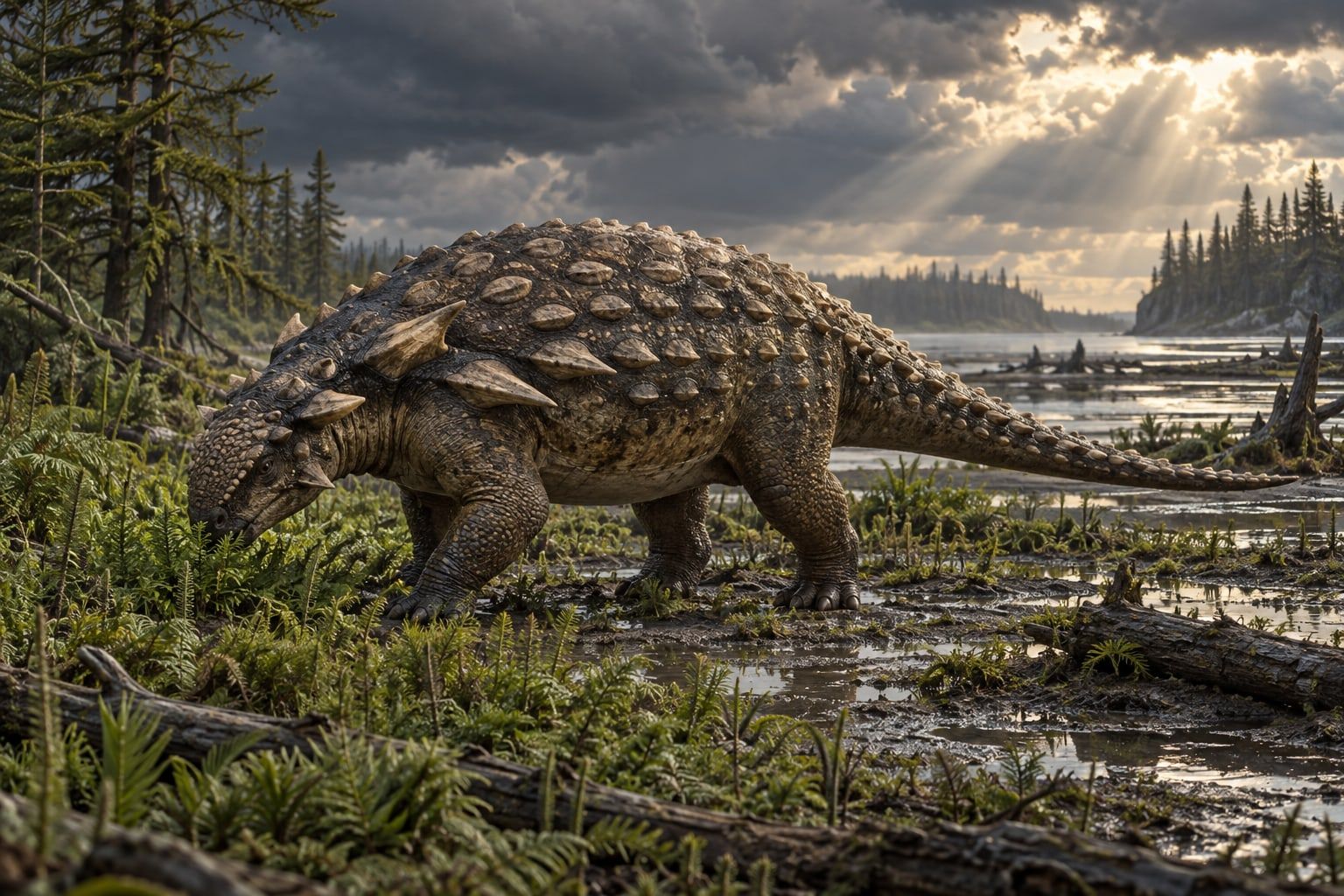
Borealopelta was a heavily armored plant eater that grew to about 5.5 meters (18 feet) long. Rows of bony plates called osteoderms covered its neck, back, and tail, with larger spikes along its shoulders.
One fossil of Borealopelta is so well preserved that it still shows the actual armor, skin, and even the pattern of coloring from the animal's life. Traces of pigment suggest it was reddish brown on top and paler underneath, a pattern that may have helped it blend into its surroundings.
Its world
Borealopelta lived from about 121 to 113 million years ago, during the Early Cretaceous, in what is now Alberta, Canada. Its only known fossil comes from the Clearwater Formation.
The remains also preserved contents from the animal's last meal, giving researchers a rare direct look at what this plant eater had been feeding on shortly before it died.
How it was found
Brown and colleagues named Borealopelta in 2017, based on a single remarkably complete specimen. It is one of the best preserved armored dinosaurs ever found, and its closest relatives include Edmontonia, Nodosaurus, and Sauropelta, all members of the nodosaur family.
The evidence
Where its fossils were found
Today
115 million years ago
To scale
How big was Borealopelta?
Close relatives
Other members of Nodosauridae.
Sources: Paleobiology Database, WikidataNamed in: C. M. Brown, D. M. Henderson, and J. Vinther, I. F., A. Sistiaga, J. Herrera, R. E. Summons. 2017. An exceptionally preserved three-dimensional armored dinosaur reveals insights into coloration and Cretaceous predator-prey dynamics. Current Biology 27:2514-2521