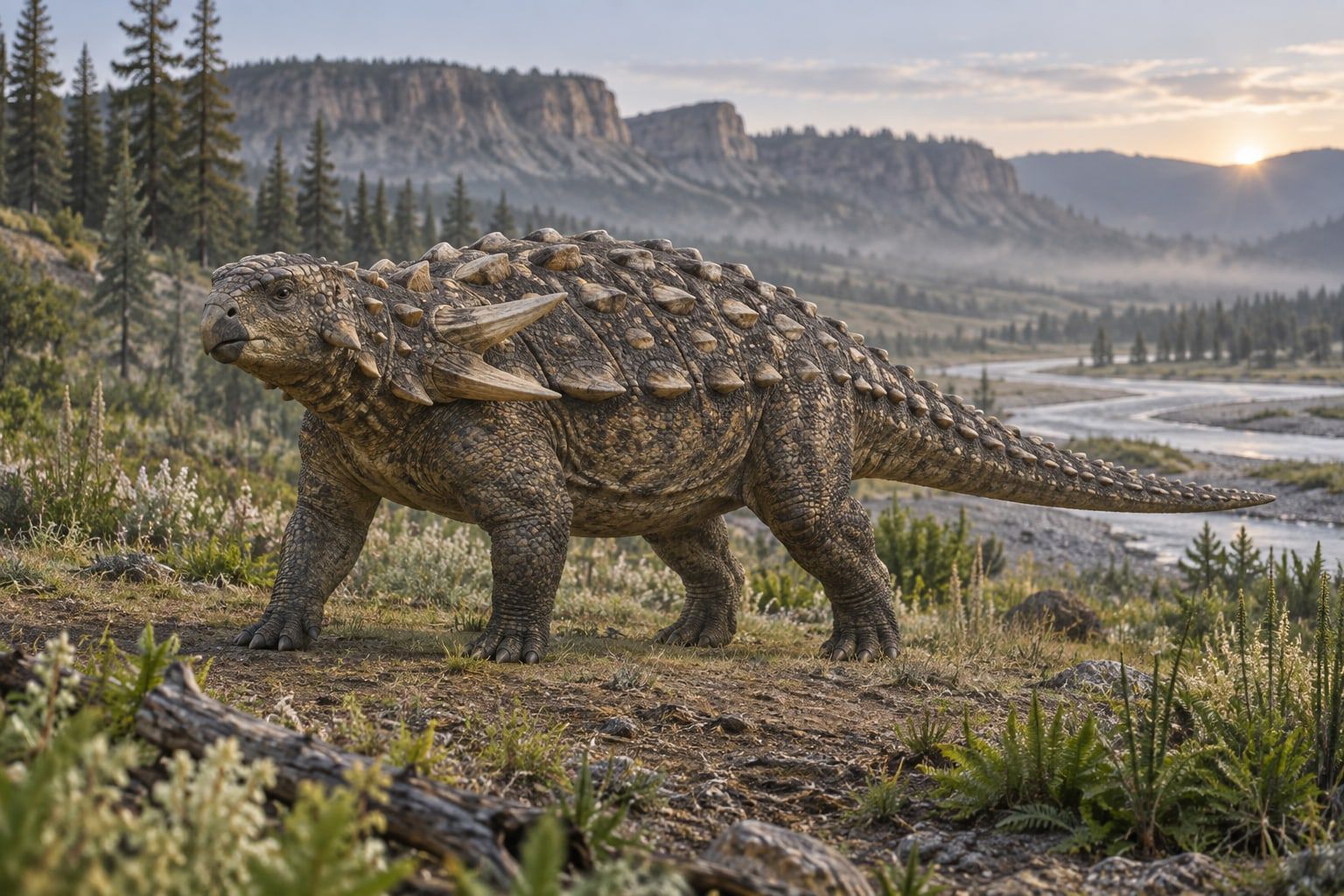
Edmontonia
ed-mon-TOH-nee-uh
DV-0136
- Lived
- 84 to 66 million years ago, Late Cretaceous
- Diet
- Herbivore
- Length
- estimates range from 4 to 6.6 m (13 to 22 ft)
- Group
- Ankylosaurs, Nodosauridae
- Found in
- United States and Canada
- Named by
- Sternberg 1928
Field notes
About Edmontonia
What it was like
Edmontonia was a heavily armored, low-slung plant eater covered in bony plates from its neck to its tail. Large spikes jutted forward from its shoulders, some of the biggest seen on any armored dinosaur, likely used for defense against attacking predators.
Unlike its ankylosaurid cousins, Edmontonia had no club on the end of its tail. Its main protection came from its armor and its spikes, along with a body built low and wide, which would have made it hard for a predator to flip over or bite through.
Its world
Edmontonia lived from about 84 to 66 million years ago, through the final stretch of the Late Cretaceous, across what are now the United States and Canada. Its bones have been found from Alberta down to Colorado and South Dakota, in rock layers including the Judith River, Hell Creek, and Dinosaur Park formations, among others.
It shared its world with Tyrannosaurus and Triceratops, along with smaller hunters such as Troodon and Dromaeosaurus, and its close relative Panoplosaurus. About 12 fossil finds of Edmontonia are known, giving paleontologists a fairly good picture of the animal across its range.
How it was found
Sternberg named Edmontonia in 1928. It belongs to the family Nodosauridae, alongside relatives such as Borealopelta, Gastonia, and Nodosaurus, all sharing bony armor and spikes but lacking the tail club seen in ankylosaurids. Fossils assigned to Edmontonia span a wide area of western North America, reflecting finds from Alaska down through Montana and South Dakota.
The evidence
Where its fossils were found
Today
75 million years ago
Lived alongside
Found in the same rock formations.
Close relatives
Other members of Nodosauridae.
Sources: Paleobiology Database, WikidataNamed in: C. M. Sternberg. 1928. A new armored dinosaur from the Edmonton Formation of Alberta. Transactions of the Royal Society of Canada, series 3 22:93-106