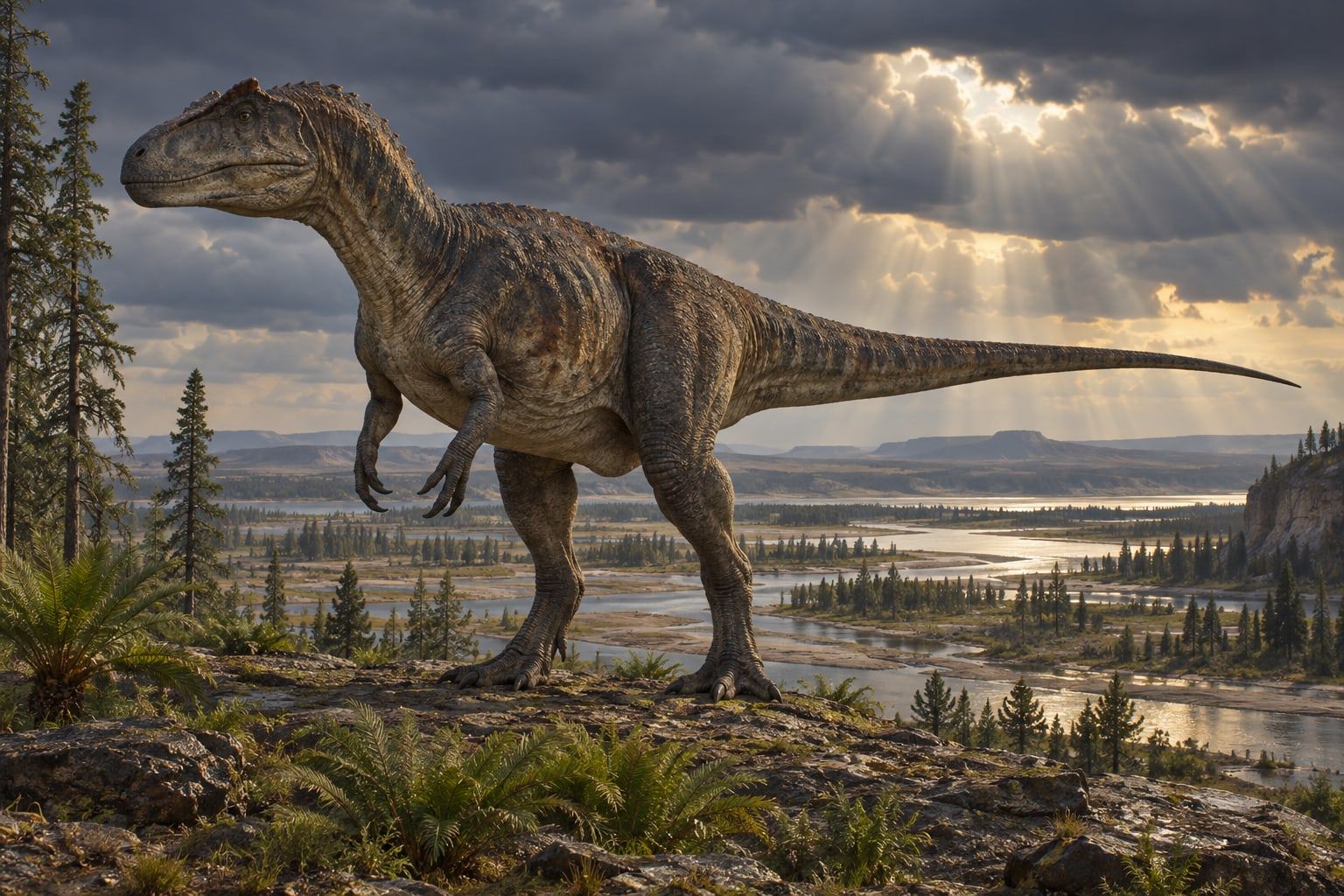
Saurophaganax
SORE-oh-FAG-an-ax
"lizard-eating lord"
DV-0385 · type species Saurophaganax maximus
- Lived
- 152 to 143 million years ago, Late Jurassic to Early Cretaceous
- Diet
- Carnivore
- Length
- about 12 m (39 ft)
- Group
- Theropods, Allosauridae
- Found in
- United States
- Named by
- Chure 1995
Field notes
About Saurophaganax
What it was like
Saurophaganax was a large predator, estimated at around 12 meters (39 feet) long, making it one of the biggest theropods known from the Morrison Formation. It was built much like Allosaurus, with a deep skull, blade-like teeth, and powerful legs.
In fact, scientists disagree over whether Saurophaganax deserves its own genus at all. Some think the bones assigned to it are simply an unusually large species of Allosaurus, and others have suggested the material may even be a mix of more than one animal.
Its world
Saurophaganax lived from about 152 to 143 million years ago, spanning the Late Jurassic and Early Cretaceous, in what is now Oklahoma. Its fossils come from the Morrison Formation.
It shared this floodplain habitat with Allosaurus, the plated Stegosaurus, the long-necked sauropods Brachiosaurus, Brontosaurus, Diplodocus, Apatosaurus, and Camarasaurus, and the smaller predator Ceratosaurus.
How it was found
Chure named Saurophaganax maximus in 1995. Only two fossil finds are attributed to the genus, and because they overlap so much with Allosaurus in age and anatomy, it remains one of the more debated dinosaur names from the Morrison Formation.
The evidence
Where its fossils were found
Today
150 million years ago
To scale
How big was Saurophaganax?
Lived alongside
Found in the same rock formations.
Sources: Paleobiology Database, WikidataNamed in: D. J. Chure. 1995. A reassessment of the gigantic theropod Saurophagus maximus from the Morrison Formation (Upper Jurassic) of Oklahoma, USA. A. Sun and Y. Wang (eds.), Sixth Symposium on Mesozoic Terrestrial Ecosystems and Biota, Short Papers, China Ocean Press, Beijing