Thescelosaurus
thess-EL-oh-SORE-us
"wonderful lizard"
DV-0089
- Lived
- 72 to 66 million years ago, Late Cretaceous
- Diet
- Herbivore
- Length
- about 3.5 m (11 ft)
- Group
- Early ornithischians, Thescelosauridae
- Found in
- United States and Canada
- Named by
- Gilmore 1913
Field notes
About Thescelosaurus
What it was like
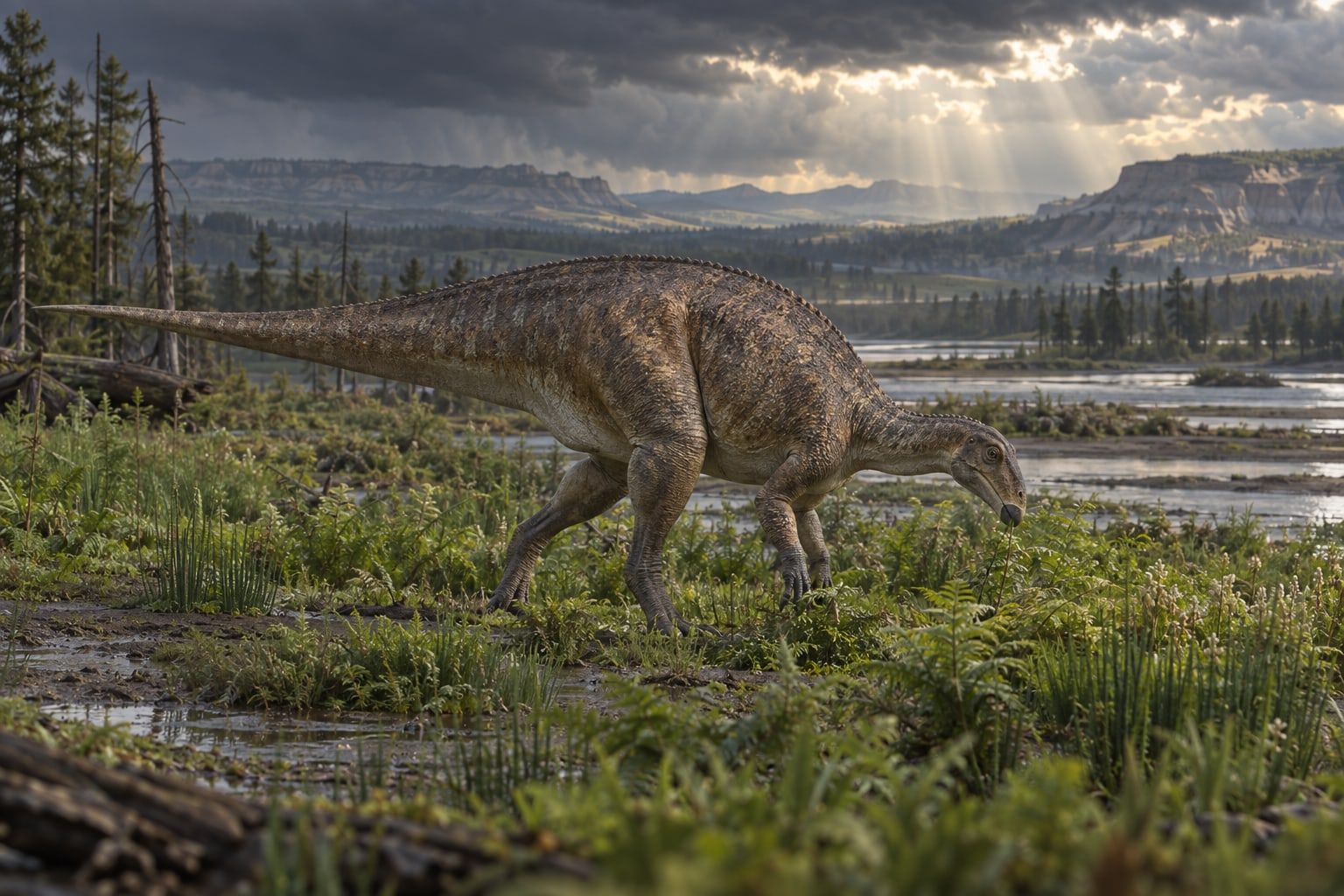
Thescelosaurus was a sturdy, plant-eating dinosaur that walked on two legs, balanced by a long, stiffened tail. It grew to roughly 3.5 meters (11.5 feet) long, with a small head, a toothless beak, and cheek teeth suited to grinding tough plants. Its legs were strong but built more for steady walking than for speed. Some paleontologists think it may have sheltered in burrows, as its close relative Oryctodromeus is known to have done.
Its world
Thescelosaurus lived across what are now the western United States and Canada during the Late Cretaceous, right up until the end of the Mesozoic about 66 million years ago. Its bones come from formations including Hell Creek, Lance, and Frenchman, found across Montana, North Dakota, South Dakota, Wyoming, Alberta, and Saskatchewan.
It shared this world with Triceratops, Tyrannosaurus, and the armored Ankylosaurus, among other dinosaurs of the time.
How it was found
Gilmore named Thescelosaurus in 1913, with forty-two fossil finds known since. It gives its name to Thescelosauridae, a family that also includes Parksosaurus and the burrowing Oryctodromeus. Living right until the mass extinction that ended the Mesozoic, Thescelosaurus was among the last non-avian dinosaurs on Earth.
The evidence
Where its fossils were found
Today
70 million years ago
To scale
How big was Thescelosaurus?
Lived alongside
Found in the same rock formations.
Close relatives
Other members of Thescelosauridae.
Sources: Paleobiology Database, WikidataNamed in: C. W. Gilmore. 1913. A new dinosaur from the Lance Formation of Wyoming. Smithsonian Miscellaneous Publications 61(5):1-5