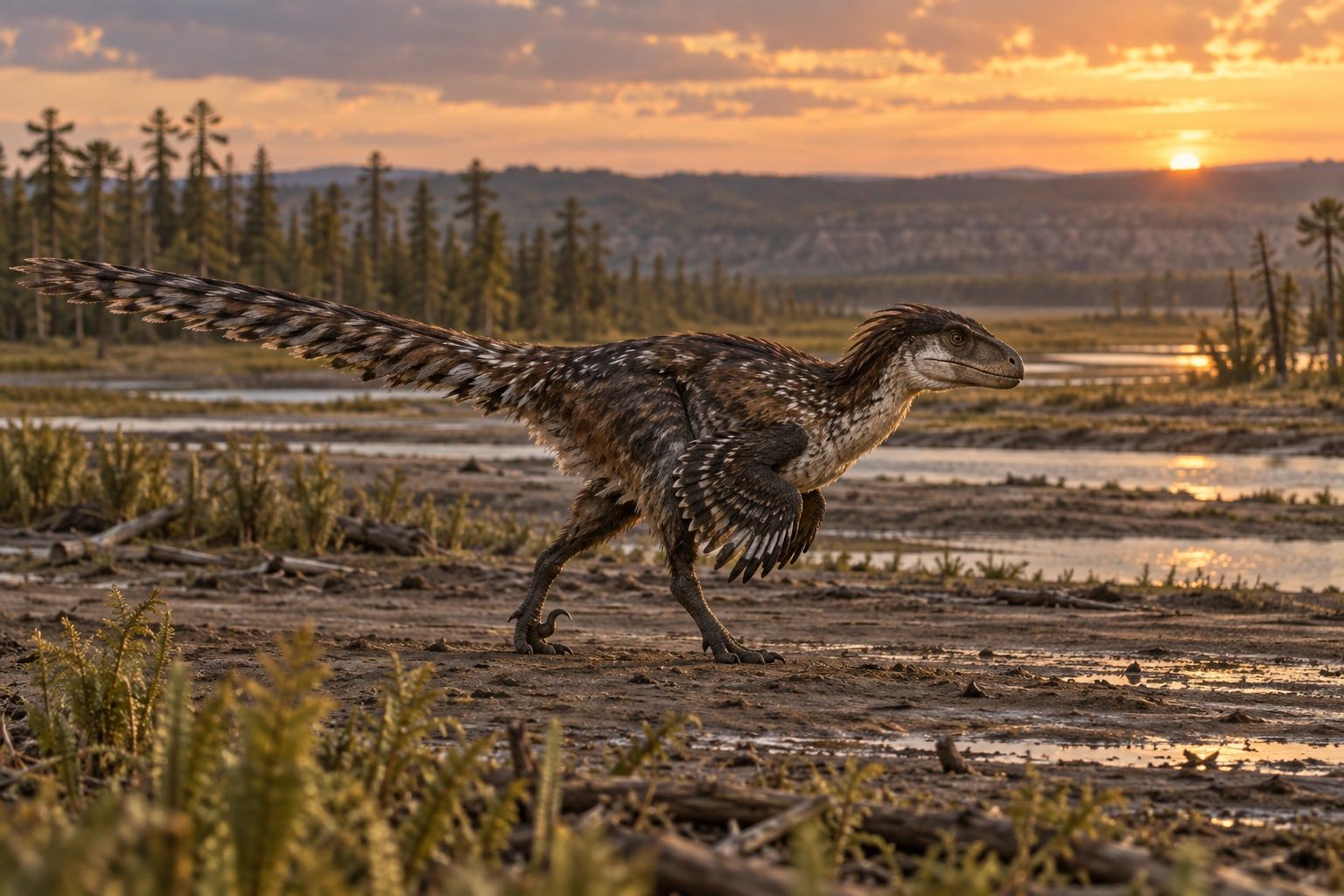
Dromaeosaurus
DROM-ee-oh-SORE-us
"running lizard"
DV-0110
- Lived
- 84 to 66 million years ago, Late Cretaceous
- Diet
- Carnivore
- Length
- about 2 m (7 ft)
- Group
- Theropods, Dromaeosauridae
- Found in
- Canada and United States
- Named by
- Matthew and Brown 1922
Field notes
About Dromaeosaurus
What it was like
Dromaeosaurus was a heavily built, ground-dwelling predator, sturdier than many of its raptor relatives despite its modest size. It grew to about 2 meters (7 feet) long, and its skull was deep and powerful, with strong jaw muscles for gripping and crushing prey.
Like other dromaeosaurids, it carried an enlarged, curved claw on each second toe, likely used to grip and slash at prey, and its stiffened tail probably helped with balance while running and turning.
Its world
Dromaeosaurus lived from about 84 to 66 million years ago, in the Late Cretaceous, in what is now Alberta, in Canada, and Montana and Wyoming, in the United States.
It shared its world with the small, sharp-clawed Troodon and Saurornitholestes, the horned Triceratops, the predator Tyrannosaurus, and the dome-headed Pachycephalosaurus.
How it was found
Matthew and Brown named Dromaeosaurus in 1922. With around 41 fossil finds known, it is one of the better-represented small theropods of its time, though much of that material is teeth and partial bones rather than complete skeletons. Dromaeosaurus gives its name to the whole dromaeosaurid family, and its closest relatives include Dakotaraptor, Velociraptor, and Deinonychus.
The evidence
Where its fossils were found
Today
75 million years ago
To scale
How big was Dromaeosaurus?
Lived alongside
Found in the same rock formations.
Close relatives
Other members of Dromaeosauridae.
Sources: Paleobiology Database, WikidataNamed in: W. D. Matthew and B. Brown. 1922. The family Deinodontidae, with notice of a new genus from the Cretaceous of Alberta. Bulletin of the American Museum of Natural History 46(6):367-385