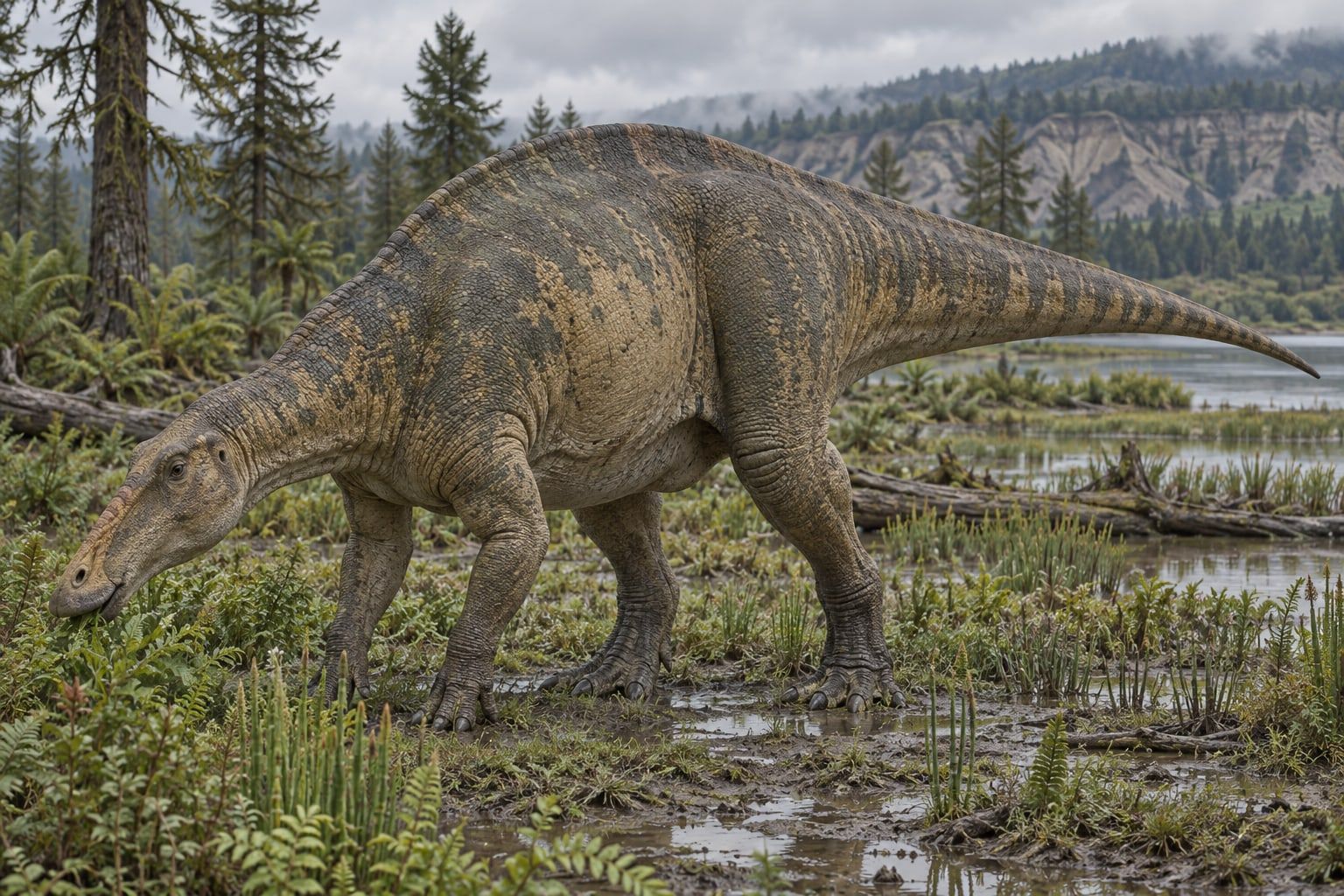
Edmontosaurus
ed-MON-toe-SORE-us
"lizard from Edmonton"
DV-0102
- Lived
- 84 to 66 million years ago, Late Cretaceous
- Diet
- Herbivore
- Length
- about 12 m (39 ft)
- Group
- Ornithopods, Hadrosauridae
- Found in
- United States and Canada
- Named by
- Lambe 1917
Field notes
About Edmontosaurus
What it was like
Edmontosaurus was a large plant eater with a wide, flattened beak used for cropping plants, and rows of tightly packed teeth further back in its jaws for grinding tough food. It grew to about 12 meters (39 feet) long, making it one of the largest duck-billed dinosaurs known.
Unlike some of its relatives, it had no tall bony crest on its head, just a smaller, fleshy comb. It probably walked on four legs while feeding but could run on two, and well-preserved skin impressions show it was covered in small, bumpy scales.
Its world
Edmontosaurus lived from about 84 to 66 million years ago, during the Late Cretaceous, across a wide part of what is now the United States and Canada, including Montana, Alberta, Wyoming, South Dakota, Alaska, and Colorado.
It lived alongside Triceratops, Pachyrhinosaurus, and Tyrannosaurus, among the last dinosaurs to exist before the Cretaceous came to an end. Bones found together in large groups suggest Edmontosaurus lived and may have moved in herds.
How it was found
Lambe named Edmontosaurus in 1917, from fossils found in Alberta. It is now one of the best known dinosaurs, with 68 finds recorded, and its close relatives include Saurolophus, Maiasaura, and Parasaurolophus, other duck-billed dinosaurs from around the same time.
The evidence
Where its fossils were found
Today
75 million years ago
To scale
How big was Edmontosaurus?
Lived alongside
Found in the same rock formations.
Close relatives
Other members of Hadrosauridae.
Sources: Paleobiology Database, WikidataNamed in: L. M. Lambe. 1917. A new genus and species of crestless hadrosaur from the Edmonton Formation of Alberta. The Ottawa Naturalist 31(7):65-73