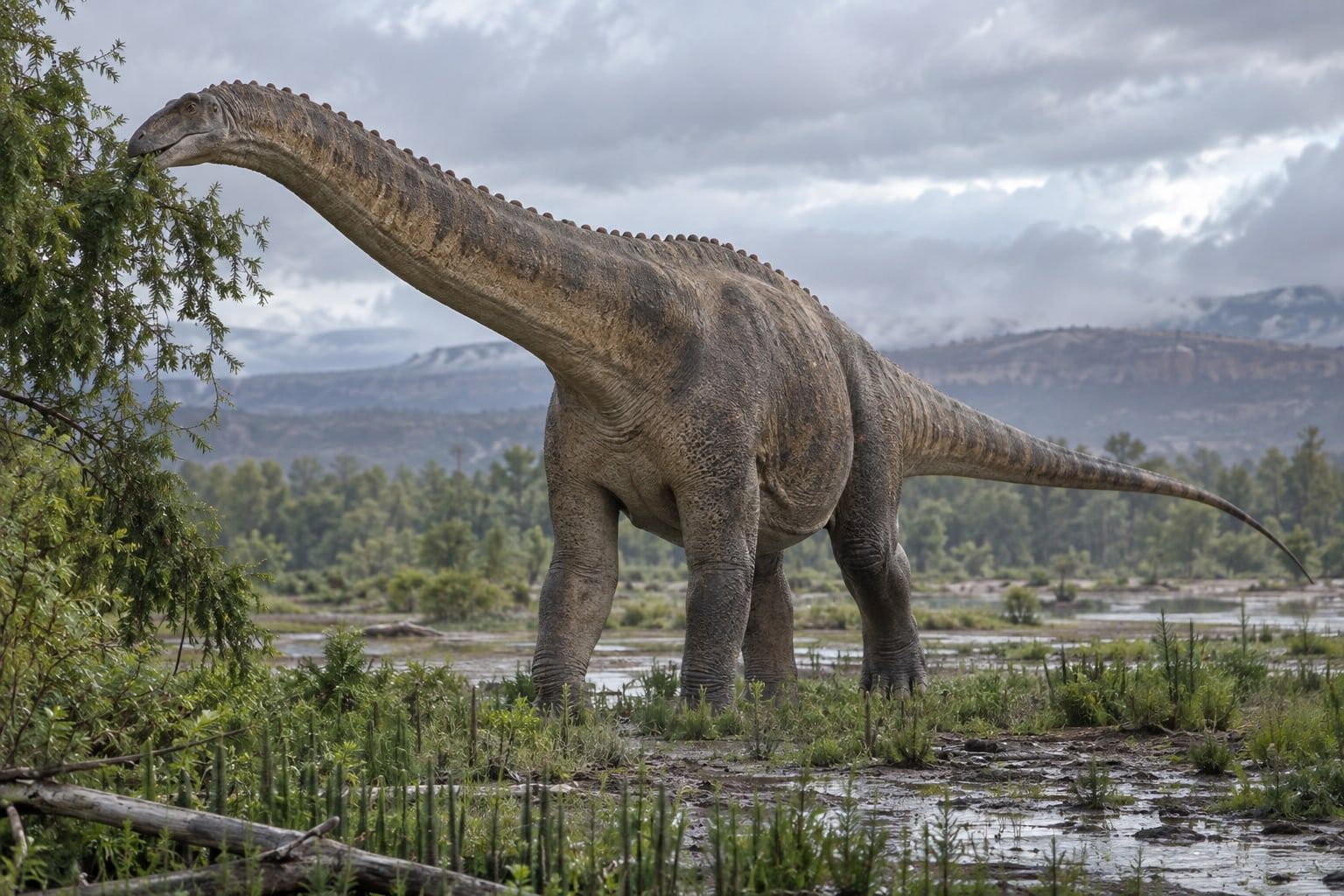
Alamosaurus
AL-uh-moh-SORE-us
DV-0109
- Lived
- 84 to 66 million years ago, Late Cretaceous
- Diet
- Herbivore
- Group
- Sauropods, Saltasauridae
- Found in
- United States
- Named by
- Gilmore 1922
Field notes
About Alamosaurus
What it was like
Alamosaurus was an enormous, long-necked plant eater, among the largest dinosaurs known from North America. Its body was carried on thick, pillar-like legs, with a long tail balancing its long neck. Bony plates called osteoderms were embedded in its skin, a feature shared with its close relatives.
Alamosaurus belonged to a group of armored sauropods called titanosaurs, related to Saltasaurus and Opisthocoelicaudia. Exact size estimates vary between studies, but it was almost certainly one of the heaviest animals ever to walk in North America.
Its world
Alamosaurus lived in what is now New Mexico, Texas, and Utah, from about 84 to 66 million years ago, at the very end of the Late Cretaceous. Its bones come from formations including Ojo Alamo, Javelina, Kirtland, North Horn, Black Peaks, and McRae.
It shared its floodplain habitat with the horned Triceratops and Pentaceratops, the duck-billed Kritosaurus and Parasaurolophus, the armored Glyptodontopelta, and the predator Tyrannosaurus.
How it was found
Gilmore named Alamosaurus in 1922, taking the name from the Ojo Alamo Formation where the first fossils were found. About 32 finds of the genus are now known, though sauropods had been mostly absent from North America for tens of millions of years before Alamosaurus reappeared near the end of the Cretaceous.
The evidence
Where its fossils were found
Today
75 million years ago
Lived alongside
Found in the same rock formations.
Close relatives
Other members of Saltasauridae.
Sources: Paleobiology Database, WikidataNamed in: C. W. Gilmore. 1922. A new sauropod dinosaur from the Ojo Alamo Formation of New Mexico. Smithsonian Miscellaneous Collections 72(34):1-9