Parasaurolophus
pair-uh-sor-OL-oh-fus
"near crested lizard"
DV-0111
- Lived
- 84 to 72 million years ago, Late Cretaceous
- Diet
- Herbivore
- Length
- about 9.5 m (31 ft)
- Weight
- about 2.5 metric tons (2.8 short tons)
- Group
- Ornithopods, Hadrosauridae
- Found in
- United States and Canada
- Named by
- Parks 1922
Field notes
About Parasaurolophus
What it was like
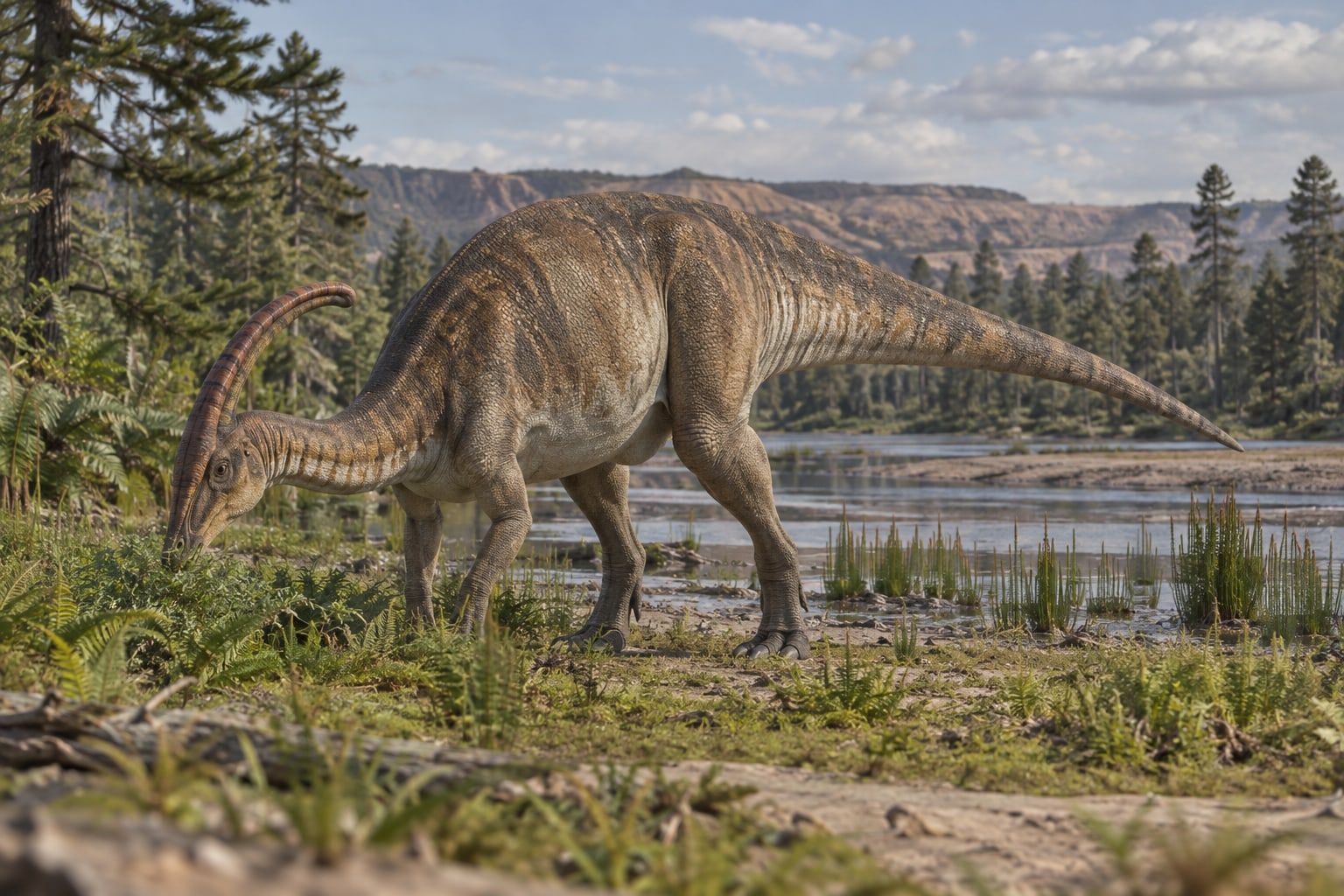
Parasaurolophus is known for the long, curved, tube-shaped crest that swept back from its skull, one of the most unusual head ornaments of any dinosaur. At about 9.5 meters long and 2500 kilograms in weight, it walked on two legs or four, browsing on plants with a wide, toothless beak backed by rows of grinding teeth.
The crest was hollow, with airways running through it from the nose to the tip and back again. Scientists think Parasaurolophus may have used it to make loud, low calls, and possibly to help members of a herd recognize each other by sight as well as sound.
Its world
Parasaurolophus lived in the Late Cretaceous, from about 84 to 72 million years ago, in what is now New Mexico, Utah, and Alberta. Its fossils come from formations such as Kirtland and Kaiparowits, rock layers laid down by ancient rivers and floodplains.
It lived alongside Tyrannosaurus and the smaller hunter Daspletosaurus, as well as the horned Pentaceratops and the dome-headed Stegoceras. Despite this crowd of predators, Parasaurolophus had few close relatives nearby, and remains a fairly rare find compared with other duck-billed dinosaurs.
How it was found
Parasaurolophus was named in 1922 by Parks, based on a skull and partial skeleton found in Alberta. Paleontologists have since recorded 15 finds across two countries, yet it is still known from fewer good skeletons than many of its relatives, such as Edmontosaurus and Corythosaurus.
The evidence
Where its fossils were found
Today
80 million years ago
To scale
How big was Parasaurolophus?
 Play and learnColor it in: a printable Parasaurolophus coloring pageFree to print or download.
Lived alongside
Found in the same rock formations.
Close relatives
Other members of Hadrosauridae.
Sources: Paleobiology Database, WikidataNamed in: W. A. Parks. 1922. Parasaurolophus walkeri, a new genus and species of crested trachodont dinosaur. University of Toronto Studies, Geology Series 13:1-32