Torosaurus
TOR-oh-SORE-us
"perforated lizard"
DV-0060 · type species Torosaurus latus
- Lived
- 84 to 66 million years ago, Late Cretaceous
- Diet
- Herbivore
- Length
- about 7.5 m (25 ft)
- Group
- Ceratopsians, Ceratopsidae
- Found in
- United States
- Named by
- Marsh 1891
Field notes
About Torosaurus
What it was like
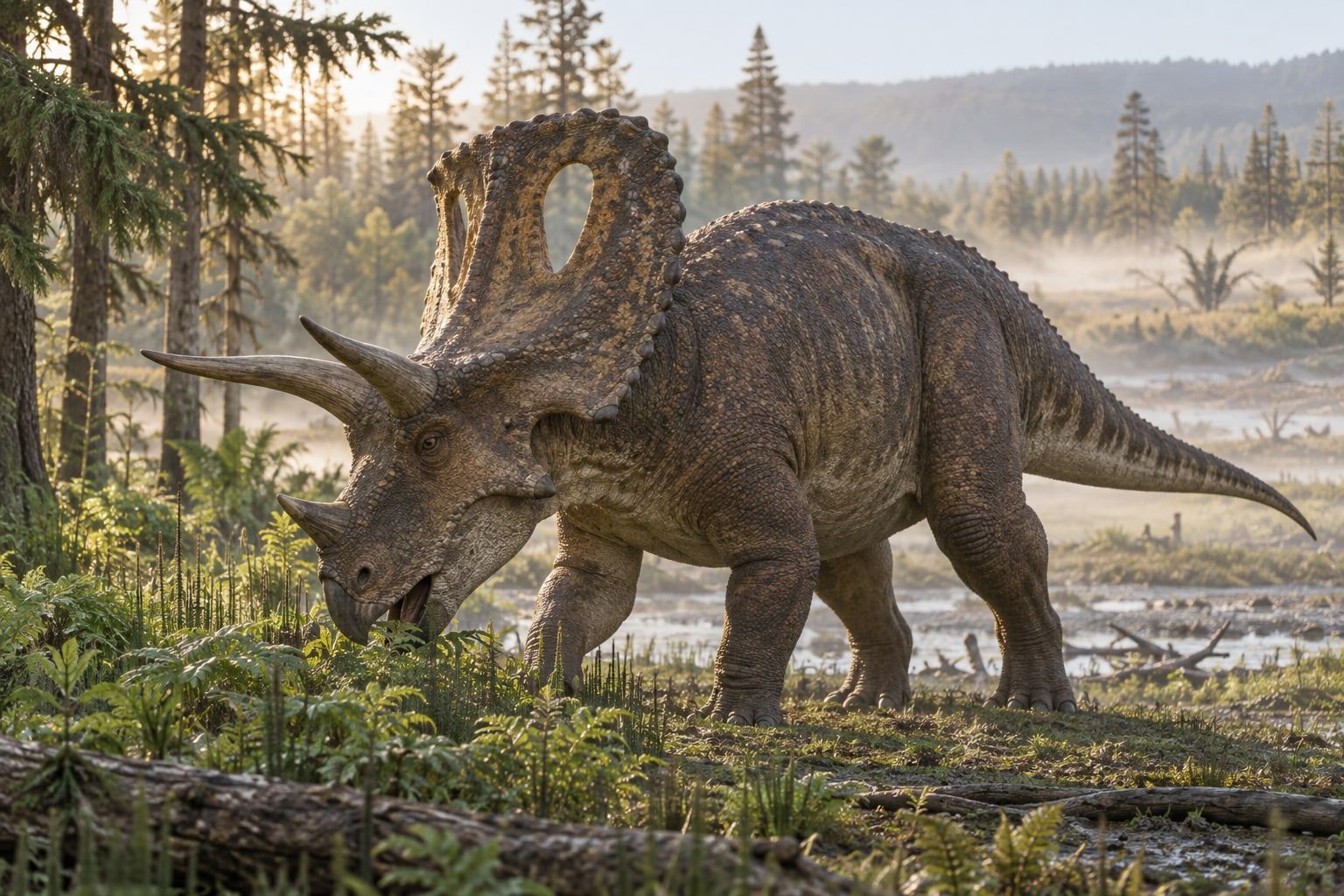
Torosaurus was a large, plant-eating ceratopsian with a huge, bony frill extending back from its skull, pierced by two large openings, and a short horn above its nose. It grew to about 7.5 meters (25 feet) long and likely used its beaked mouth to crop tough, fibrous plants.
Its frill was thin and lightweight, supported mostly along its outer edge, and carried at least five pairs of small hornlets along the back margin. Scientists still debate whether Torosaurus was truly a separate genus or simply a fully grown Triceratops, since the two look similar apart from the frill.
Its world
Torosaurus lived from about 84 to 66 million years ago, in the Late Cretaceous, across what is now the western United States, including South Dakota, Wyoming, New Mexico, and North Dakota.
It lived alongside Tyrannosaurus, Triceratops, the armored Ankylosaurus, and the dome-headed Pachycephalosaurus, in an ecosystem thick with large, plant-eating ceratopsians.
How it was found
Marsh named Torosaurus in 1891. Around six fossil finds are known, and the question of whether Torosaurus represents a mature Triceratops rather than its own genus remains unresolved among paleontologists. Its close relatives include Triceratops, Styracosaurus, and Pentaceratops, all members of the horned dinosaur family Ceratopsidae.
The evidence
Where its fossils were found
Today
75 million years ago
To scale
How big was Torosaurus?
Lived alongside
Found in the same rock formations.
Close relatives
Other members of Ceratopsidae.
Sources: Paleobiology Database, WikidataNamed in: O. C. Marsh. 1891. Notice of new vertebrate fossils. The American Journal of Science, series 3 42:265-269