Aquilops
AK-wih-lops
"eagle face"
DV-0879
- Lived
- 110 to 101 million years ago, Early Cretaceous
- Diet
- Herbivore
- Length
- about 0.6 m (2 ft)
- Group
- Ceratopsians
- Found in
- United States
- Named by
- Farke et al. 2014
Field notes
About Aquilops
What it was like
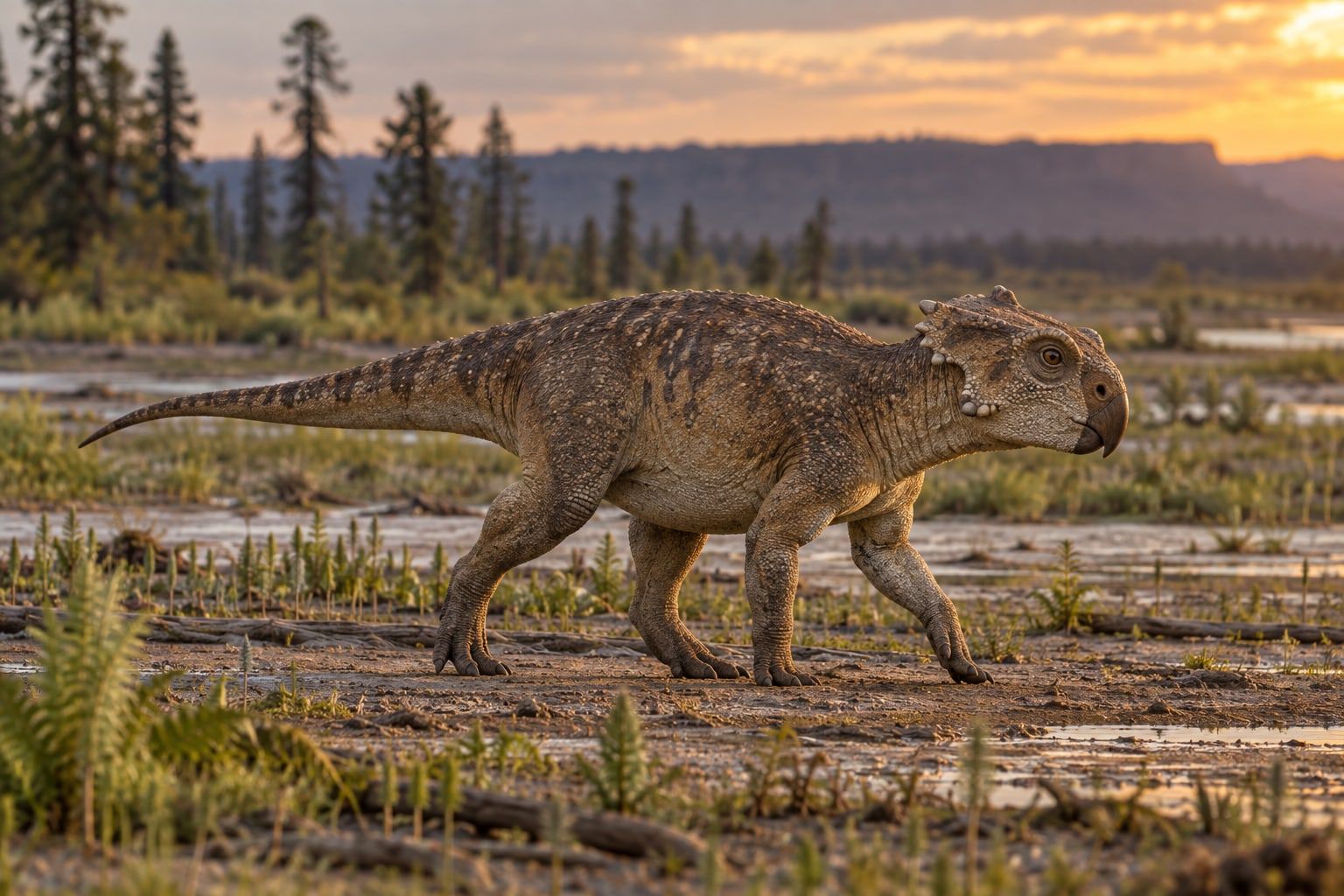
Aquilops was a small plant eater with a sharply hooked, eagle-like beak at the front of its jaws. It measured roughly 0.6 meters (2 feet) long, small enough to fit in a person's arms, and probably walked on two legs.
Its skull was triangular when viewed from above, with a steep slope in front of the eyes. Unlike later ceratopsians, it had no horns or large frill, only a small beak built for nipping at low plants.
Its world
Aquilops lived about 110 to 101 million years ago, in the Early Cretaceous, in what is now Montana, in the United States. Its only known fossil comes from the Cloverly Formation.
It lived alongside much larger animals, including the sail-backed Acrocanthosaurus, the long-necked Sauroposeidon, the armored Sauropelta, the plant eater Tenontosaurus, and the small, sharp-clawed Deinonychus.
How it was found
Farke and colleagues named Aquilops in 2014, based on a single skull. That skull is still the only confirmed fossil find of the genus, so much about its body remains unknown. Aquilops is considered one of the earliest ceratopsians known from North America, and its closest relatives, such as Auroraceratops and Liaoceratops, come from Asia, suggesting early ceratopsians moved between the two continents.
The evidence
Where its fossils were found
Today
105 million years ago
To scale
How big was Aquilops?
Lived alongside
Found in the same rock formations.
Close relatives
Other members of Neoceratopsia.
Sources: Paleobiology Database, WikidataNamed in: A. A. Farke, W. D. Maxwell, and R. L. Cifelli, M. J. Wedel. 2014. A ceratopsian dinosaur from the Lower Cretaceous of western North America, and the biogeography of Neoceratopsia. PLoS ONE 9(12):e11205:1-18