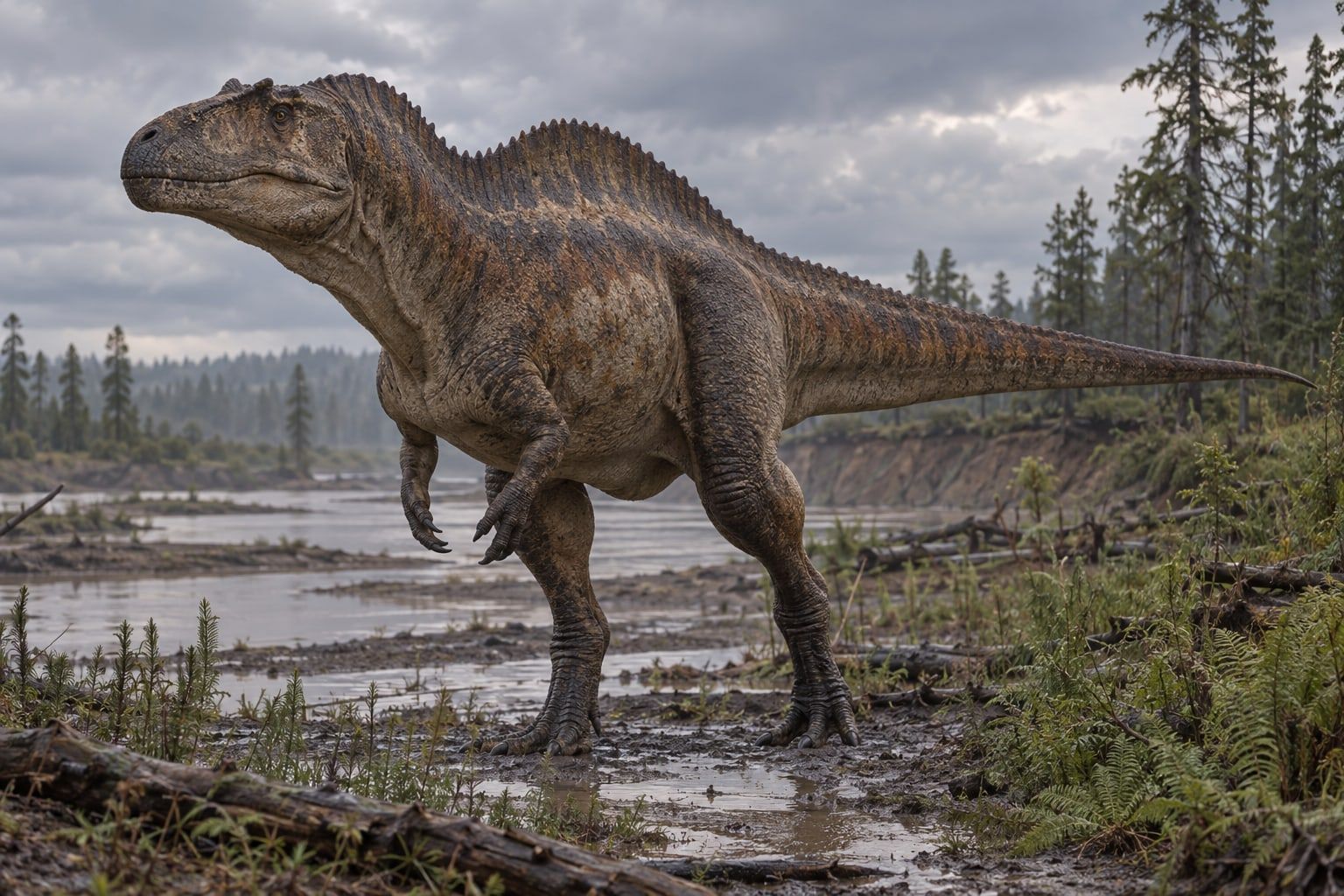
Acrocanthosaurus
AK-ro-KAN-tho-SORE-us
"high-spined lizard"
DV-0172 · type species Acrocanthosaurus atokensis
- Lived
- 121 to 94 million years ago, Early Cretaceous to Late Cretaceous
- Diet
- Carnivore
- Length
- about 12 m (38 ft)
- Group
- Theropods, Carcharodontosauridae
- Found in
- United States
- Named by
- Stovall and Langston 1950
Field notes
About Acrocanthosaurus
What it was like
Acrocanthosaurus was a huge meat-eating dinosaur, growing to about 11.5 meters (38 feet) long, making it one of the largest predators ever found in North America. Tall spines rose from many of its backbones, probably supporting a raised ridge of muscle along its neck, back, and hips.
Its skull was large and its jaws held many curved, serrated teeth. Its arms were smaller than its legs but still strong, and it likely used them to grip struggling prey while its jaws did most of the damage.
Its world
Acrocanthosaurus lived from about 121 to 94 million years ago, spanning the Early and Late Cretaceous, across what is now the United States, including Oklahoma, Texas, Arkansas, Wyoming, Arizona, and Maryland.
It shared its world with large plant eaters such as Sauroposeidon and Tenontosaurus, as well as smaller dinosaurs including Deinonychus and Sauropelta. As the largest predator around, Acrocanthosaurus was probably the top hunter in its habitat.
How it was found
Stovall and Langston named Acrocanthosaurus in 1950, based on fossils found in Oklahoma. Around 9 finds are now known across several states. Its closest relatives include Carcharodontosaurus and Giganotosaurus, other huge, spine-backed predators found on other continents.
The evidence
Where its fossils were found
Today
110 million years ago
To scale
How big was Acrocanthosaurus?
Lived alongside
Found in the same rock formations.
Close relatives
Other members of Carcharodontosauridae.
Sources: Paleobiology Database, WikidataNamed in: J. W. Stovall and W. Langston, Jr. 1950. Acrocanthosaurus atokensis, a new genus and species of Lower Cretaceous Theropoda from Oklahoma. American Midland Naturalist 43(4):686-728