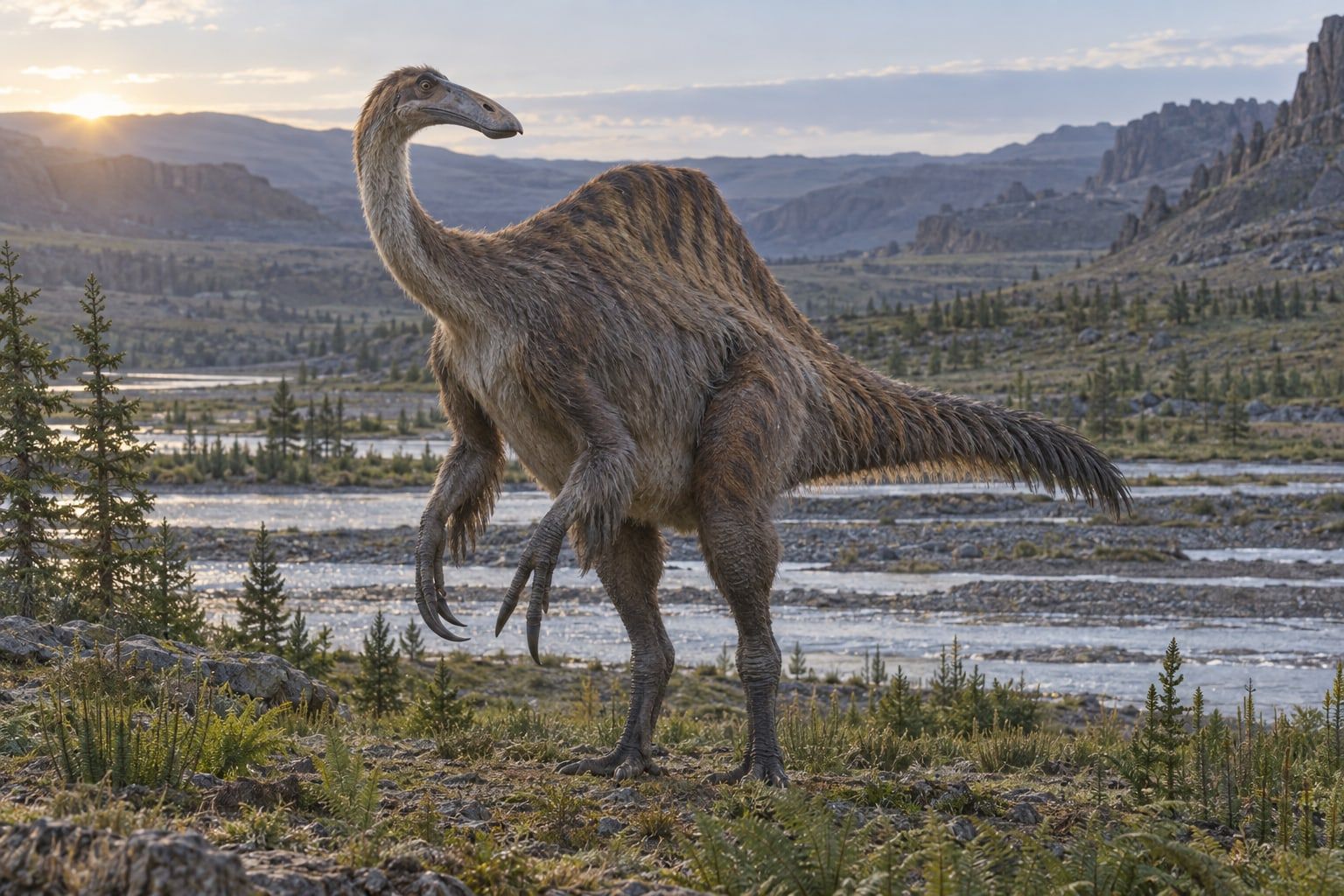
Deinocheirus
DY-no-KY-rus
"terrible hand"
DV-0199
- Lived
- 72 to 66 million years ago, Late Cretaceous
- Diet
- Omnivore
- Length
- about 11 m (36 ft)
- Weight
- about 6.4 metric tons (7.1 short tons)
- Group
- Theropods, Deinocheiridae
- Found in
- Mongolia
- Named by
- Kielan-Jaworowska 1969
Field notes
About Deinocheirus
What it was like
Deinocheirus was a huge, bulky ornithomimosaur with a wide, flattened bill somewhat like that of a duck-billed dinosaur, and tall spines along its back that likely formed a hump or sail. It grew to about 11 meters (36 feet) long and weighed around 6,400 kilograms (about 7 short tons), making it by far the largest animal in its family.
Its arms were unusually long and ended in blunt claws, though its legs were short for its size. Paleontologists think it ate both plants and animals: its bill suggests it fed on soft vegetation, while fish remains found with one skeleton suggest it also caught prey near water.
Its world
Deinocheirus lived about 72 to 66 million years ago, in the Late Cretaceous, in what is now Mongolia. Its fossils come from the Nemegt Formation.
It shared this floodplain habitat with the clawed Therizinosaurus, the predator Tarbosaurus, the small Alioramus, the plant eater Saurolophus, the long-necked Opisthocoelicaudia, and the small-armed Mononykus and Adasaurus.
How it was found
Kielan-Jaworowska named Deinocheirus in 1969, based only on a pair of huge arms and shoulder bones. For decades, no other remains turned up, and its full body shape stayed a mystery. Since then, paleontologists have recovered about four fossil finds, including more complete skeletons that finally showed what the rest of the animal looked like. It is considered a close relative of the smaller Garudimimus.
The evidence
Where its fossils were found
Today
70 million years ago
To scale
How big was Deinocheirus?
Lived alongside
Found in the same rock formations.
Close relatives
Other members of Deinocheiridae.
Sources: Paleobiology Database, WikidataNamed in: Z. Kielan-Jaworowska. 1969. Fossils from the Gobi desert. Science Journal 5(1):32-38