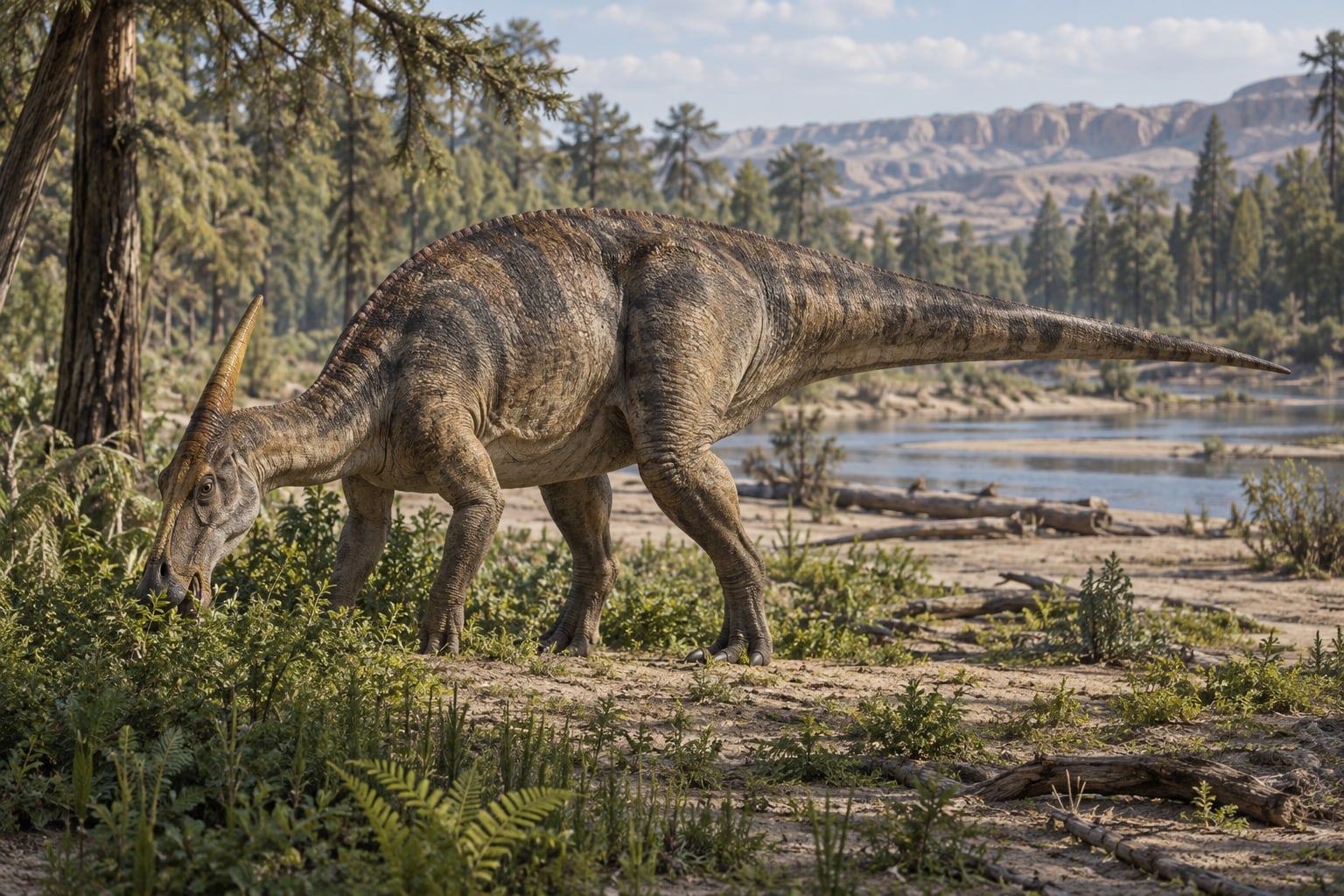
Saurolophus
SORE-oh-LOAF-us
"lizard crest"
DV-0084
- Lived
- 84 to 66 million years ago, Late Cretaceous
- Diet
- Herbivore
- Length
- about 9 m (30 ft)
- Group
- Ornithopods, Hadrosauridae
- Found in
- Mongolia and Canada
- Named by
- Brown 1912
Field notes
About Saurolophus
What it was like
Saurolophus was a large, duck-billed plant eater that grew to about 9 meters (30 feet) long. A single bony spike swept up and back from the top of its skull, likely used for display rather than for fighting.
It could probably walk on either two legs or all four, dropping onto its front feet while feeding low to the ground and rising onto its hind legs to move faster.
Its world
Saurolophus lived from about 84 to 66 million years ago, in the Late Cretaceous, and is unusual among dinosaurs for being known from more than one continent, with fossils from both Mongolia and Canada, and further finds reported from the United States. Its bones come from formations including Nemegt, Horseshoe Canyon, Almond, and Oldman.
In North America it shared its world with the predators Troodon and Albertosaurus, the fast-running Struthiomimus, the armored Euoplocephalus, and relatives such as Corythosaurus and Lambeosaurus.
How it was found
Brown named Saurolophus in 1912, and it has since become one of the better-known hadrosaurs, with around 36 fossil finds recorded. That wide fossil record, spanning two continents, has helped make it a useful reference point for comparing other crested hadrosaurs like Parasaurolophus and Shantungosaurus.
The evidence
Where its fossils were found
Today
75 million years ago
To scale
How big was Saurolophus?
Lived alongside
Found in the same rock formations.
Close relatives
Other members of Hadrosauridae.
Sources: Paleobiology Database, WikidataNamed in: B. Brown. 1912. A crested dinosaur from the Edmonton Cretaceous. Bulletin of the American Museum of Natural History 31(14):131-136