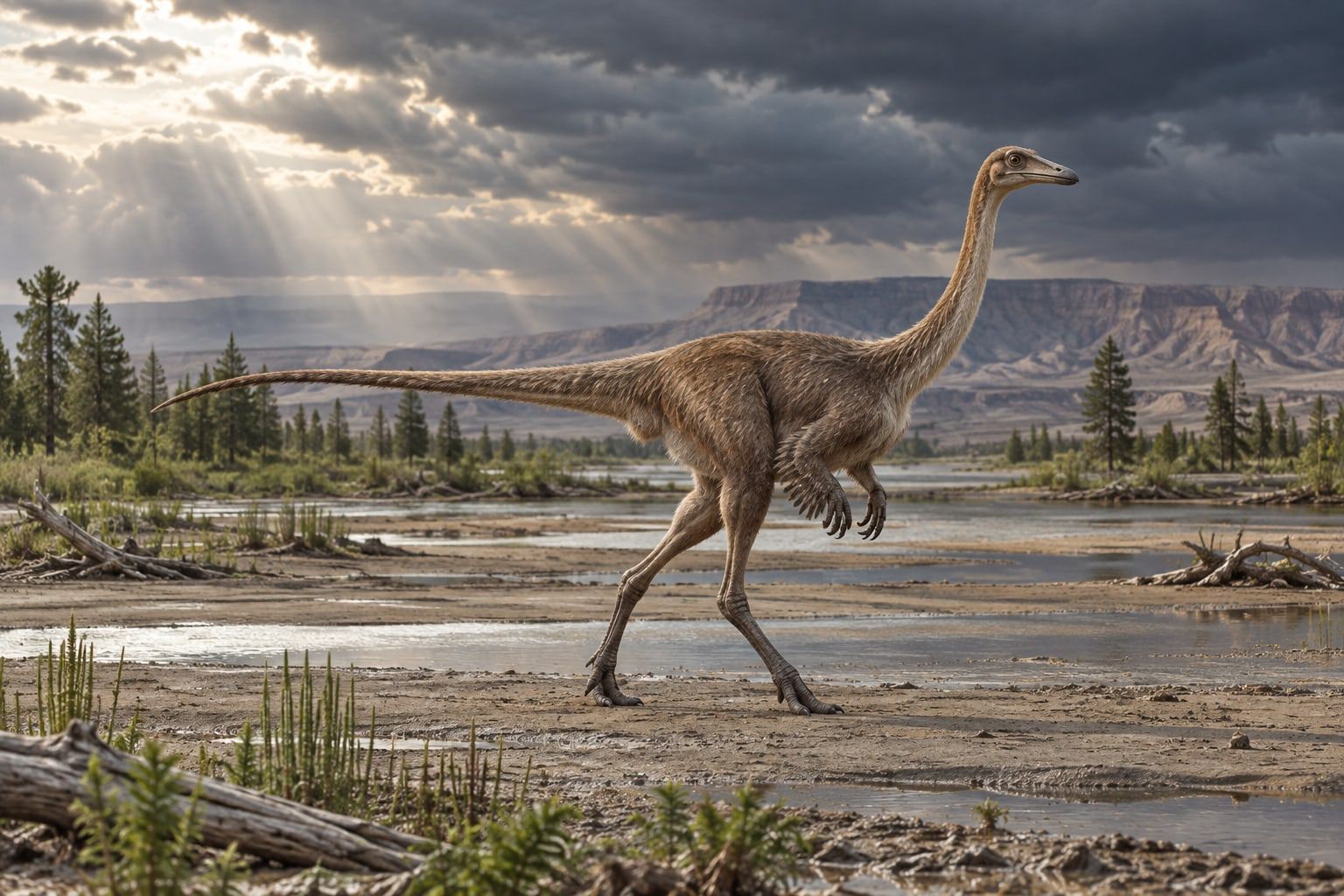
Gallimimus
GAL-ih-MY-mus
"chicken mimic"
DV-0213
- Lived
- 72 to 66 million years ago, Late Cretaceous
- Diet
- Omnivore
- Length
- about 6 m (20 ft)
- Weight
- about 440 kg (970 lb)
- Group
- Theropods, Ornithomimidae
- Found in
- Mongolia
- Named by
- Osmólska et al. 1972
Field notes
About Gallimimus
What it was like
Gallimimus was a slender, long-legged theropod built for speed, with a small toothless head, a long neck, and a beak-like mouth. It grew to about 6 meters (20 feet) long and weighed around 440 kilograms (970 pounds), making it the largest known member of its family.
Its arms were short with three clawed fingers, and its long hind legs suggest it could run fast to escape predators. Gallimimus was probably an omnivore, eating small animals, plants, or both, though scientists still debate exactly what made up its diet.
Its world
Gallimimus lived in what is now Mongolia between about 72 and 66 million years ago, during the Late Cretaceous. Its fossils come from the Nemegt and Baruungoyot formations.
It shared its habitat with the armored Tarchia, the feathered Avimimus, and predators such as Velociraptor and Tarbosaurus. The huge, long-armed Deinocheirus, a distant relative, lived in the same region.
How it was found
Osmólska and colleagues named Gallimimus in 1972, based on fossils collected in Mongolia. About 27 finds of the genus are known today, including skeletons of different ages, which has helped researchers study how it grew.
The evidence
Where its fossils were found
Today
70 million years ago
To scale
How big was Gallimimus?
Lived alongside
Found in the same rock formations.
Close relatives
Other members of Ornithomimidae.
Sources: Paleobiology Database, WikidataNamed in: H. Osmólska, E. Roniewicz, and R. Barsbold. 1972. A new dinosaur, Gallimimus bullatus n. gen., n. sp. (Ornithomimidae) from the Upper Cretaceous of Mongolia. Palaeontologia Polonica 27:103-143