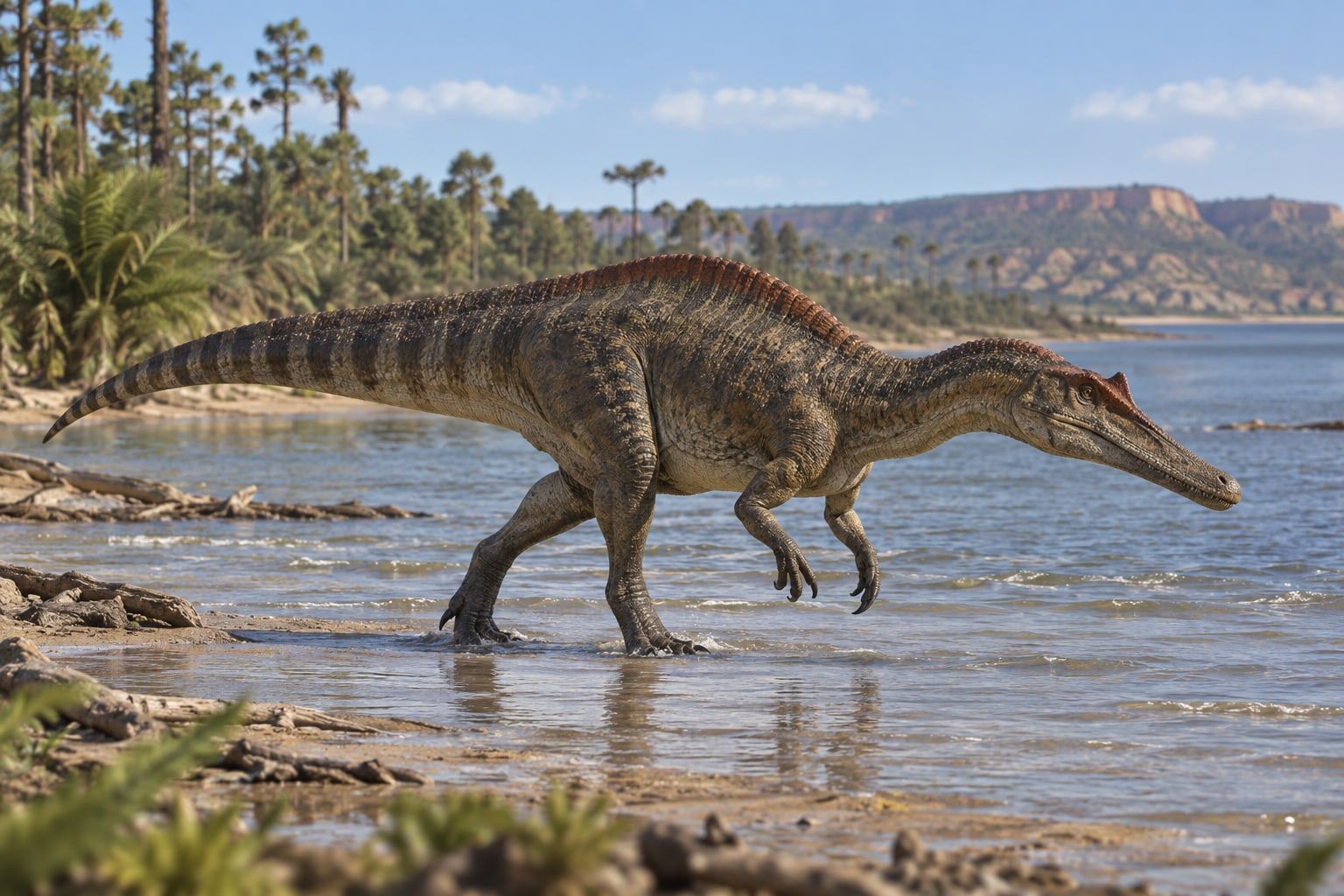
Irritator
IH-rih-TAY-tor
"one who irritates"
DV-0391
- Lived
- 120 to 113 million years ago, Early Cretaceous
- Diet
- Carnivore
- Length
- about 6.5 m (21 ft)
- Group
- Theropods, Spinosauridae
- Found in
- Brazil
- Named by
- Martill et al. 1996
Field notes
About Irritator
What it was like
Irritator had a long, narrow, crocodile-like snout lined with straight, unserrated teeth built for gripping slippery prey. A low, bony crest ran along the top of its head, and it likely carried a sail of skin along its back like other spinosaurids. It grew to roughly 6.5 meters (21 feet) long, making it one of the smaller members of its family.
Its nostrils sat well back from the tip of the snout, an adaptation that may have let it breathe even with its jaws partly submerged. Paleontologists think Irritator hunted fish and other small prey near water, and one fossil shows it had eaten a pterosaur.
Its world
Irritator lived from about 120 to 113 million years ago, in the Early Cretaceous, in what is now Brazil. Its skull comes from the Romualdo Formation.
It shared its coastal habitat with smaller theropods such as Santanaraptor, Mirischia, and Aratasaurus, along with turtles, crocodile relatives, and many species of pterosaurs and fish.
How it was found
Martill and colleagues named Irritator in 1996, from a skull that had been damaged and reshaped before scientists could study it properly, which is how the genus got its name. Only one confirmed fossil find is known. Some paleontologists think the similar spinosaurid Angaturama, named from a snout tip found nearby, may be the same animal as Irritator, though this remains debated.
The evidence
Where its fossils were found
Today
115 million years ago
To scale
How big was Irritator?
Lived alongside
Found in the same rock formations.
Close relatives
Other members of Spinosauridae.
Sources: Paleobiology Database, WikidataNamed in: D. M. Martill, A. R. I. Cruickshank, and E. Frey, P. G. Small, M. Clarke. 1996. A new crested maniraptoran dinosaur from the Santana Formation (Lower Cretaceous) of Brazil. Journal of the Geological Society, London 153:5-8