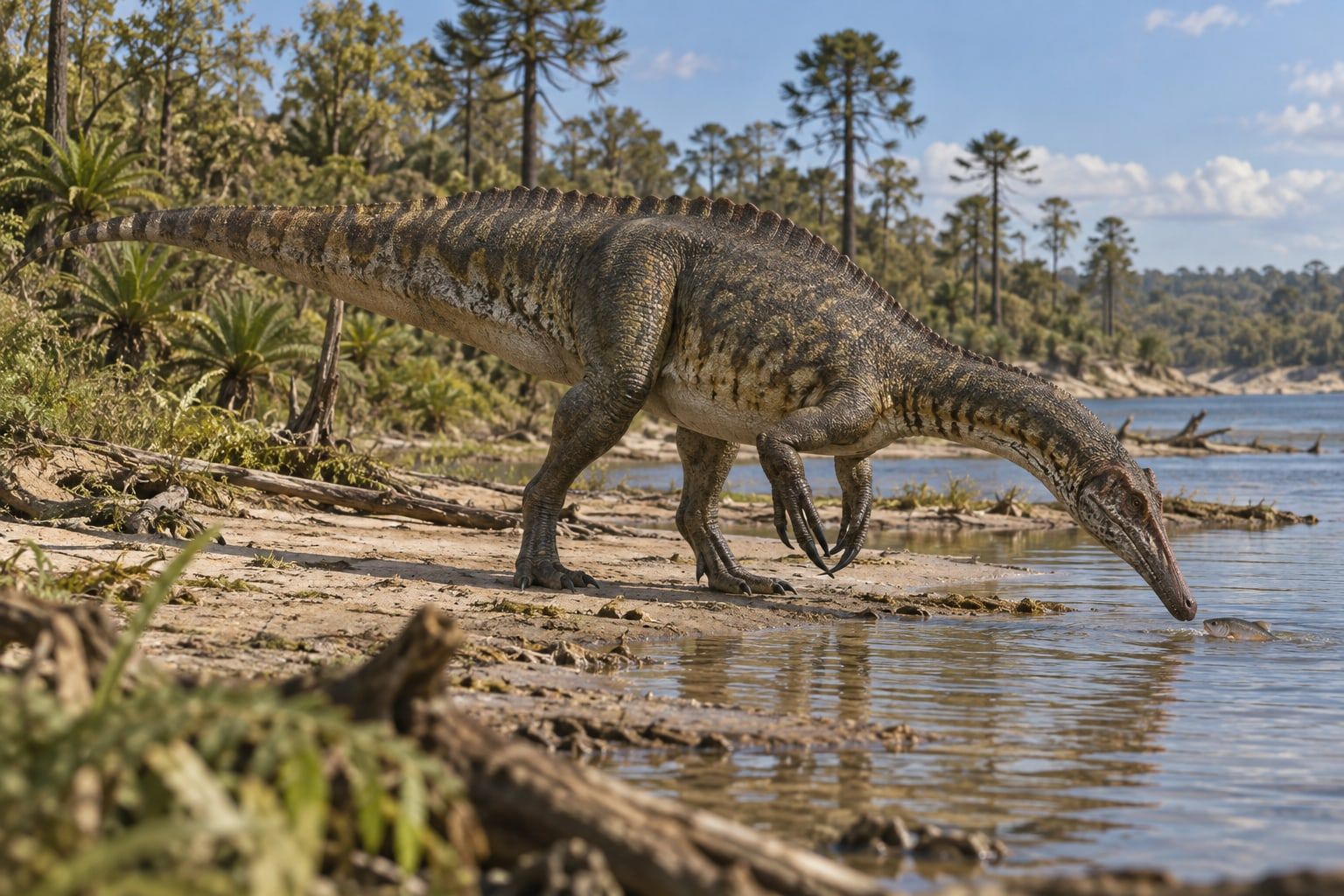
Oxalaia
DV-0792
- Lived
- 101 to 94 million years ago, Late Cretaceous
- Diet
- Carnivore
- Group
- Theropods, Spinosauridae
- Found in
- Brazil
- Named by
- Kellner et al. 2011
Field notes
About Oxalaia
What it was like
Oxalaia was a large, fish-eating theropod with a long, narrow snout lined with straight teeth, built for gripping slippery prey much like a crocodile's jaws. As a spinosaurid, it was likely a strong swimmer or wader that hunted in rivers and along coastlines, and may also have taken other prey such as small dinosaurs when the chance arose. It is known as one of the largest predatory dinosaurs so far found in Brazil.
Its world
Oxalaia lived in what is now Brazil during the Late Cretaceous, between about 101 and 94 million years ago. Its remains, from a single find, come from the Alcântara Formation. It shared its world with the predator Carcharodontosaurus and the sauropod Itapeuasaurus.
How it was found
Kellner and colleagues named Oxalaia in 2011, based on two partial skull bones. It belongs to Spinosauridae, the family of fish-eating theropods that also includes Spinosaurus, Baryonyx, and Suchomimus. Because so little of its skeleton is known, some researchers have suggested Oxalaia may be the same animal as Spinosaurus, though others consider it a distinct genus.
The evidence
Where its fossils were found
Today
95 million years ago
Lived alongside
Found in the same rock formations.
Close relatives
Other members of Spinosauridae.
Sources: Paleobiology Database, WikidataNamed in: A. W. A. Kellner, S. A. K. Azevedo, and E. B. Machado, L. B. de Carvalho, D. D. R. Henriques. 2011. A new dinosaur (Theropoda, Spinosauridae) from the Cretaceous (Cenomanian) Alcântara Formation, Cajual Island, Brazil. Anais da Academia Brasileira de Ciências 83(1):99-108