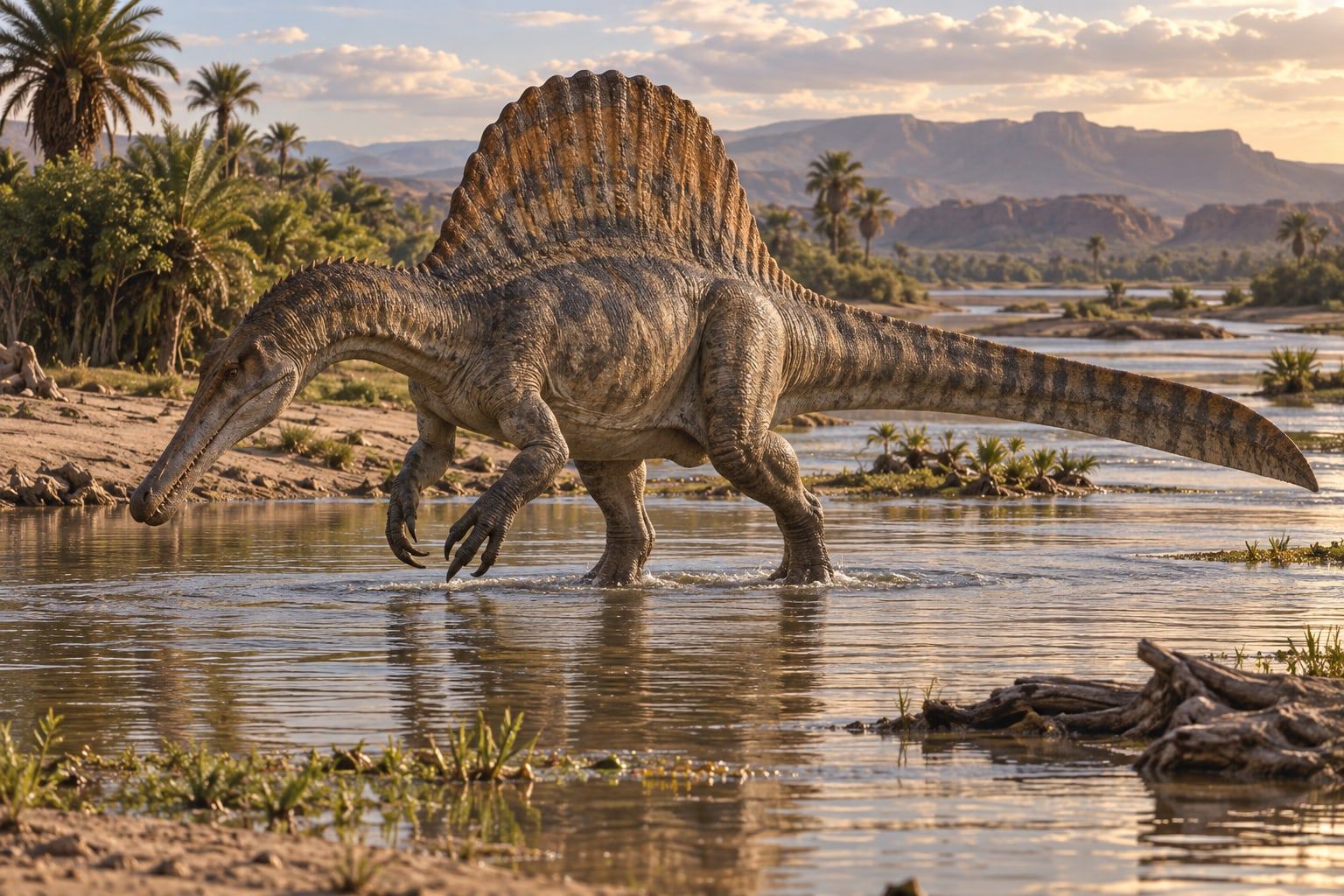
Spinosaurus
SPY-no-SORE-us
"spine lizard"
DV-0099 · type species Spinosaurus aegyptiacus
- Lived
- 106 to 94 million years ago, Early Cretaceous to Late Cretaceous
- Diet
- Carnivore
- Length
- about 14 m (46 ft)
- Group
- Theropods, Spinosauridae
- Found in
- Morocco, Egypt, Niger, Algeria and Tunisia
- Named by
- Stromer 1915
Field notes
About Spinosaurus
What it was like
Spinosaurus had a long, narrow skull much like a crocodile's, lined with straight, cone-shaped teeth for gripping slippery prey. Tall spines rose from its backbone, probably covered in skin to form a sail along its back. It grew to roughly 14 meters (46 feet) long, making it one of the longest meat-eating dinosaurs known.
Its legs were short for its body size, and its feet and tail were built more for moving through water than for running on land. Most researchers think it waded or swam, hunting fish alongside other prey.
Its world
Spinosaurus lived from about 106 to 94 million years ago, spanning the Early and Late Cretaceous, in what is now North Africa. Its bones come from Morocco, Egypt, Niger, Algeria, and Tunisia, including rock layers such as Ifezouane and Baharîje.
It shared its river and coastal habitat with other large predators, including Carcharodontosaurus and Deltadromeus, as well as the plant eater Ouranosaurus.
How it was found
Stromer named Spinosaurus in 1915 from bones found in Egypt. The original fossils were destroyed decades later, but new material found since has let paleontologists study the animal again. Around 30 fossil finds of Spinosaurus are known today, still a modest number for such a large animal, so parts of its anatomy remain debated.
The evidence
Where its fossils were found
Today
100 million years ago
To scale
How big was Spinosaurus?
 Play and learnColor it in: a printable Spinosaurus coloring pageFree to print or download.
Lived alongside
Found in the same rock formations.
Close relatives
Other members of Spinosauridae.
Sources: Paleobiology Database, WikidataNamed in: E. Stromer. 1915. Ergebnisse der Forschungsreisen Prof. E. Stromers in den Wüsten Ägyptens. II. Wirbeltier-Reste der Baharîje-Stufe (unterstes Cenoman). 3. Das Original des Theropoden Spinosaurus aegyptiacus nov. gen., nov. spec. Abhandlungen der Königlich Bayerischen Akademie der Wissenschaften Mathematisch-physikalische Klasse Abhandlung 28(3):1-31