Suchomimus
SOO-koh-MY-mus
"crocodile mimic"
DV-0427
- Lived
- 121 to 101 million years ago, Early Cretaceous
- Diet
- Carnivore
- Length
- about 10 m (33 ft)
- Group
- Theropods, Spinosauridae
- Found in
- Niger
- Named by
- Sereno et al. 1998
Field notes
About Suchomimus
What it was like
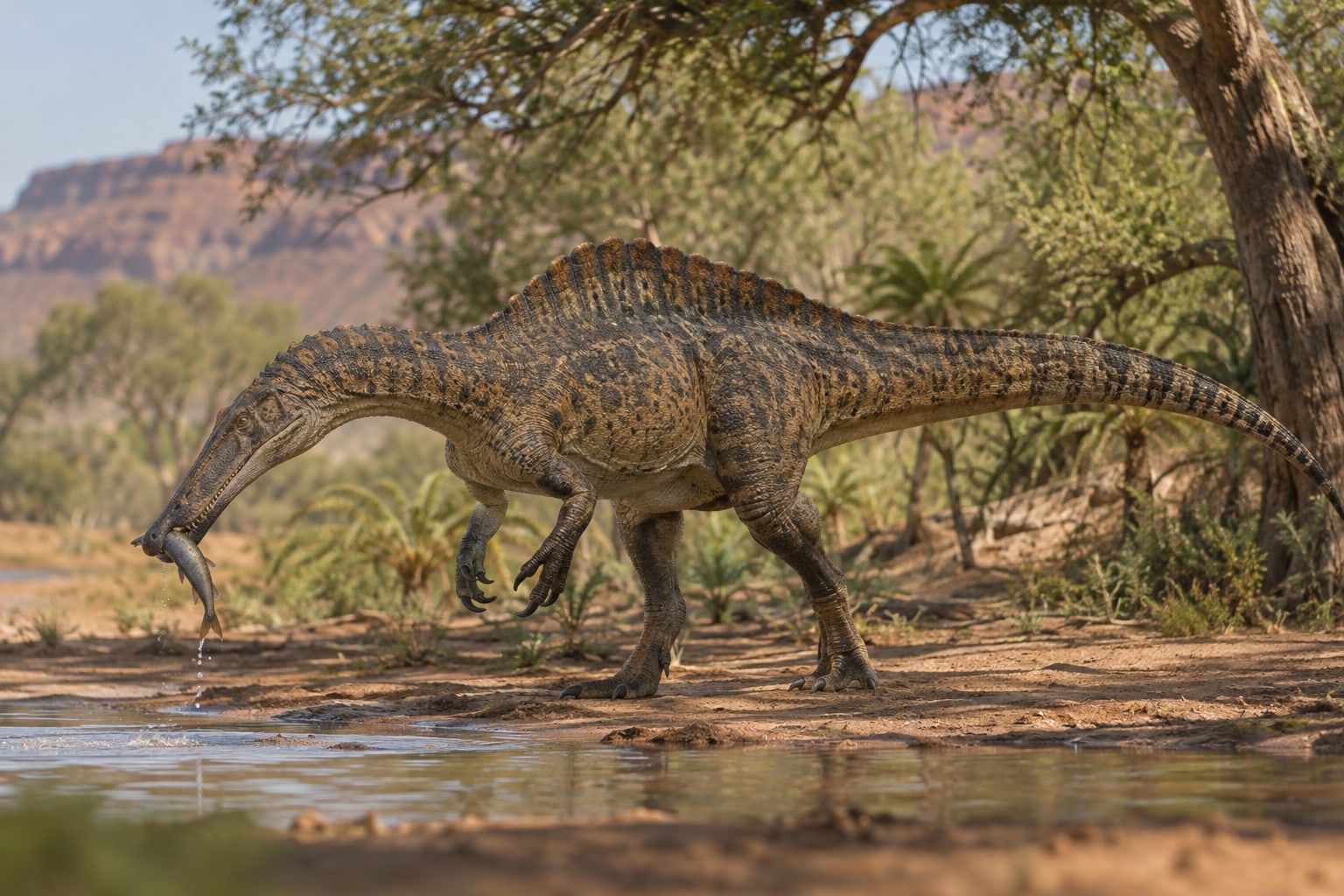
Suchomimus had a long, low, narrow skull much like a crocodile's, lined with many cone-shaped teeth for gripping slippery prey. A large, curved claw tipped each thumb, and a row of tall spines ran along its back, probably supporting a low sail of skin. It grew to roughly 10 meters (33 feet) long.
Its body was built for hunting near water. Paleontologists think it waded through rivers and swamps, snatching fish and other prey with its long jaws and clawed hands.
Its world
Suchomimus lived from about 121 to 101 million years ago, in the Early Cretaceous, in what is now Niger. Its fossils come from the Elrhaz Formation.
It shared its floodplain habitat with the huge predator Carcharodontosaurus, the smaller carnivore Eocarcharia, the plant eaters Ouranosaurus and Lurdusaurus, the armored Kryptops, and the long-necked Nigersaurus.
How it was found
Sereno and colleagues named Suchomimus in 1998, based on bones found in Niger. Only about two fossil finds are known, so much of what scientists know comes from a small number of skeletons. Some researchers think Suchomimus may be the same animal as the spinosaurid Baryonyx, or a separate but closely related genus; the question remains debated. It is considered a close relative of Spinosaurus and Irritator.
The evidence
Where its fossils were found
Today
110 million years ago
To scale
How big was Suchomimus?
Lived alongside
Found in the same rock formations.
Close relatives
Other members of Spinosauridae.
Sources: Paleobiology Database, WikidataNamed in: P. C. Sereno, A. L. Beck, and D. B. Dutheil, B. Gado, H. C. E. Larsson, G. H. Lyon, J. D. Marcot, O. W. M. Rauhut, R. W. Sadleir, C. A. Sidor, D. D. Varricchio, G. P. Wilson, J. A. Wilson. 1998. A long-snouted predatory dinosaur from Africa and the evolution of spinosaurids. Science 282:1298-1302