Lythronax
LYE-thro-naks
"gore king"
DV-0863 · type species Lythronax argestes
- Lived
- 84 to 72 million years ago, Late Cretaceous
- Diet
- Carnivore
- Length
- about 8 m (26 ft)
- Group
- Theropods, Tyrannosauridae
- Found in
- United States
- Named by
- Loewen et al. 2013
Field notes
About Lythronax
What it was like
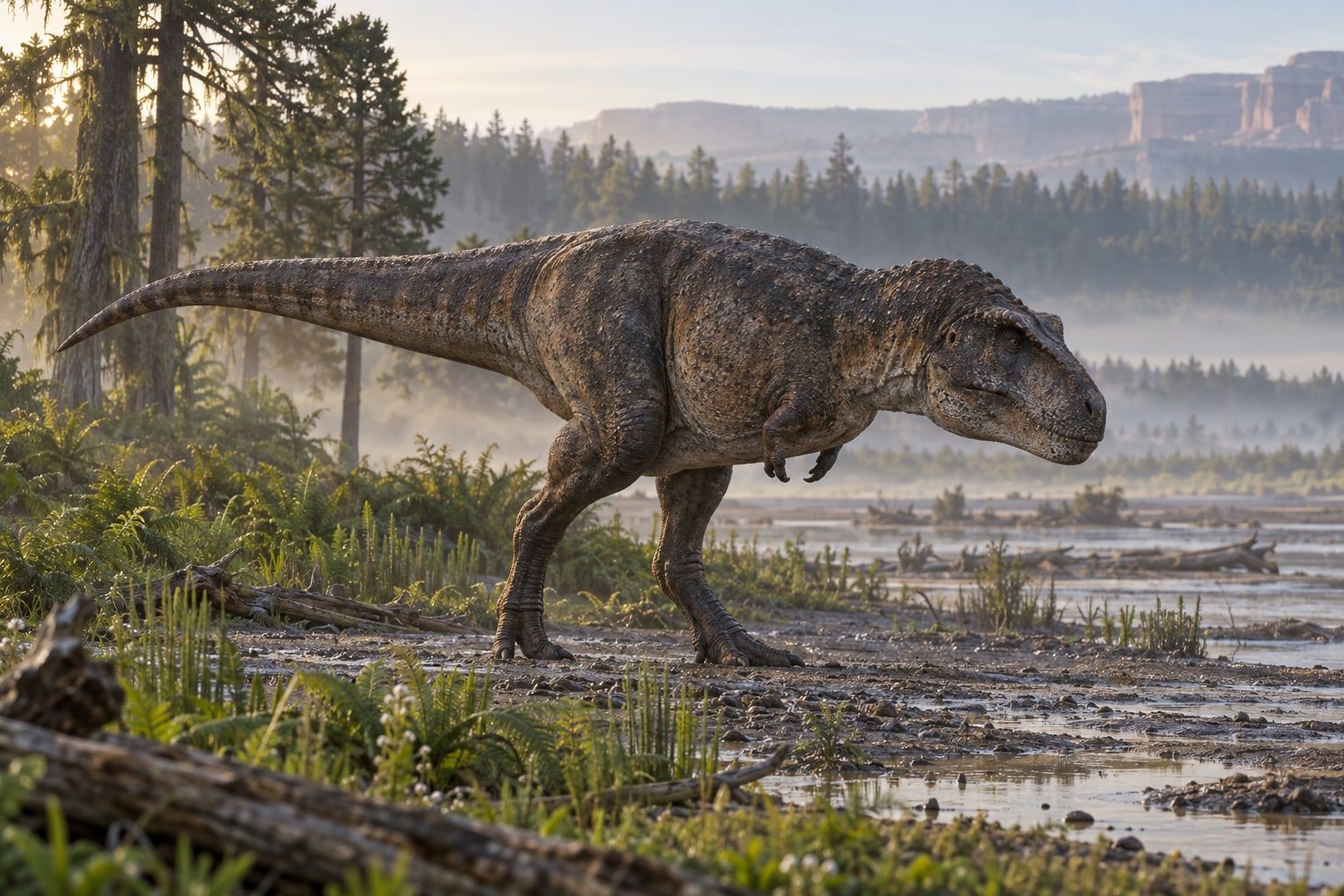
Lythronax was a heavily built tyrannosaurid, growing to around 8 meters (26 feet) long. Like its famous relative Tyrannosaurus, it had a broad rear skull and forward-facing eyes, giving it good depth perception for judging distance to prey.
Its forelimbs were small with two fingers, and its hindlimbs were powerful, the same basic build shared by all tyrannosaurids. The shape of its skull, wide at the back and narrow toward the snout, is one of the features that lets paleontologists tell it apart from its relatives.
Its world
Lythronax lived from about 84 to 72 million years ago, in the Late Cretaceous, in what is now Utah. Its remains come from the Wahweap Formation.
It shared its world with the horned Diabloceratops, the hadrosaur Acristavus, and other plant eaters such as Adelolophus and Machairoceratops, on the western landmass of Laramidia, separated from the rest of North America by the Western Interior Seaway.
How it was found
Loewen and colleagues named Lythronax in 2013, giving it the species name Lythronax argestes. It is among the oldest known tyrannosaurids, older than close relatives such as Tyrannosaurus, Tarbosaurus, Albertosaurus, and Daspletosaurus, making it important for understanding how the family's distinctive skull shape developed.
The evidence
Where its fossils were found
Today
80 million years ago
To scale
How big was Lythronax?
Lived alongside
Found in the same rock formations.
Close relatives
Other members of Tyrannosauridae.
Sources: Paleobiology Database, WikidataNamed in: M. A. Loewen, R. B. Irmis, and J. J. W. Sertich, P. J. Currie, S. D. Sampson. 2013. Tyrant dinosaur evolution tracks the rise and fall of Late Cretaceous oceans. PLoS ONE 8(11):e79420