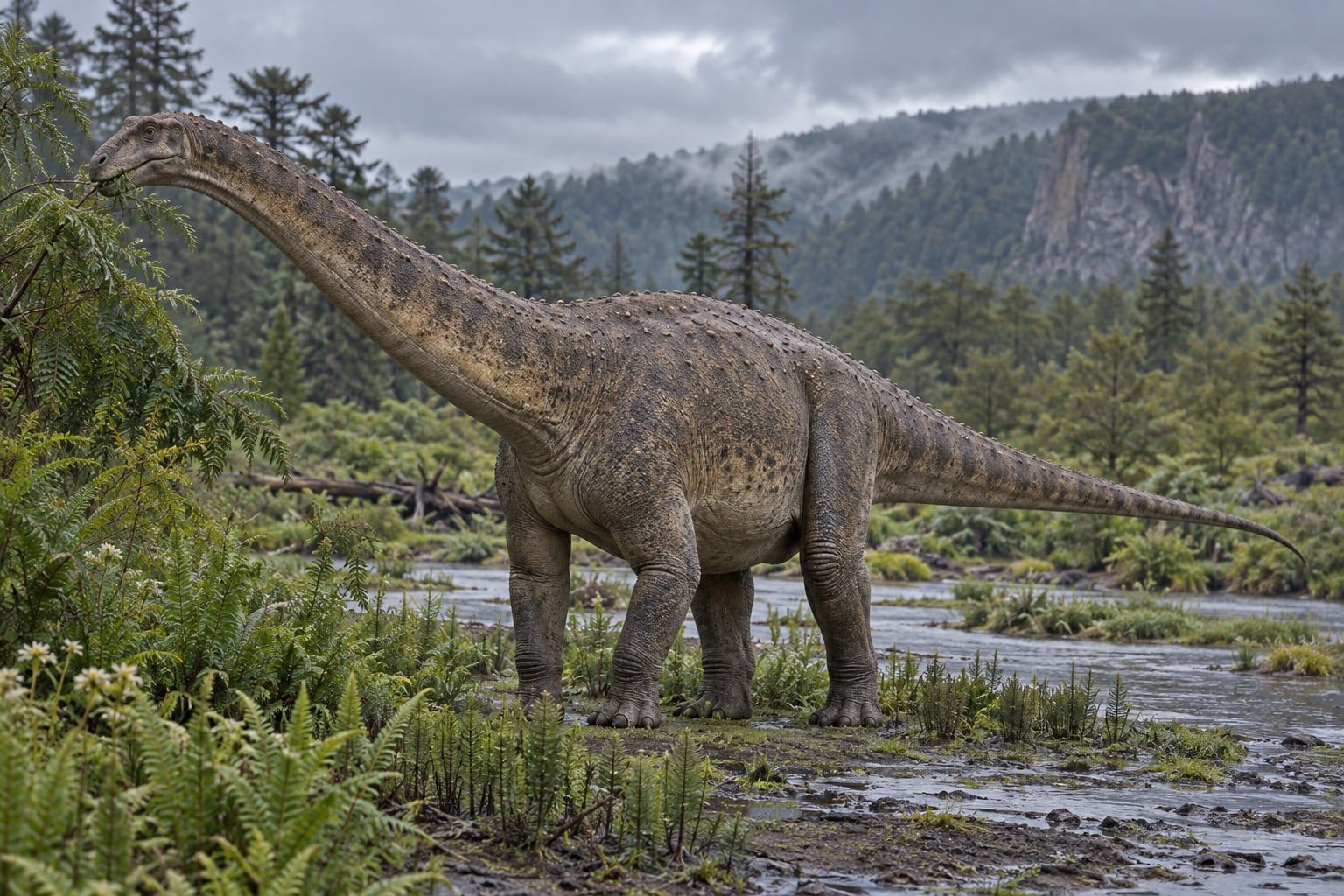
Magyarosaurus
muh-JAR-oh-SORE-us
"Hungarian lizard"
DV-0146 · type species Magyarosaurus dacus
- Lived
- 72 to 66 million years ago, Late Cretaceous
- Diet
- Herbivore
- Length
- about 5 m (16 ft)
- Group
- Sauropods
- Found in
- Romania
- Named by
- Huene 1932
Field notes
About Magyarosaurus
What it was like
Magyarosaurus was a dwarf sauropod, tiny by the standards of its family. It grew to only about 5 meters (16 feet) long, far smaller than giant relatives such as Argentinosaurus and Patagotitan. Scientists think its small size developed because it lived on an island, where limited food and space over many generations favored smaller bodies, a pattern known as island dwarfism.
Even at its small size, Magyarosaurus kept the same basic body plan as its giant relatives, with a long neck and tail and thick, column-like legs to support its body.
Its world
Magyarosaurus lived in what is now Romania during the Late Cretaceous, between about 72 and 66 million years ago. Its bones, nine finds in all, come from formations including Sînpetru, Densuș-Ciula, and Sebeş. It shared this island world with other small dinosaurs, including the plant eater Zalmoxes and the armored Struthiosaurus, along with the unusual predator Balaur.
How it was found
Huene named Magyarosaurus in 1932, giving it the type species Magyarosaurus dacus. It belongs to Titanosauria, the group of sauropods that also includes Argentinosaurus and Dreadnoughtus, though Magyarosaurus stands out among them for its small size rather than its bulk.
The evidence
Where its fossils were found
Today
To scale
How big was Magyarosaurus?
Lived alongside
Found in the same rock formations.
Close relatives
Other members of Eutitanosauria.
Sources: Paleobiology Database, WikidataNamed in: F. v. Huene. 1932. Die fossile Reptil-Ordnung Saurischia, ihre Entwicklung und Geschichte [The fossil reptile order Saurischia, their development and history]. Monographien zur Geologie und Palaeontologie, serie 1 4(1-2):1-361