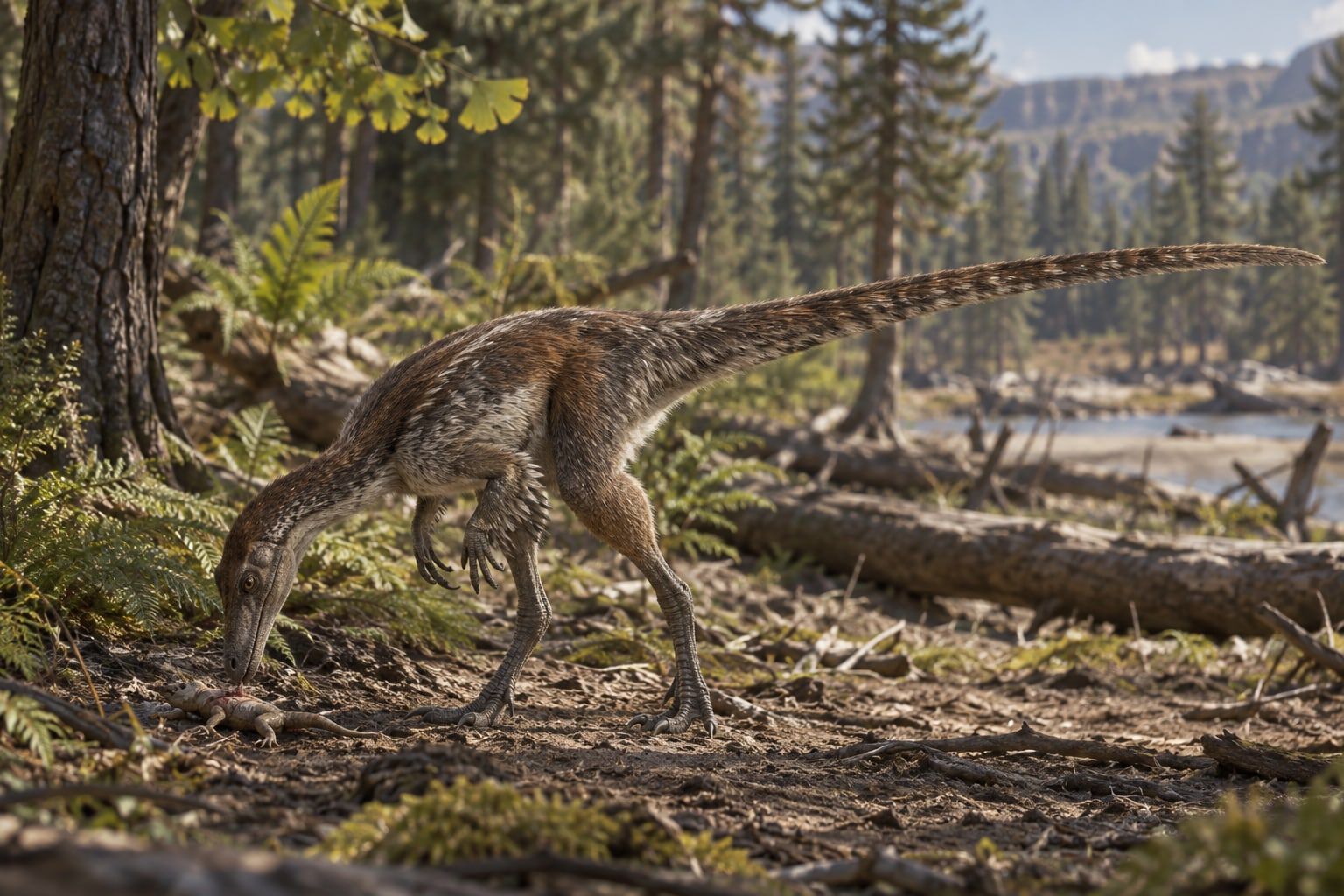
Ornitholestes
or-nih-THOL-es-teez
"bird robber"
DV-0071 · type species Ornitholestes hermanni
- Lived
- 158 to 143 million years ago, Late Jurassic to Early Cretaceous
- Diet
- Carnivore
- Length
- about 2 m (7 ft)
- Group
- Theropods, Compsognathidae
- Found in
- United States
- Named by
- Osborn 1903
Field notes
About Ornitholestes
What it was like
Ornitholestes was a small, lightly built theropod with long, grasping hands and sharp, narrow teeth suited to catching small, quick prey such as lizards or insects. It ran on two legs and likely relied on speed and agility rather than size to catch its meals. Ornitholestes grew to about 2 meters (6.6 feet) long, including a long tail that probably helped it balance while running. The type species is Ornitholestes hermanni.
Its world
Ornitholestes lived from about 158 to 143 million years ago, spanning the Late Jurassic into the Early Cretaceous, in what is now the United States. Its fossils come from the Morrison Formation in Wyoming, a rock unit famous for giant dinosaurs such as Stegosaurus, Allosaurus, Brachiosaurus, and Diplodocus. Ornitholestes itself was far too small to challenge animals like these, and probably hunted smaller game instead.
How it was found
Osborn named Ornitholestes in 1903. Two fossil finds are known today. A hand fossil once thought to belong to Ornitholestes is now thought to belong to a different theropod, showing how new discoveries can change what scientists know even about dinosaurs found long ago.
The evidence
Where its fossils were found
Today
150 million years ago
To scale
How big was Ornitholestes?
Lived alongside
Found in the same rock formations.
Close relatives
Other members of Compsognathidae.
Sources: Paleobiology Database, WikidataNamed in: H. F. Osborn. 1903. Ornitholestes hermanni, a new compsognathoid dinosaur from the Upper Jurassic. Bulletin of the American Museum of Natural History 19(12):459-464