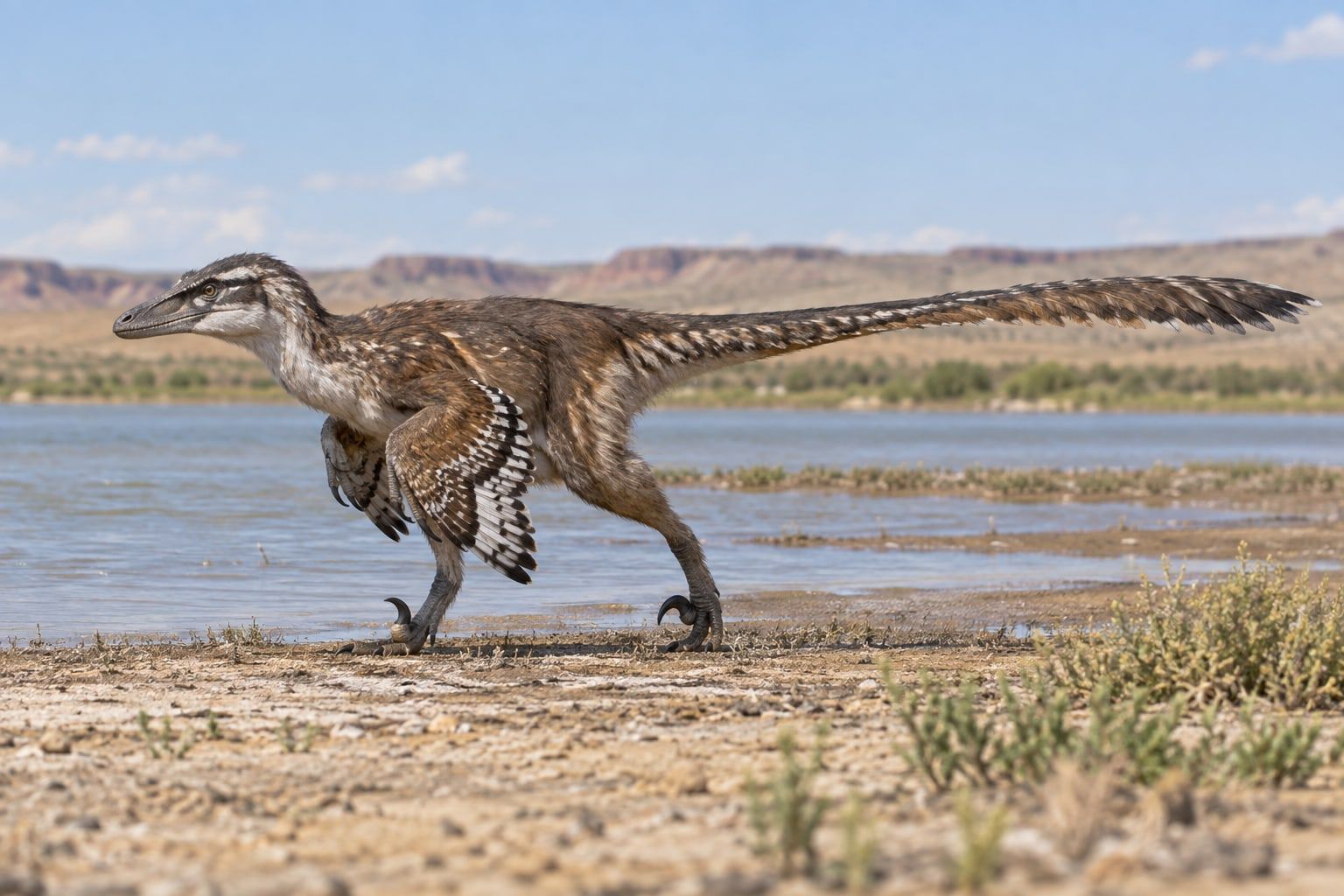
Achillobator
uh-KIL-oh-BAH-tor
"Achilles hero"
DV-0430
- Lived
- 101 to 84 million years ago, Late Cretaceous
- Diet
- Carnivore
- Length
- about 5 m (16 ft)
- Group
- Theropods, Dromaeosauridae
- Found in
- Mongolia
- Named by
- Perle et al. 1999
Field notes
About Achillobator
What it was like
Achillobator was a large, heavily built dromaeosaurid, more robust than most of its raptor relatives, with a deep skull, stocky legs, and an enlarged, curved claw on each second toe. It grew to about 5 meters (16 feet) long, ranking among the biggest known members of its family, alongside Utahraptor and Austroraptor.
Its short, muscular arms and sturdy build suggest Achillobator hunted large prey on the ground rather than climbing or gliding, unlike some of its smaller, lighter relatives. Its stocky legs also suggest it was not built for high speed the way some other dromaeosaurids were.
Its world
Achillobator lived from about 101 to 84 million years ago, in the Late Cretaceous, in what is now Mongolia. Its fossils come from the Baynshire Formation.
It shared its world with plant eaters such as Segnosaurus, Erlikosaurus, and the armored Talarurus, as well as the ostrich-like Garudimimus.
How it was found
Perle and colleagues named Achillobator in 1999, from bones found in Mongolia. Only one fossil find has been reported for the genus so far, so several aspects of its life and behavior remain uncertain. Achillobator is closely related to Dromaeosaurus and Utahraptor, and along with Austroraptor and Dakotaraptor, it ranks among the largest dromaeosaurids known.
The evidence
Where its fossils were found
Today
90 million years ago
To scale
How big was Achillobator?
Lived alongside
Found in the same rock formations.
Close relatives
Other members of Dromaeosauridae.
Sources: Paleobiology Database, WikidataNamed in: A. Perle, M. A. Norell, and J. M. Clark. 1999. A new maniraptoran theropod—Achillobator giganticus (Dromaeosauridae)—from the Upper Cretaceous of Burkhant, Mongolia. Contributions of the Department of Geology, National University of Mongolia 101:1-105