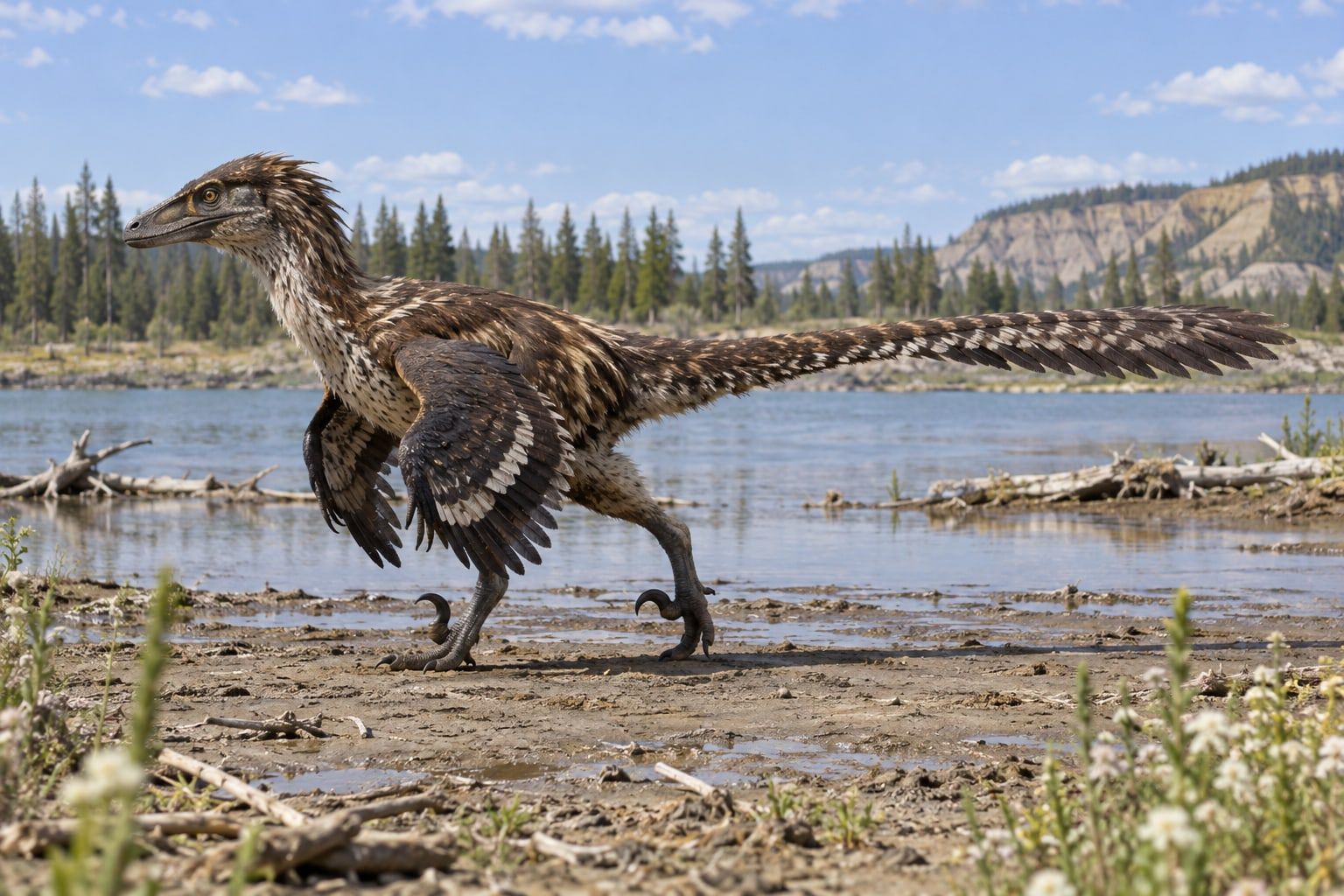
Dakotaraptor
duh-KOH-tuh-RAP-tor
"Dakota thief"
DV-0916
- Lived
- 72 to 66 million years ago, Late Cretaceous
- Diet
- Carnivore
- Group
- Theropods, Dromaeosauridae
- Found in
- United States
- Named by
- DePalma et al. 2015
Field notes
About Dakotaraptor
What it was like
Dakotaraptor was a large, powerfully built dromaeosaurid, among the biggest raptors known from North America. It had long legs suited for fast running and, like its relatives, an enlarged, curved claw on each second toe for gripping prey.
Some of its arm bones show ridges where large flight-type feathers likely attached, suggesting Dakotaraptor was feathered even though it was far too big and heavy to fly.
Its world
Dakotaraptor lived from about 72 to 66 million years ago, right at the end of the Late Cretaceous, in what is now South Dakota, in the United States. Its fossils come from the Hell Creek Formation.
It shared its world with Tyrannosaurus, Triceratops, the armored Ankylosaurus, and the dome-headed Pachycephalosaurus, in one of the best-studied ecosystems from just before the mass extinction that ended the Mesozoic.
How it was found
DePalma and colleagues named Dakotaraptor in 2015. Only two fossil finds have been reported for the genus, and the bones have ended up split between institutions and a private collection, which has made further study difficult and left parts of its classification debated. Dakotaraptor may have been one of the last dromaeosaurids to survive before the end of the Cretaceous, though some researchers question exactly where it belongs within the family.
The evidence
Where its fossils were found
Today
70 million years ago
Lived alongside
Found in the same rock formations.
Close relatives
Other members of Dromaeosauridae.
Sources: Paleobiology Database, WikidataNamed in: R. A. DePalma, D. A. Burnham, and L. D. Martin, P. L. Larson, R. T. Bakker. 2015. The first giant raptor (Theropoda: Dromaeosauridae) from the Hell Creek Formation. The University of Kansas Paleontological Contributions 14:1-16