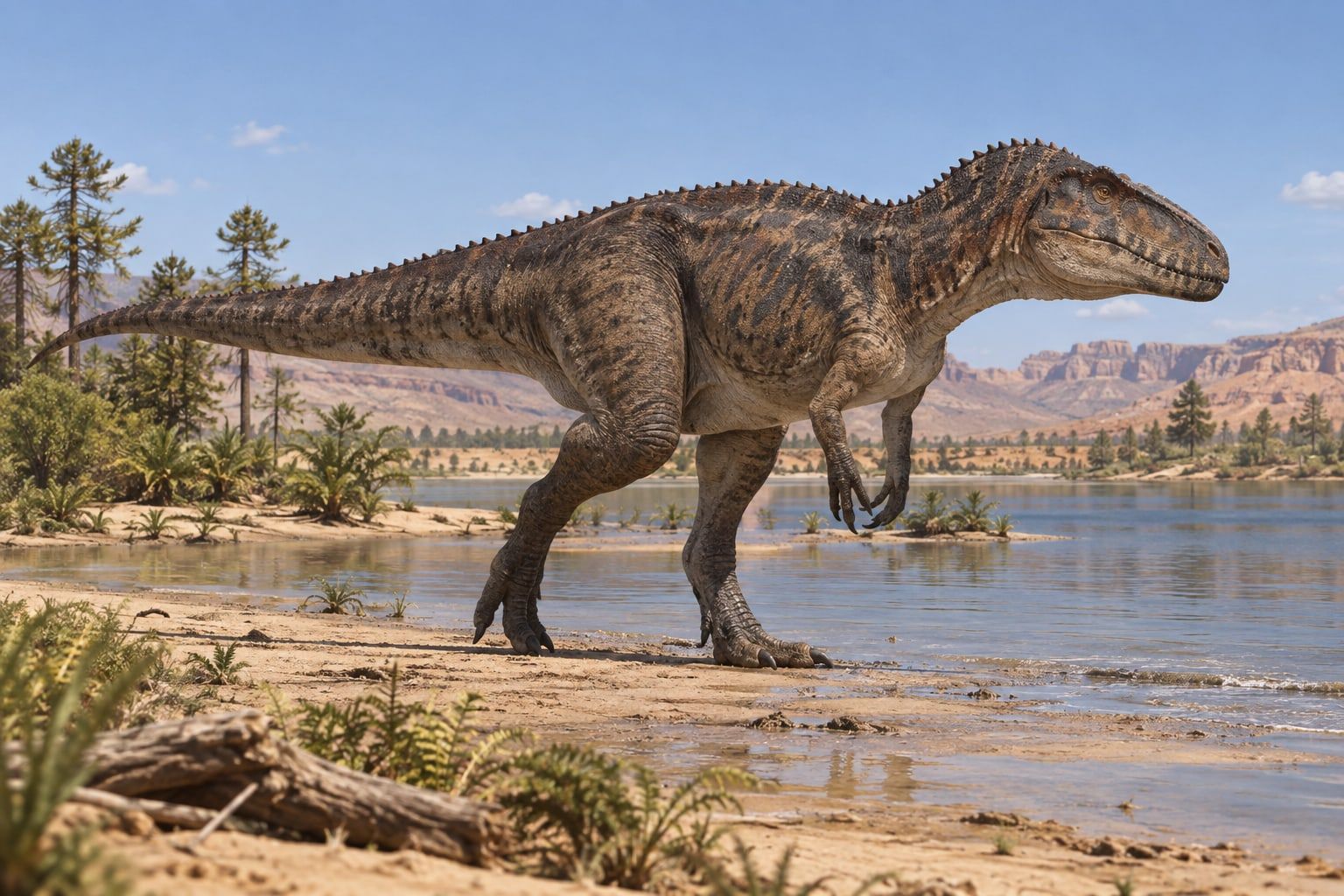
Carcharodontosaurus
kar-KAR-oh-DON-toh-SORE-us
"shark-toothed lizard"
DV-0143
- Lived
- 121 to 94 million years ago, Early Cretaceous to Late Cretaceous
- Diet
- Carnivore
- Length
- about 12 m (39 ft)
- Group
- Theropods, Carcharodontosauridae
- Found in
- Algeria, Morocco, Niger and Tunisia
- Named by
- Stromer 1931
Field notes
About Carcharodontosaurus
What it was like
Carcharodontosaurus was one of the largest meat-eating dinosaurs known, growing to roughly 12 meters (39 feet) long. Its skull was long and lightly built, with large openings that saved weight, and its jaws held rows of flattened, serrated teeth shaped more for slicing than for crushing bone.
Its arms were small compared to its powerful legs, and a long, muscular tail balanced its body as it moved. Like its close relatives, it probably relied on quick, slashing bites rather than a single crushing one to bring down prey.
Its world
Carcharodontosaurus lived from about 121 to 94 million years ago, spanning the Early and Late Cretaceous, in what is now North Africa. Its fossils come from Algeria, Morocco, Niger, and Tunisia, with possible finds also reported from Brazil and Egypt.
It shared its habitat with other huge predators, including Spinosaurus and Suchomimus, as well as plant eaters such as Ouranosaurus and the armored Lurdusaurus. Rivers and wetlands across the region supported a rich mix of fish, crocodile relatives, and other animals.
How it was found
Stromer named Carcharodontosaurus in 1931 from fossils found in North Africa. Around 36 finds are now known, a solid record for such a large predator, and its closest relatives, including Giganotosaurus, Mapusaurus, and Acrocanthosaurus, were also huge meat eaters found on other continents.
The evidence
Where its fossils were found
Today
110 million years ago
To scale
How big was Carcharodontosaurus?
Lived alongside
Found in the same rock formations.
Close relatives
Other members of Carcharodontosauridae.
Sources: Paleobiology Database, WikidataNamed in: E. Stromer. 1931. Ergebnisse der Forschungsreisen Prof. E. Stromers in den Wüsten Ägyptens. II. Wirbeltier-Reste der Baharîjestufe (unterstes Cenoman). 10. Ein Skelett-Rest von Carcharodontosaurus nov. gen. Abhandlungen der Bayerischen Akademie der Wissenschaften Mathematisch-naturwissenschaftliche Abteilung, Neue Folge 9:1-23