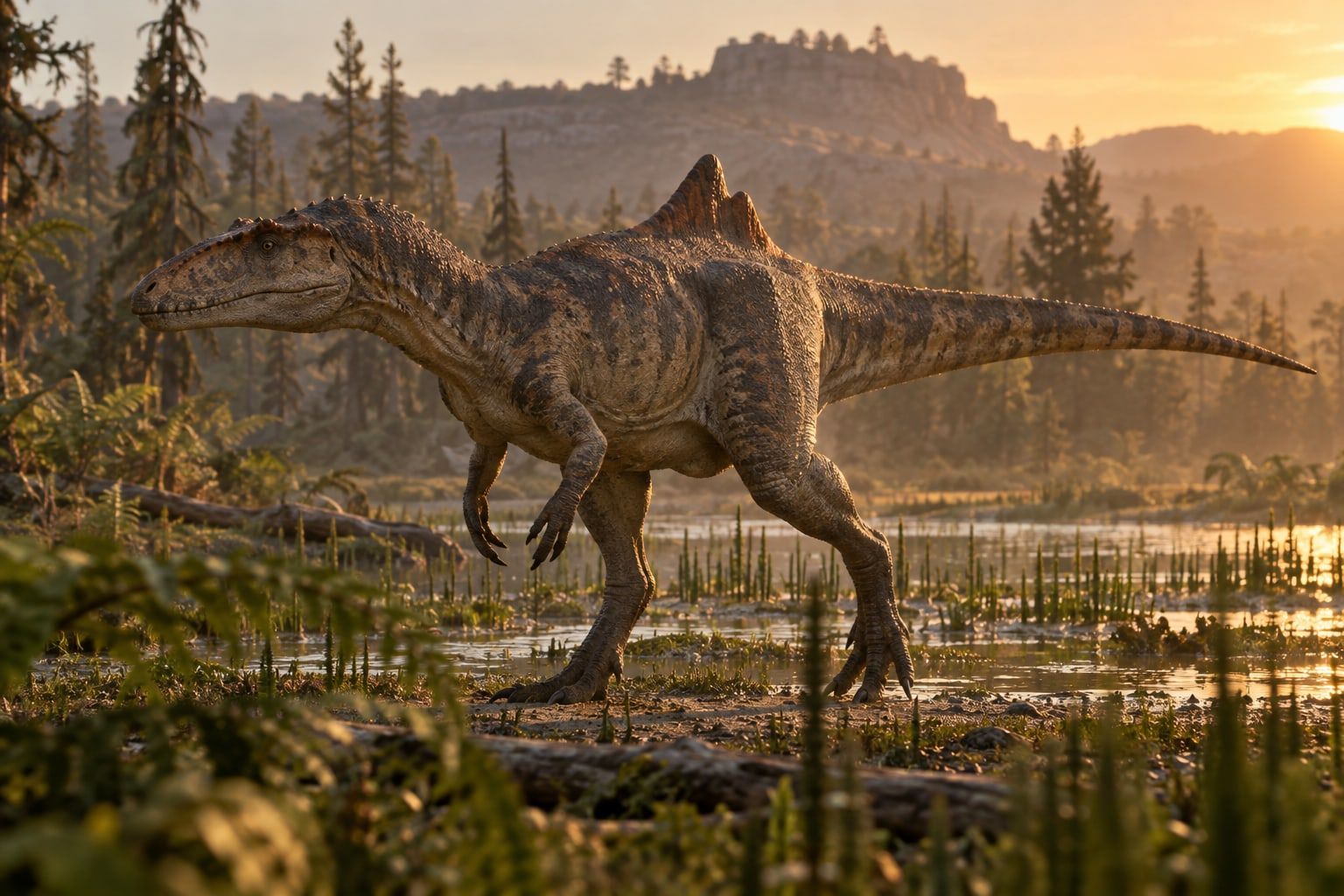
Concavenator
kon-KAH-ven-AY-tor
"Cuenca hunter"
DV-0729 · type species Concavenator corcovatus
- Lived
- 126 to 121 million years ago, Early Cretaceous
- Diet
- Carnivore
- Length
- estimates range from 5 to 6 m (16 to 20 ft)
- Group
- Theropods, Carcharodontosauridae
- Found in
- Spain
- Named by
- Ortega et al. 2010
Field notes
About Concavenator
What it was like
Concavenator was a medium-sized theropod, growing to roughly 5 to 6 meters (16 to 20 feet) long. Its most unusual feature was a tall, sail-like hump formed by extra-tall spines over its hips, unlike almost any other member of its family.
Small bumps along its forearm have led some researchers to suggest it carried simple quill-like structures there, though this idea is debated and not accepted by everyone who has studied the skeleton.
Its world
Concavenator lived from about 126 to 121 million years ago, in the Early Cretaceous, in what is now Spain. Its single known skeleton comes from the La Huérguina Formation.
It shared its habitat with Pelecanimimus, an unusual long-snouted theropod, and was part of the same broad family as much larger relatives like Giganotosaurus, Carcharodontosaurus, and Acrocanthosaurus, though Concavenator itself was far smaller than those giants.
How it was found
Ortega and colleagues named Concavenator corcovatus in 2010, based on a single, nearly complete skeleton. It remains the only known specimen of the genus, which makes every detail of that one skeleton especially valuable for understanding this branch of the theropod family tree.
The evidence
Where its fossils were found
Today
125 million years ago
Lived alongside
Found in the same rock formations.
Close relatives
Other members of Carcharodontosauridae.
Sources: Paleobiology Database, WikidataNamed in: F. Ortega, F. Escaco, and J. L. Sanz. 2010. A bizarre, humped Carcharodontosauria (Theropoda) from the Lower Cretaceous of Spain. Nature 467:203-206