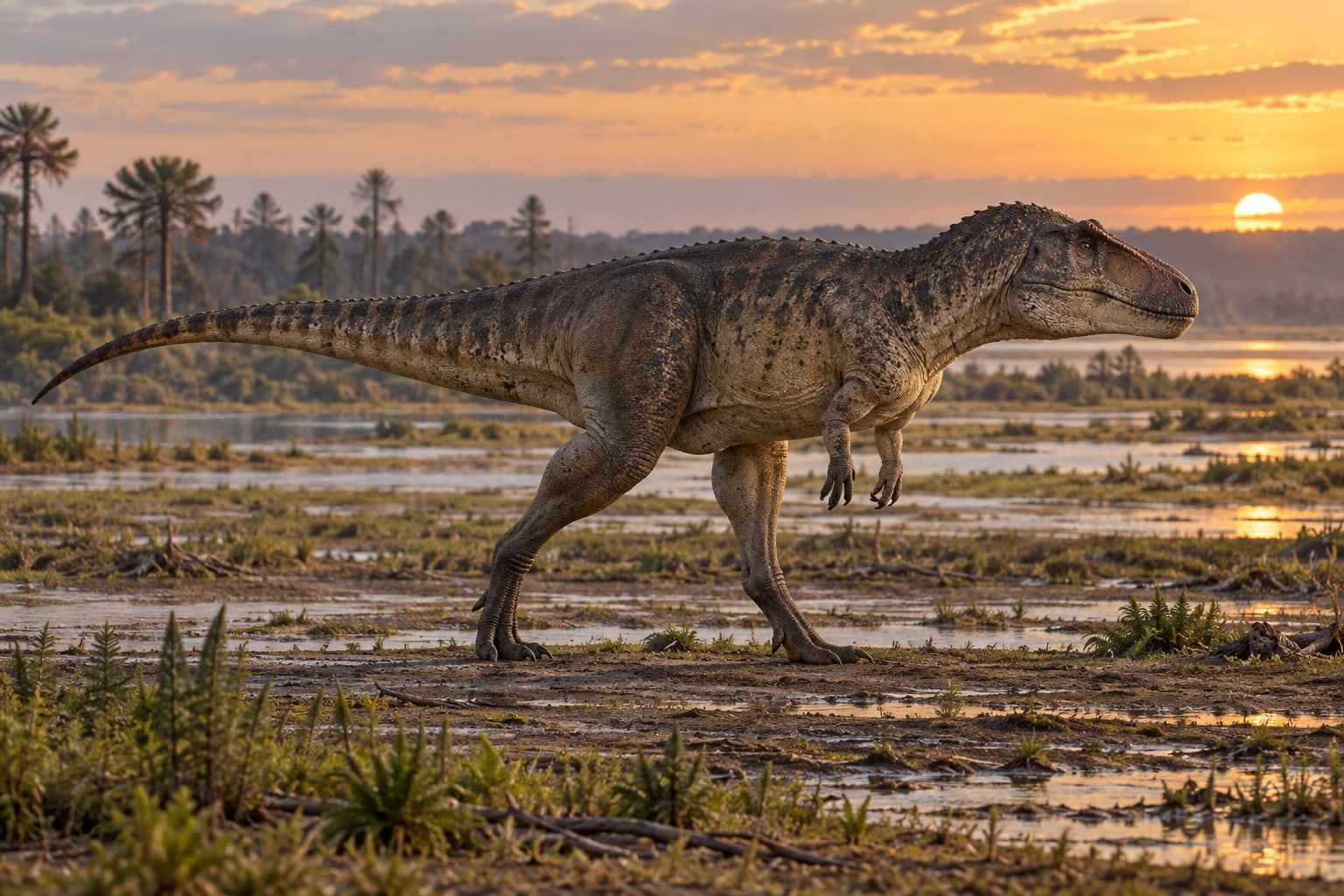
Tameryraptor
"thief from the beloved land"
DV-1289 · type species Tameryraptor markgrafi
- Lived
- 101 to 94 million years ago, Late Cretaceous
- Diet
- Carnivore
- Group
- Theropods, Carcharodontosauridae
- Found in
- Egypt
- Named by
- Kellermann et al. 2025
Field notes
About Tameryraptor
What it was like
Tameryraptor was a large carnivorous theropod related to Carcharodontosaurus, with the same lightly built, blade-toothed skull typical of its family. It stood out for a distinctive horn-like bump on its snout, a feature not seen on its closest relatives.
Its backbone had hollow depressions that would have held air sacs, a feature shared with many large theropods. Only partial remains are known, so much about its full size and proportions is still uncertain.
Its world
Tameryraptor lived from about 101 to 94 million years ago, in the Late Cretaceous, in what is now Egypt. Its bones come from the Bahariya Formation, a site that has also produced other giant predators and the sail-backed Spinosaurus. Several enormous carnivorous dinosaurs are known from the same region and time, making this one of the most predator-rich habitats of the Cretaceous.
How it was found
Kellermann and colleagues named Tameryraptor in 2025, giving it the species name Tameryraptor markgrafi. The fossils had been collected decades earlier and were originally classified as a species of Carcharodontosaurus. The original specimen was destroyed decades ago, but surviving photographs let researchers reexamine the material and recognize it as belonging to a separate genus after all.
The evidence
Where its fossils were found
Today
95 million years ago
Close relatives
Other members of Carcharodontosauridae.
Sources: Paleobiology Database, WikidataNamed in: M. Kellermann, E. Cuesta, and O. W. M. Rauhut. 2025. Re-evaluation of the Bahariya Formation carcharodontosaurid (Dinosauria: Theropoda) and its implications for allosauroid phylogeny. PLOS ONE 20(1):e0311096:1-56