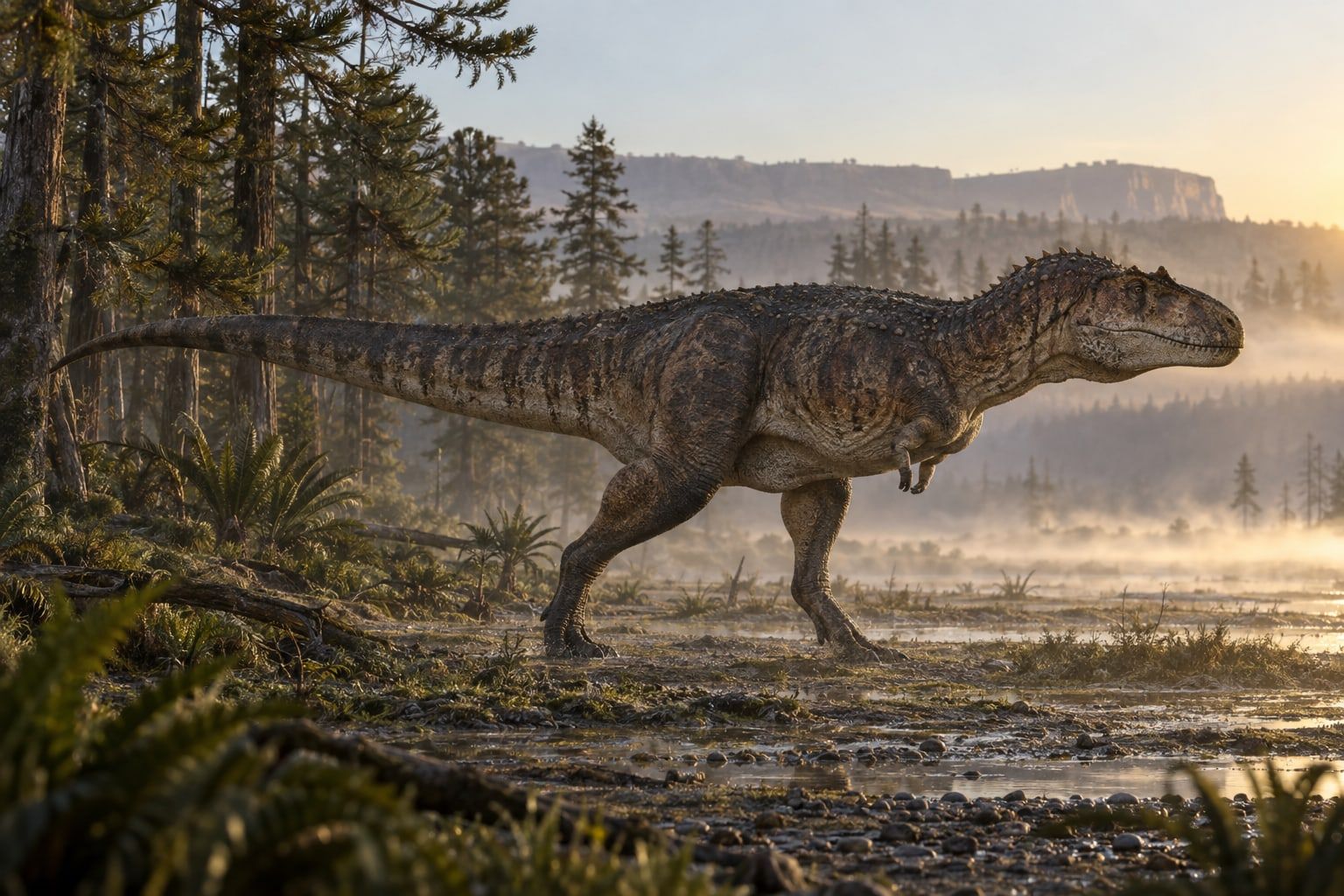
Meraxes
DV-1183 · type species Meraxes gigas
- Lived
- 110 to 106 million years ago, Early Cretaceous
- Diet
- Carnivore
- Group
- Theropods, Carcharodontosauridae
- Found in
- Argentina
- Named by
- Canale et al. 2022
Field notes
About Meraxes
What it was like
Meraxes was a large carcharodontosaurid predator, closely related to Giganotosaurus and Carcharodontosaurus. Its skeleton is unusually complete for such a large theropod, preserving much of the skull, spine, and limbs. One striking feature is how small and short its arms were relative to its body size, a trait it shares, independently, with the much later Tyrannosaurus rex. Like other giant theropods, it probably relied on a powerful skull and a strong bite, rather than its arms, to bring down prey.
Its world
Meraxes lived from about 110 to 106 million years ago, during the Early Cretaceous, in what is now Argentina. Its bones come from the Huincul Formation, alongside some of the largest animals ever to walk the earth, including the sauropod Argentinosaurus. It also shared its world with other big predators, such as Giganotosaurus and Mapusaurus.
How it was found
Canale and colleagues named Meraxes in 2022, based on a single, well preserved skeleton, a rare find for a predator of this size. The type species is Meraxes gigas. The genus is named after a dragon from a work of fantasy fiction, following a tradition of naming fierce predatory dinosaurs after mythical monsters.
The evidence
Where its fossils were found
Today
110 million years ago
Lived alongside
Found in the same rock formations.
Close relatives
Other members of Carcharodontosauridae.
Sources: Paleobiology Database, WikidataNamed in: J. I. Canale, S. Apesteguía, and P. A. Gallina, J. Mitchell, N. D. Smith, T. M. Cullen, A. Shinya, A. Haluza, F. A. Gianechini, P. J. Makovicky. 2022. New giant carnivorous dinosaur reveals convergent evolutionary trends in theropod arm reduction. Current Biology 32(14):3195-3202