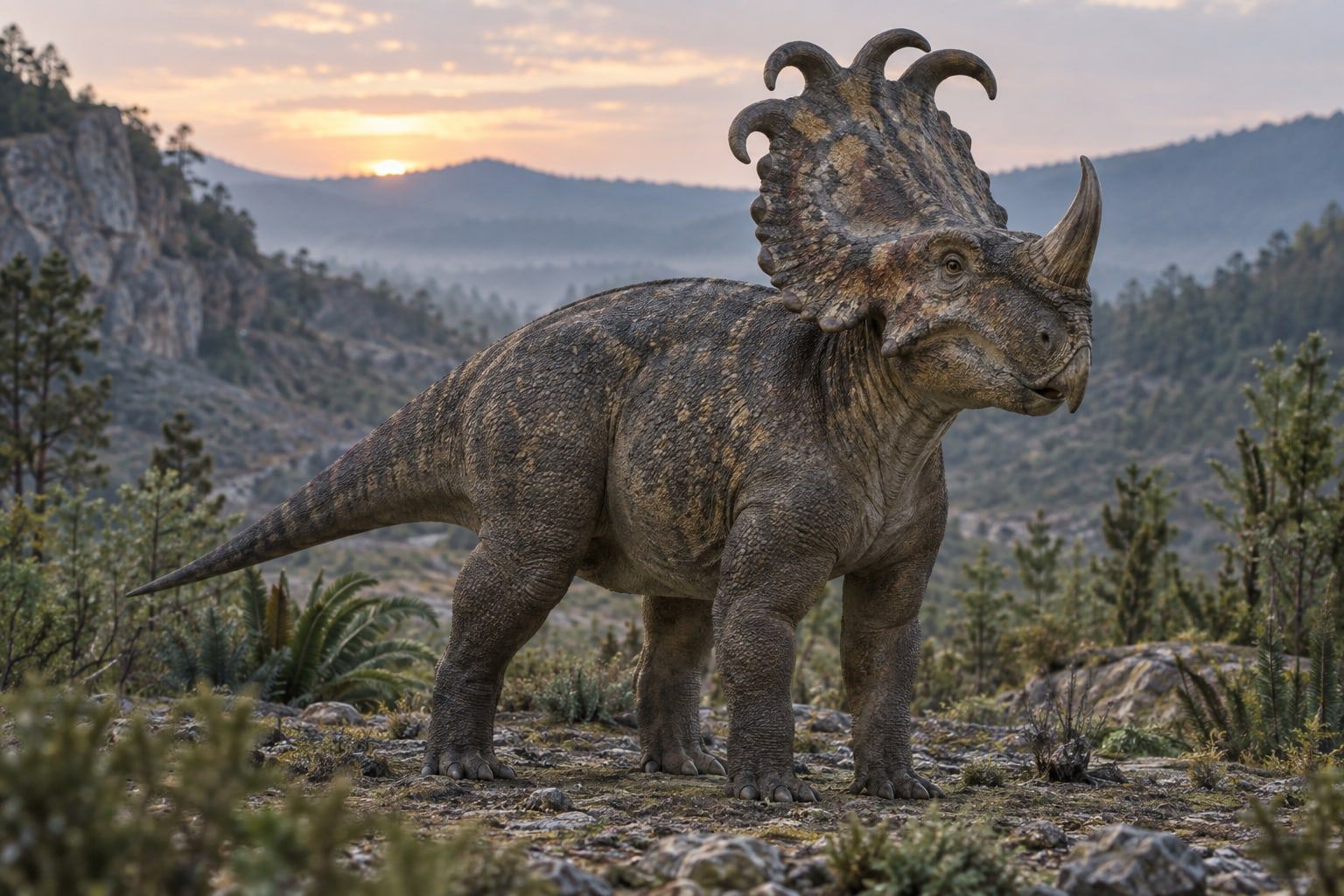
Sinoceratops
SY-no-SEH-ruh-tops
"Chinese horned face"
DV-0757 · type species Sinoceratops zhuchengensis
- Lived
- 84 to 72 million years ago, Late Cretaceous
- Diet
- Herbivore
- Group
- Ceratopsians, Ceratopsidae
- Found in
- China
- Named by
- Xu et al. 2010
Field notes
About Sinoceratops
What it was like
Sinoceratops was a large, four-legged plant eater with a broad, bony frill and a row of short horns curling forward along its edge, along with a single horn on its nose. Its build was sturdy and its size was fairly typical for a ceratopsid, the group that also includes Triceratops.
It is the only ceratopsid dinosaur known from Asia. All its close relatives, including Triceratops, Styracosaurus, and Centrosaurus, come from fossil beds in North America, making Sinoceratops important evidence that this group of horned dinosaurs once crossed between the continents.
Its world
Sinoceratops lived from about 84 to 72 million years ago, in the Late Cretaceous, in what is now China. Its remains come from the Hongtuya Formation.
It shared this world with the huge duck-billed Shantungosaurus, the tyrannosaur Zhuchengtyrannus, and smaller dinosaurs including the horned Zhuchengceratops and the armored Sinankylosaurus.
How it was found
Xu and colleagues named Sinoceratops in 2010, giving it the species name Sinoceratops zhuchengensis. It is known from a single find, but that discovery filled a long-standing gap, since no ceratopsid had ever been confirmed outside North America before.
The evidence
Where its fossils were found
Today
80 million years ago
Lived alongside
Found in the same rock formations.
Close relatives
Other members of Ceratopsidae.
Sources: Paleobiology Database, WikidataNamed in: X. Xu, K.-B. Wang, and X.-J. Zhao, D.-J. Li. 2010. First ceratopsid dinosaur from China and its biogeographical implications. Chinese Science Bulletin 55(16):1631-1635