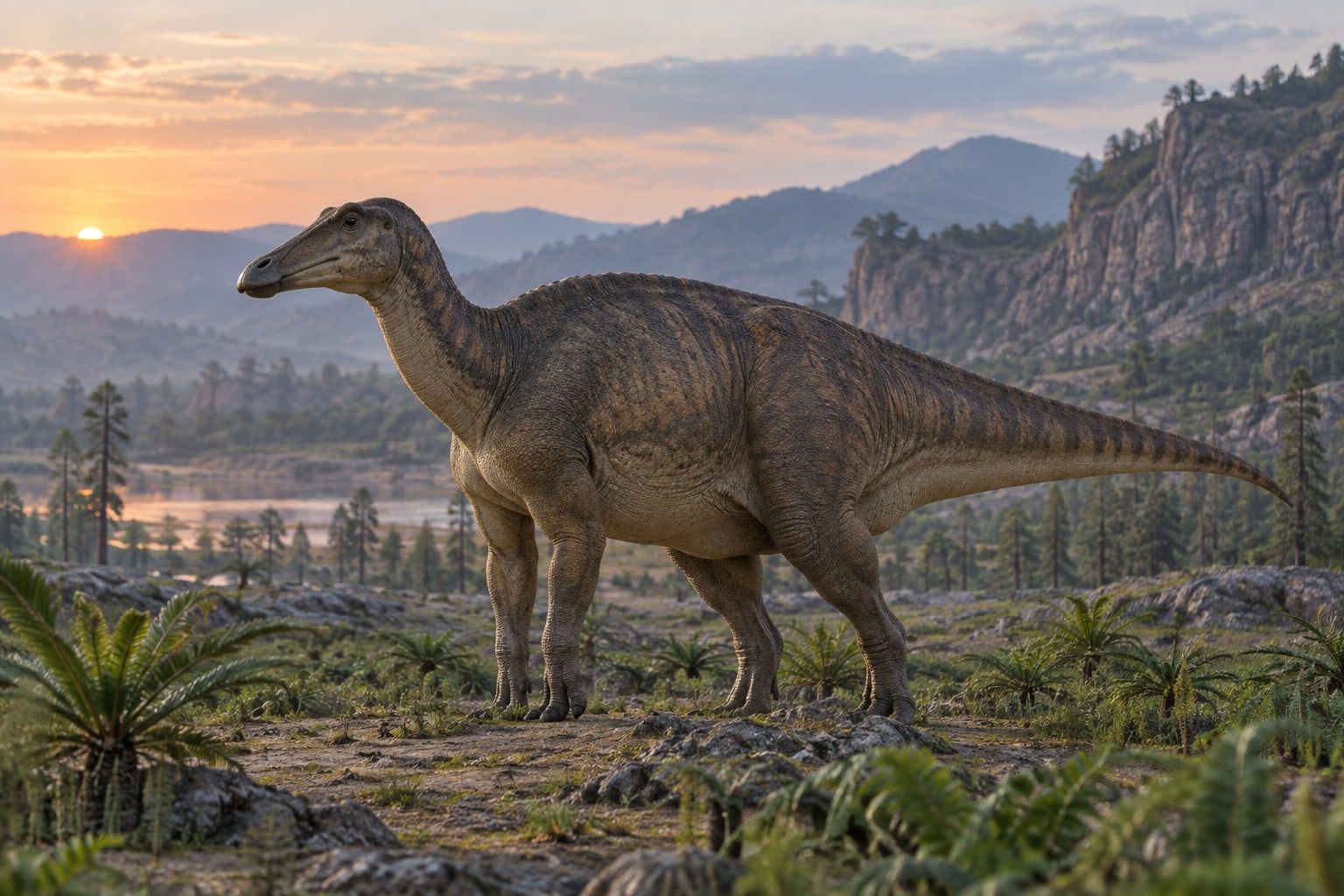
Shantungosaurus
shan-TUNG-oh-SORE-us
"Shandong lizard"
DV-0219
- Lived
- 84 to 72 million years ago, Late Cretaceous
- Diet
- Herbivore
- Length
- about 15 m (49 ft)
- Group
- Ornithopods, Hadrosauridae
- Found in
- China
- Named by
- Hu 1973
Field notes
About Shantungosaurus
What it was like
Shantungosaurus was an enormous duck-billed dinosaur, among the largest ornithopods known. It grew to roughly 15 meters (49 feet) long, walking on four legs while browsing but able to rear up on two. Like other hadrosaurs, it had a wide, flattened beak backed by rows of grinding teeth for processing tough plants.
Unlike crested relatives such as Corythosaurus and Lambeosaurus, Shantungosaurus had a flat, unadorned head. Its rows of cheek teeth formed a dense battery that kept replacing itself as older teeth wore down from grinding tough plant material.
Its world
Shantungosaurus lived in what is now China during the Late Cretaceous, between about 84 and 72 million years ago. Its bones come from the Hongtuya Formation, with three finds known so far.
It shared its habitat with the tyrannosaur Zhuchengtyrannus, the horned Sinoceratops, and other dinosaurs including Zhuchengtitan, Zhuchengceratops, and the armored Sinankylosaurus.
How it was found
Hu named Shantungosaurus in 1973. It belongs to Hadrosauridae, the family of duck-billed dinosaurs that also includes Edmontosaurus, Saurolophus, and the crested Corythosaurus and Lambeosaurus. Its huge size, among the largest of any hadrosaur, invites comparison with relatives from North America and Asia, such as Parasaurolophus and Maiasaura.
The evidence
Where its fossils were found
Today
80 million years ago
To scale
How big was Shantungosaurus?
Lived alongside
Found in the same rock formations.
Close relatives
Other members of Hadrosauridae.
Sources: Paleobiology Database, WikidataNamed in: C.-C. Hu. 1973. [A new hadrosaur from the Cretaceous of Chucheng, Shantung]. Acta Geologica Sinica 1973(2):179-206