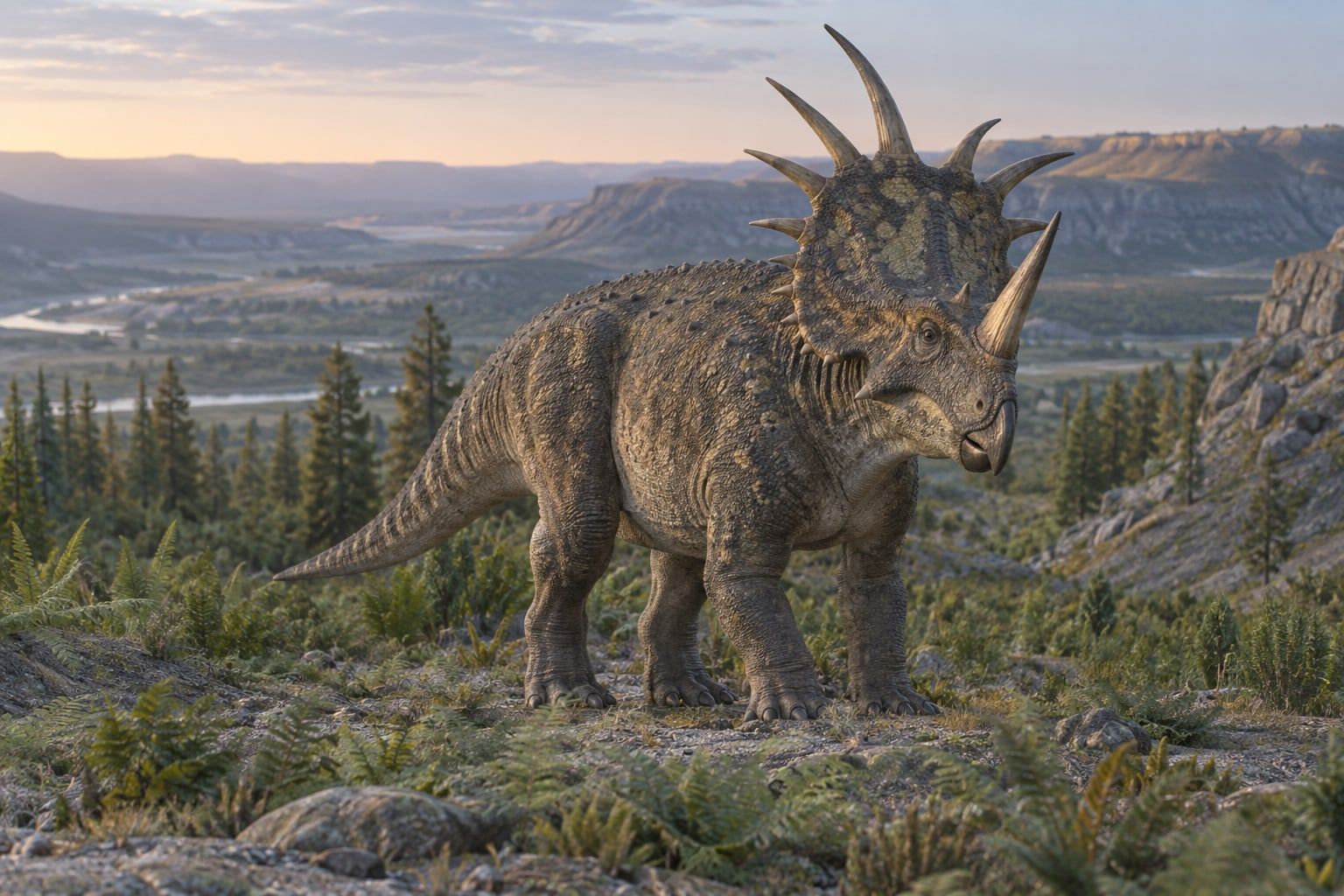
Styracosaurus
sty-RAK-oh-SORE-us
"spiked lizard"
DV-0088
- Lived
- 84 to 72 million years ago, Late Cretaceous
- Diet
- Herbivore
- Length
- about 5.5 m (18 ft)
- Group
- Ceratopsians, Ceratopsidae
- Found in
- Canada
- Named by
- Lambe 1913
Field notes
About Styracosaurus
What it was like
Styracosaurus had a long, curved horn on its nose and a bony neck frill ringed with several long spikes. Its beak and rows of tightly packed cheek teeth were built for slicing tough plants. It grew to roughly 5.5 meters (18 feet) long and walked on four short, sturdy legs.
Scientists still debate what the horn and spiked frill were used for. They may have helped Styracosaurus recognize others of its species, attract mates, or defend itself against predators.
Its world
Styracosaurus lived from about 84 to 72 million years ago, in the Late Cretaceous, in what is now Alberta, Canada. Its fossils come from the Dinosaur Park Formation.
It shared this world with the horned Triceratops, the crested Parasaurolophus, the thick-skulled Pachycephalosaurus, the small predator Troodon, and the large hunters Gorgosaurus and Daspletosaurus.
How it was found
Lambe named Styracosaurus in 1913. About 10 fossil finds of the genus are known today, including bonebeds that suggest Styracosaurus may have lived and traveled in herds. It is considered a close relative of other horned dinosaurs such as Centrosaurus, Pachyrhinosaurus, and Triceratops.
The evidence
Where its fossils were found
Today
80 million years ago
To scale
How big was Styracosaurus?
Lived alongside
Found in the same rock formations.
Close relatives
Other members of Ceratopsidae.
Sources: Paleobiology Database, WikidataNamed in: L. M. Lambe. 1913. A new genus and species of Ceratopsia from the Belly River Formation of Alberta. The Ottawa Naturalist 27(9):109-116