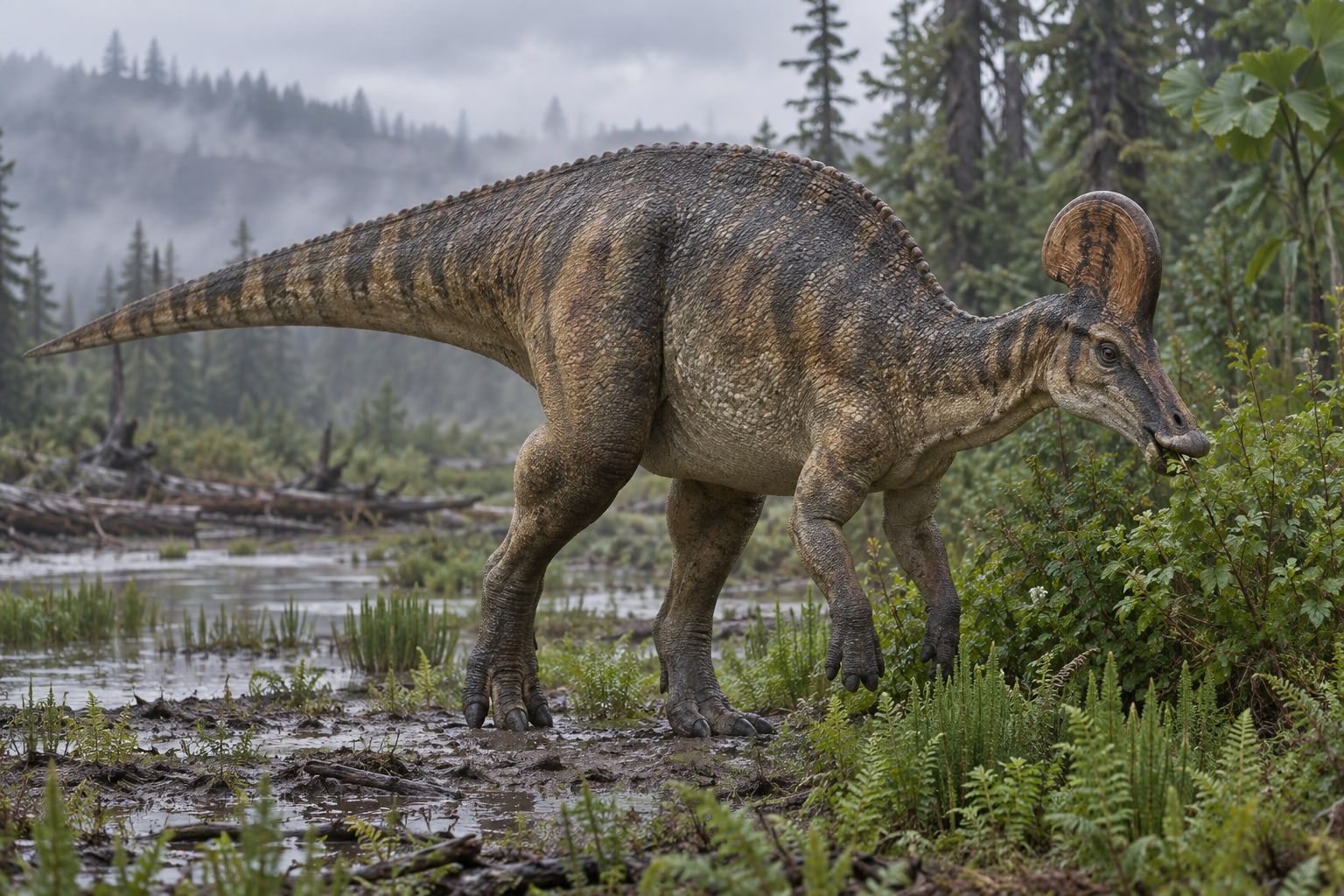
Corythosaurus
koh-RITH-oh-SORE-us
"helmeted lizard"
DV-0092
- Lived
- 84 to 72 million years ago, Late Cretaceous
- Diet
- Herbivore
- Length
- about 10 m (33 ft)
- Group
- Ornithopods, Hadrosauridae
- Found in
- Canada and United States
- Named by
- Brown 1914
Field notes
About Corythosaurus
What it was like
Corythosaurus was a duck-billed dinosaur best known for the tall, rounded crest on its head, shaped somewhat like a helmet. It grew to about 10 meters (33 feet) long and walked on four legs while feeding, though it could likely rear up on two. The crest was hollow, connected to the nasal passages, and probably helped the animal make sounds, perhaps to call to others of its kind.
Its world
Corythosaurus lived in what is now Alberta, Canada, and Montana, in the United States, during the Late Cretaceous, between about 84 and 72 million years ago. Its bones, twenty-nine finds in all, come mainly from the Dinosaur Park Formation, along with the Oldman, Judith River, and Two Medicine formations.
It shared its world with the tyrannosaur Gorgosaurus, the small predator Troodon, and the armored Euoplocephalus.
How it was found
Brown named Corythosaurus in 1914. It belongs to Hadrosauridae, the family of duck-billed dinosaurs, and is closely related to other crested forms such as Lambeosaurus and Olorotitan. With twenty-nine finds, it is one of the best-known hadrosaurs, including specimens preserved with skin impressions.
The evidence
Where its fossils were found
Today
80 million years ago
To scale
How big was Corythosaurus?
Lived alongside
Found in the same rock formations.
Close relatives
Other members of Hadrosauridae.
Sources: Paleobiology Database, WikidataNamed in: B. Brown. 1914. Corythosaurus casuarius, a new crested dinosaur from the Belly River Cretaceous, with provisional classification of the family Trachodontidae. 33(35):559-564