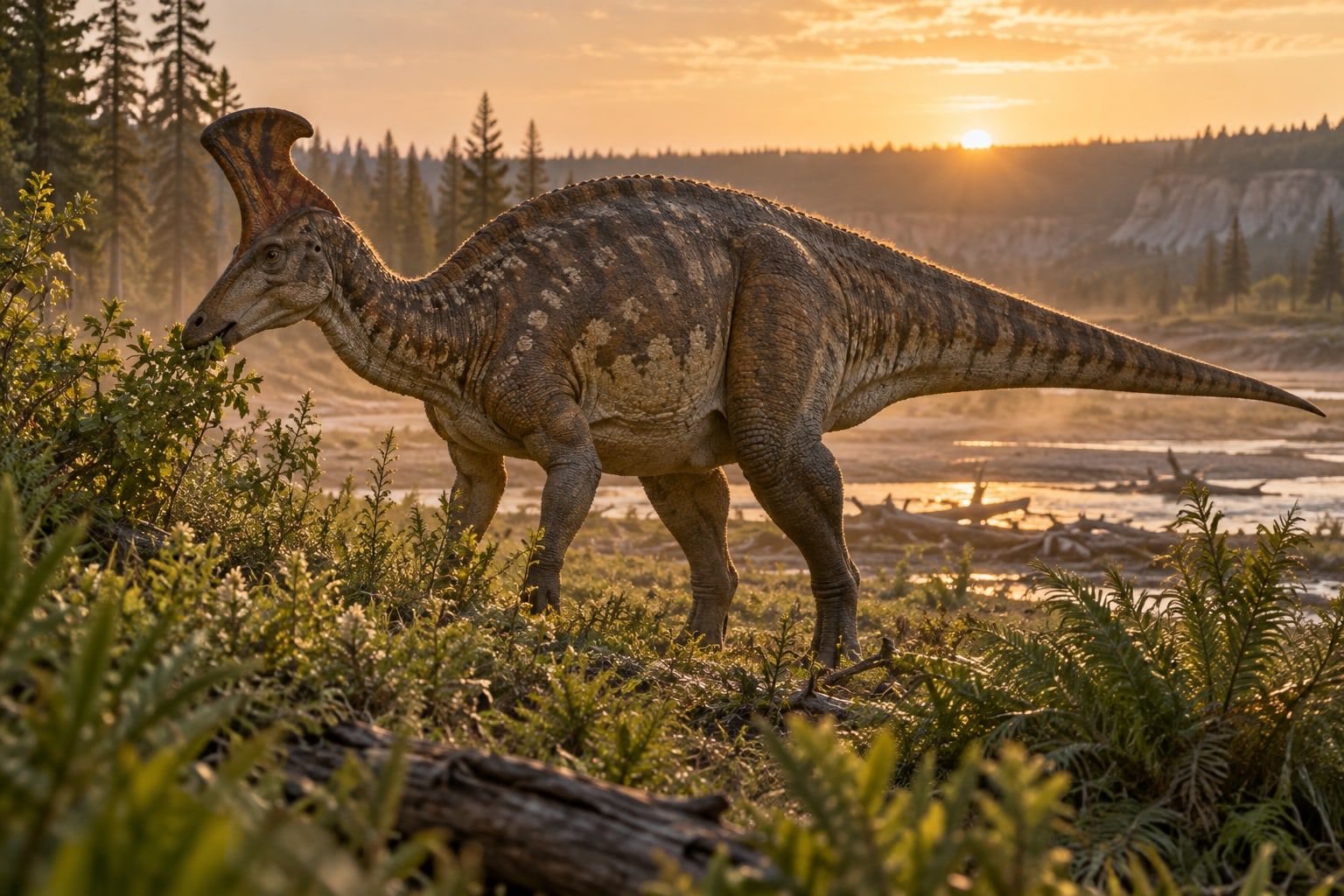
Lambeosaurus
LAM-bee-oh-SORE-us
"Lambe's lizard"
DV-0114
- Lived
- 84 to 72 million years ago, Late Cretaceous
- Diet
- Herbivore
- Length
- about 9 m (30 ft)
- Group
- Ornithopods, Hadrosauridae
- Found in
- Canada
- Named by
- Parks 1923
Field notes
About Lambeosaurus
What it was like
Lambeosaurus was a duck-billed dinosaur, a hadrosaur, that grew to about 9 meters (30 feet) long. Like its relatives, it had a broad, flat beak for cropping plants and rows of grinding teeth packed tightly along its jaws. Its most striking feature was a tall, hollow crest on its head, made from the same bones that form the nose. The crest likely helped Lambeosaurus make sounds, and may also have signaled age or species to other members of a herd.
Lambeosaurus could walk on two legs or drop onto four, and had a long, deep tail balanced by a stiff network of tendons.
Its world
Lambeosaurus lived in Alberta, Canada, from about 84 to 72 million years ago, during the Late Cretaceous. It shared its floodplain habitat with fellow hadrosaurs, including Corythosaurus, and with the horned Chasmosaurus and Centrosaurus. Predators such as Gorgosaurus and Daspletosaurus, along with smaller hunters like Troodon and Dromaeosaurus, would have posed a constant threat, while herds of hadrosaurs likely relied on numbers and alertness for safety.
How it was found
Parks named Lambeosaurus in 1923, based on fossils from the Dinosaur Park Formation of Alberta. Its bones have since turned up in about 19 separate fossil finds, making it one of the better known hadrosaurs from the region, alongside close relatives such as Corythosaurus and Parasaurolophus.
The evidence
Where its fossils were found
Today
80 million years ago
To scale
How big was Lambeosaurus?
Lived alongside
Found in the same rock formations.
Close relatives
Other members of Hadrosauridae.
Sources: Paleobiology Database, WikidataNamed in: W. A. Parks. 1923. Corythosaurus intermedius, a new species of trachodont dinosaur. University of Toronto Studies, Geology Series 15:1-57